.png)
 1 month ago
35
1 month ago
35
Zahra Fatimaand Maia Davies

 Reuters
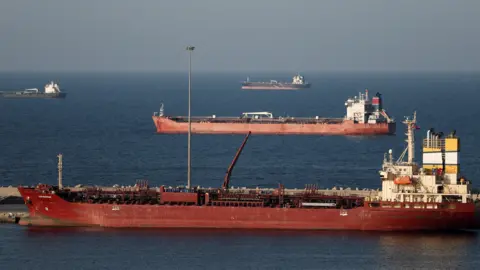
A tanker anchored in Muscat, Oman near the strait on 7 March (file photo)
The UK is looking at "any options" - including working with the US and allies - to secure key oil shipping routes through the Strait of Hormuz, Ed Miliband has said.
It comes after US President Donald Trump on Saturday threatened to open the channel "one way or another" and urged countries including the UK, China, and France to send warships to the waterway.
The energy secretary told the BBC it was "very important" that the strait be made safe for shipping, but refused to give details of options being considered by the government.
According to a statement attributed to Iran's new Supreme Leader Mojtaba Khamenei, Iran will continue blocking the strait, as a means of political and economic pressure against the US.
As the US and Israel's war with Iran enters its third week, a number of ships are said to have been attacked as they attempted to navigate the narrow strait - through which about 20% of the world's oil usually passes.
There are also concerns that Iran has placed mines in the passage as part of its attempts to hinder shipping.
Getting Strait of Hormuz reopened 'a priority for the world', the energy secretary says
Speaking on BBC One's Sunday with Laura Kuenssberg programme, Miliband said it was a "priority" for the strait to be reopened and that there were "different ways we can contribute, including with mine-hunting drones".
Pressed on whether the UK was considering sending drones or ships to the region, Miliband responded: "You can rest assured that any options that can help to get the strait reopened are being looked at in concert with our allies."
Refusing to be drawn into operational details, Miliband reiterated that "ending the conflict is the best and surest way to get the strait reopened".
Speaking later on the same programme, shadow energy secretary Claire Coutinho said the UK should explore sending ships or drones to the Middle East if it were in the national interest.
She said it was in the UK's interests to reopen international shipping lanes and protect military assets abroad, and added that the Conservative party would have allowed its US allies to use UK military bases more quickly than Labour did.
Meanwhile, Liberal Democrat leader Sir Ed Davey argued the UK should not send ships to help secure the strait, and instead focus on "de-escalating" the war.
Hitting out at Trump as "very reckless" in this "illegal and damaging war", Sir Ed said Britain should not be at the beck and call of an American president "who does not seem to know what he is doing".
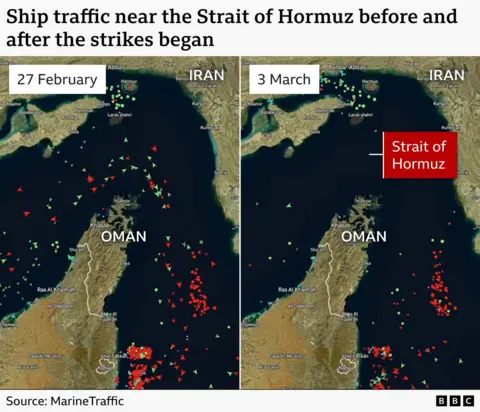
In 2025, about 20 million barrels of oil passed through the Strait of Hormuz per day, according to estimates from the US Energy Information Administration – nearly $600bn (£447bn) worth of energy trade per year.
It is also a key trading route for other commodities such as helium, the chemical sulphate, and urea, which is used to produce fertiliser.
Iran's Foreign Minister Abbas Araghchi has said the strait remains open to vessels that do not belong to the country's "enemies" and that Iran is "open to countries who want to talk" about safe passage through it.
He claimed on Sunday to have been approached by a number of nations, but did not name them.
Tehran - which has adopted attacks on energy targets as a key element of its response to US and Israeli strikes - has warned that any tanker bound for the either nation or its partners is a legitimate target.
At least 16 vessels, including a number of tankers, are reported to have been attacked near the shipping lane during the conflict so far, the UK Maritime Trade Operations said in its latest update.
Oil prices have soared since the war began on 28 February, jumping from some $71 a barrel before the conflict to a high of nearly $120 on Monday. Prices have since fallen back but remain elevated.
 Reuters
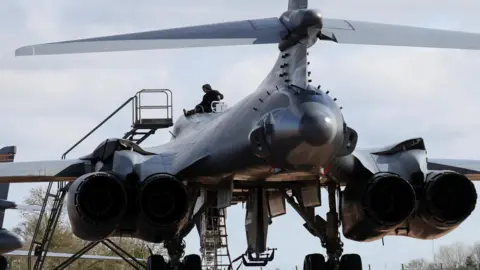
B-1 aircraft - the fastest bombers in the US Air Force, according to Boeing - have been stationed at RAF Fairford
After initially refusing to allow the US to use UK bases for the offensive against Iran, Prime Minister Sir Keir Starmer gave permission for "defensive" US action on Iranian missile sites from RAF Fairford in Gloucestershire and Diego Garcia in the Indian Ocean - while maintaining the UK did not believe in "regime change from the skies".
Trump had branded Sir Keir "no Winston Churchill" over his approach to the war, and just last week said the US did not need the UK to send aircraft carriers to the region - accusing the prime minister of seeking to "join wars after we've already won".
On Sunday, two US B-1 Lancer bombers took off from RAF Fairford - likely carrying powerful "bunker buster" bombs and cruise missiles.
Of the three large strategic US Air Force bombers being used in the war - the other two being the B-52 and B-2 stealth aircraft - the Lancers carry the largest payload of weapons.
The bombers were expected to take some seven or eight hours to reach Iran, for a total mission time of around 15 hours.
Additional reporting by Chris Partridge, BBC News weapons analyst