.png)
 1 month ago
45
1 month ago
45
Just now
Jayne McCormack,Political correspondentand Niall Glynn,BBC News NI

 Getty Images
Communities Minister Gordon Lyons is set to propose households in Northern Ireland with a total income of about £30,000 or less will get an extra payment to help with heating oil bills.
Stormont ministers are meeting to discuss how to manage pressures facing farmers, businesses and households in Northern Ireland due to rising fuel costs.
The proposal, if approved would see about 340,000 households receive a payment of about £100 to use for heating oil.
"I am asking for additional sums because I want to give something that will actually make a difference to people," the Democratic Unionist Party (DUP) politician said.
"I don't believe that [the current amount pledged] is sufficient and that is why I am looking for additional money from the executive.
"We are bringing forward a plan that will target those on the lowest incomes, including those that are not on benefits and it will come in the form of direct financial support which they will be able to use specifically for the purposes of home heating oil costs because that's where the concern is right now."
He said if the scheme was approved it would still take "a couple to three months to put into place" before those affected would receive the money.
Lyons told The Nolan Show the scheme "would not help everyone" and urged the government to look at cutting fuel duty.
The issue of fuel costs will be raised in the context of ongoing talks at the executive about a multi-year budget.
Ministers have repeatedly said they need additional resources from Westminster in order to balance their departmental budgets.
The government has provided the executive with additional funding worth £380m for public services over the next three years and has said that ministers must make "difficult" choices.
The first and deputy first ministers invited the Northern Ireland secretary to Thursday's executive meeting.
It is understood he will not be in Northern Ireland on Thursday, but will speak to the Stormont Finance Minister John O'Dowd from London.
 PA Media
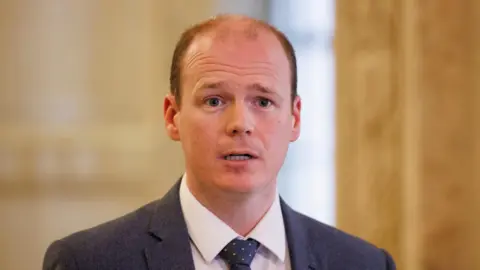
Gordon Lyons said more funding is needed than is being offered by the UK government
O'Dowd's Sinn Féin colleague, Economy Minister Caoimhe Archibald, said the executive had engaged with the British government and made the case more needed to be done.
She also said the £17m pledged by the UK government for home heating bills was insufficient.
"I will be wanting to work with my executive colleagues to get that support out to people as quickly as possible," she said.
"But clearly the executive does not have the firepower to be able to make the kind of meaningful intervention, the type of intervention that we saw in the aftermath of the war in Ukraine."
What has the executive said about fuel prices?
Fuel costs have soared globally as a result of the US-Israel war with Iran.
On Tuesday, some roads and motorways in Northern Ireland were blocked by farmers protesting over the hike in fuel, energy and fertiliser costs.
Last week, the first and deputy first ministers wrote to the prime minister asking for a package of measures to support those under pressure in Northern Ireland.
The executive does not have major financial levers to intervene, and has insisted the responsibility lies with London.
 PA Media
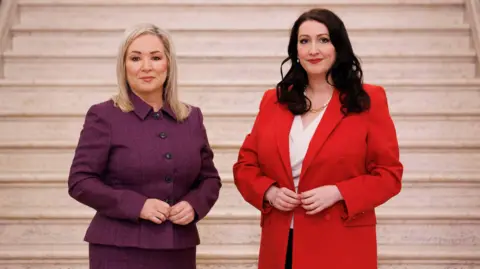
The first and deputy first ministers have asked the prime minister for a package of measures to support those under pressure
How close is the executive to agreeing a budget?
A multi-year budget would allow Stormont departments to plan longer-term spending and the executive has not agreed one for more than a decade.
But there are particularly acute pressures in the departments of health, education and justice that have made reaching agreement on it difficult.
A Stormont source said the executive was "stretched to breaking point" and that the current funding allocation was not enough over the next three years.
The executive is also exploring the option of agreeing a budget for 2026-27, but in the event that is the outcome, ministers would face returning to discussions before the end of the year to set a budget for 2027-28.
The timing of the next assembly election in May 2027 could complicate negotiations on a budget for that year.
Matthew O'Toole, leader of the opposition at the assembly, said the executive was "desperate to simply shift responsibility rather than agree with one another their priorities for the public in Northern Ireland".
"They could have been meeting with trade unions, farmers groups, business groups understanding the extent of the cost pressure and then go to the UK government and say 'this is the type of support we need to implement, we need your financial backing'," the Social Democratic and Labour Party politician told Good Morning Ulster.
"They haven't done any of that, their first approach has been to say, as it were, 'computer says no, go and talk to London'.
"So while I agree that the UK government is clearly responsible for things like fuel duty and has the fiscal firepower, the problem is the executive has at the very first time of asking, simply sought to shift blame."
What is the government's view?
It has repeatedly said the funding on offer to the executive is a "record settlement" from Westminster.
All the executive parties maintain that the allocation does not go far enough.
Stormont's finance minister has been making the case to the Treasury to restore the "stabilisation fund" - additional one-off funding which accompanied the restoration of devolution in 2024, which has now ended.
The Northern Ireland secretary has also continued to raise the prospect of Stormont carrying out its own methods of revenue raising, in order to help shore up public services.
This view was echoed in a research paper published by the Northern Ireland Assembly last month, which stated that significant revenue raising is "unavoidable".
However, proposals to do this such as introducing water charges and raising tuition fees have been widely rejected by the political parties so far.