.png)
 1 month ago
30
1 month ago
30
Faisal Islam,Economics editorand Peter Hoskins,Business reporter

 Anadolu via Getty Images
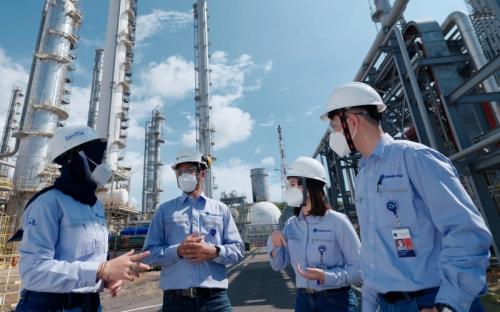
Oil facilities in Tehran were hit by airstrikes at the weekend
Global oil prices have jumped above $100 (£75.11) a barrel for the first time since 2022 as the escalating US-Israeli war with Iran has fuelled fears of prolonged disruption to shipments through the Strait of Hormuz.
Iran on Sunday named Mojtaba Khamenei to succeed his father Ali Khamenei as Supreme Leader, signalling that a week into the conflict hardliners remain in charge of the country.
The US and Israel launched fresh waves of airstrikes across Iran over the weekend, hitting multiple targets including oil depots.
Major disruption to energy supplies from the region threatens to push up prices for consumers and businesses around the world.
Early on Monday in Asia, Brent crude was around 15.5% higher at $107.16, while Nymex light sweet was up by more than 17% at $106.77.
Stock markets in the Asia-Pacific region fell sharply in early trading on Monday, with Japan's Nikkei 225 index down by more than 5% and the ASX 200 in Australia more than 3.5% lower.
Many in the markets predicted that oil would hit the $100 a barrel mark this week.
In the event it took about a minute to jump 10%, and then another 15 minutes to rise a further 10% in early Asian trading.
Last week the markets had been relatively relaxed about the seeming nightmare scenario for millions of barrels of crude and liquefied natural gas trapped in the Gulf, unable or unwilling to transit the Strait of Hormuz.
But the escalations over the weekend, alongside scenes of destruction of energy infrastructure both in Iran and across the Gulf, saw the markets take rapid fright.
The question now is where does this go? Some analysts argue that if the shutdown in the strait lasts until the end of March, we could see record oil prices above $150 a barrel.
The existing rise is likely to further increase petrol prices, and those of important derivative products such as jet fuel and vital precursors for fertilisers.
The physical supplies from the Gulf are mainly consumed in Asia.
Already however there are signs that Asian consumers are bidding up prices for US gas, with some tankers originally heading for Europe turning around in the mid-Atlantic.
US President Donald Trump responded to the jump in prices by saying that short term rises were a "small price to pay" for removing Iran's nuclear threat.
His energy secretary told US broadcasters on Sunday that Israel, not the US, was targeting Iran's energy infrastructure, amid some concern about rising domestic pump prices caused by the war.