.png)
 3 weeks ago
12
3 weeks ago
12
Phil SimScotland political correspondent

 PA Media
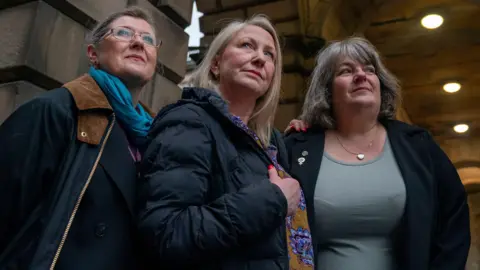
Co-directors of For Women Scotland (left to right) Susan Smith, Marion Calder and Trina Budge outside Parliament House in Edinburgh, ahead of the start of a judicial review hearing
The Scottish government is using women in prison as "pawns for political gain", a court has been told.
The campaign group For Women Scotland is challenging the government's guidance for where transgender inmates are housed, saying it is out of line with the Supreme Court's ruling on the definition of a woman.
The government has argued that having a "blanket rule" for where prisoners are housed could fall foul of human rights law.
But Aidan O'Neill KC, acting for For Women Scotland, told the Court of Session in Edinburgh that there was no case law to back this up.
He said on that basis the government could only be fighting the case on political grounds.
O'Neill described the prisons policy as "Orwellian" and added it was "based on institutional neglect of and contempt for women's rights".
Lady Ross is hearing a legal challenge against the guidance which helps decide which prisons trans people are held in.
Scottish Prison Service policy says inmates are assessed on an individual basis, with rules based on whether they could pose a risk to female prisoners.
But campaign group For Women Scotland says last year's Supreme Court ruling on the definition of a woman in equalities law means admission to women's jails should be strictly based on biological sex.
The Scottish government argues that having a general rule which prisons trans people are housed in "would violate the rights of some prisoners".
The hearing is expected to last three days.
'A political calculation'
In his opening argument, O'Neill said there was no case law from the European Court of Human Rights in Strasbourg which says trans identifying male prisoners have to be housed in the female prison estate.
He told the court: "Why are they [the Scottish government] fighting this? Who can say.
"If it's not law, if you don't have a legal case, it's presumably a political calculation.
"If that were the case - and frankly I can see no other explanation, in the absence of case law - then what is happening here is that women in prison are being treated and used by the Scottish government in this case to be traded as pawns for political gain."
O'Neill added the decision to maintain the policy, despite the Supreme Court ruling last year, was "based on institutional neglect, of and contempt for women's rights."
He continued: "It's almost Orwellian, Animal Farm-like. 'Women good… men identifying as women better'.
"Or, 'all women are equal, but men identifying as women are more equal than others'."
 PA Media
The case is being heard at the Court of Session in Edinburgh
The KC told the court there was "incredible sensitivity" to the rights, dignity and privacy of trans people, while the rights of "incredibly vulnerable" female prisoners were not factored in.
He said the government wanted to retain the flexibility to put "a totally non-violent trans-identifying man" in the women's estate, but questioned why female prisoners had to "bear the risk" of this.
O'Neill continued: "Why do women have to be human shields to protect the nice trans-identifying male prisoners against the risk of violence against them if they were in the male estate?"
He suggested that a separate prison estate for trans inmates could be set up, as happens at one specialised unit in England.
'Enforced gaslighting culture'
O'Neill also said female prisoners had been subjected to "an enforced gaslighting culture" where they were forced to keep their heads down and say nothing about the presence of "trans-identifying men".
The Scottish government's written argument had questioned what should be done with trans men - who were born biologically female - citing the Supreme Court as ruling that those of masculine appearance might not be admitted to women-only spaces regardless of their sex at birth.
O'Neill said he did not care what happened to these prisoners so long as they were kept out of women's jails.
He told the court it was a "management issue, not a legal issue" as to whether they were placed in the male estate of a separate specialist facility.
The KC added: "What is required is the preservation of women's only spaces.
"All I am interested in, because of the situation of women, is the preservation of women's dignity, security and sense of safety vis a vis men - that's all."
 PA Media
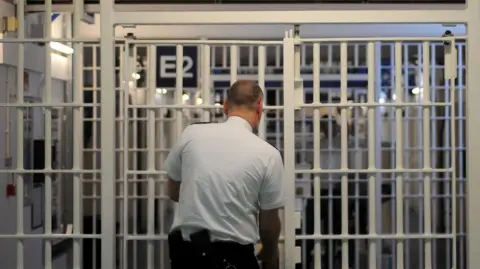
Transgender inmates make up 0.2% of the prison population in Scotland
The latest figures from the Scottish Prison Service (SPS) - dating to June 2025 - recorded a total of 19 transgender inmates.
That amounts to around 0.2% of the prison population of more than 8,000 people - 96% of whom are male.
The SPS implemented new guidance in February 2024 following a row over the case of Isla Bryson, a double rapist who was initially housed in the female estate having decided to transition while standing trial.
For Women Scotland contend that this guidance is not compatible with the Supreme Court ruling in 2025 which said sex should be defined in terms of biology in the Equality Act, the UK's main anti-discrimination law.
The group's written argument quotes the ruling as saying that "a person is either a woman or a man…provisions that refer to protection for women necessarily exclude men".
The Scottish government meanwhile argues that the Equality Act was designed to give people a basis on which to make a claim of discrimination.
Its written arguments state that the Act "does not mandate sex segregation", and "does not absolutely prohibit deviation from any norm".
The government said that a "blanket rule of the kind advanced by [For Women Scotland] would violate the rights of some prisoners" under the European Convention on Human Rights.
And it questioned how the group's argument would apply to trans men - who were born biologically female - noting that the Supreme Court had said those of masculine appearance could still be excluded from female facilities.
The government said this showed that "biology is not the sole determining factor in such a case".