.png)
 13 hours ago
6
13 hours ago
6
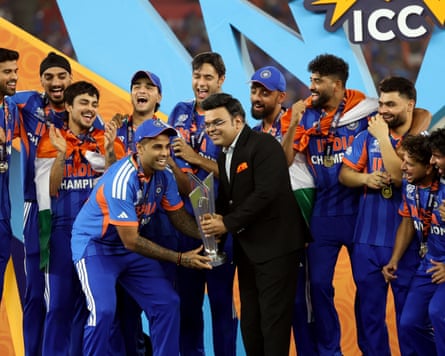
“Visuals that the whole nation will remember for ages,” reads the social media post by the Board of Control for Cricket in India, introducing a 37-second video clip. It captures the celebrations after India’s T20 World Cup triumph in Ahmedabad last month, a victory built by an astounding squad; strong enough to exclude names such as Shubman Gill and Yashasvi Jaiswal, nerveless enough to thump 255 in the final against New Zealand. But one man in a suit dominates the footage: Jay Shah.
The chair of the International Cricket Council (ICC) is in most of the shots, embracing the players and soaking in the moment alongside their head coach, Gautam Gambhir. He is all smiles alongside former India captains Rohit Sharma and MS Dhoni, and at one point there is a frame of him on his own holding the trophy. He goes on to help Suryakumar Yadav lift it. Shah is not the honorary secretary of the BCCI any more; the whole sport is his responsibility. Yet here he was, transformed into the protagonist of a story that did not belong to him.
Such pageantry is nothing new for an administrator who, even at 37, has run things for a while. Shah became BCCI secretary in 2019 before ascending to his ICC position five years later. That is great power on its own, before considering the political backdrop. His father is Amit Shah, India’s home affairs minister and the right-hand man of Narendra Modi, the country’s prime minister.
That power is projected online by the social media handles of the sport’s governing body and its most influential national board. When Shah attended last year’s World Test Championship final at Lord’s, the ICC posted a montage of the final day as South Africa finally threw away their “chokers” tag to win a global title, a moment of absolution. Yet Shah appeared overwhelmingly dominant once again, slow-mos of him in the stands – one frame is focused on the back of his head – mixed in with the winning runs. Another clip shared by the ICC followed him around on day one, the great and the good of the game always close by.
When the Indian Express last month listed Shah as No 22 on its 100-strong list of the most powerful Indians (up from 24th in 2025), the ICC promoted the news on X alongside an adoring message: “It is said that power and responsibility go hand-in-hand. This recognition is well-deserved and one that will definitely motivate our chairman @JayShah to strive harder towards loftier goals for the sport.” The BCCI made its own graphic to share the news, listing the positions of Jasprit Bumrah, Virat Kohli and Gambhir, too – all ranked way below Shah.
An image is being formed that cricket has been blessed with a brilliant administrator taking it to extraordinary heights. Shah, of course, can point to the revolutionary Women’s Premier League, established during his time at the BCCI, to the rude health of India’s national teams, to the construction of a gargantuan stadium in Gujarat named after his father’s political partner.
But now at the centre of the whole thing, there is plenty to do, several questions still to answer. The visuals are bountiful but where are the words, particularly those of substance? Shah’s award speeches are easy to find but interviews of him are scarce. Do we actually know what his vision is? What are those “loftier goals”? When he was elected, a BCCI statement quoted him wanting to prioritise Test cricket, dedicate more attention to the women’s game, and make the sport more inclusive. Those were welcome noises but not backed up with any great detail.
What we are left with is the Jay Shah show, something that would be a touch more acceptable if the game’s governance was in good order. The World Cricketers’ Association report on cricket’s global structure, published last year, argues otherwise. It is a scathing state-of-play read, criticising the “chaotic” scheduling that creates an uncomfortable relationship between international and franchise cricket, scrutinising the inequitable distribution of ICC revenues and maintaining that the governing body, well, doesn’t govern. “No one is actually in charge of the sport as a genuine custodian of the global game as a whole,” the report says, proposing the formation of an independently chaired committee to make recommendations to the ICC board. That the players’ body felt the need to compile the report feels like an indictment in itself.
The same issues exist a year on, all while ICC events fracture at the mercy of geopolitics. As Shah joyfully roamed the Ahmedabad field last month, he had presided over a tournament hurt by the absence of Bangladesh – kickstarted by the BCCI instructing the removal of Mustafizur Rahman from the Indian Premier League – and Pakistan’s initial reluctance to play India.
This is a sport in desperate need for strong, transparent leadership, and those who care for it should know exactly what the person at the top has planned. What we have at the moment are those so-called visuals for the ages. It would be helpful to hear something, too.
-
This is an extract from the Guardian’s weekly cricket email, The Spin. To subscribe, just visit this page and follow the instructions