.png)
 3 weeks ago
28
3 weeks ago
28
In Germany, coaches used to say: “Follow your opponent right into the loo!” That was the call to man-mark. So defenders weren’t meant to think too deeply. This retro tactical approach has been making an unexpected comeback since Atalanta won the Europa League in 2024 using this method.
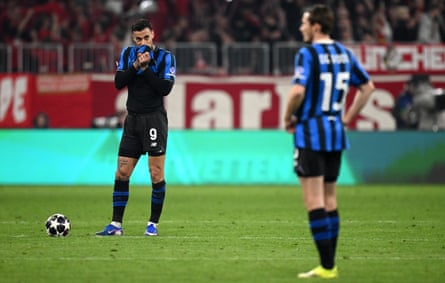
Against a team with a significantly superior individual quality, you naturally don’t stand a chance with man-marking. Atalanta had to learn that the hard way in the Champions League last 16. Bayern enjoyed absurdly vast spaces and scored 10 goals. Rarely has a knockout-stage match been so one-sided.
I hope that the right conclusions are drawn from this in Germany, because I’m now seeing man-marking more frequently in the Bundesliga again. Yet it can only be a short-term measure if you want to surprise the opponent and put them under pressure, as in handball just before the final whistle. It is not, however, a strategy for the whole match. A football pitch is too big for that.
The Spaniards therefore stick to a different idea they have adopted: ball-oriented defending, clearly defined positions and roles, organised combination football that shifts the action into the opposition’s half. Cognitively, this demands more than 90 minutes of one-on-one battles. Players must cooperate, orient themselves and, at the right moment, guided by the swarm, go into one-on-one situations. For one-on-one is still the nucleus of excellence.
The whole country operates this way; for the Spaniards, it is a matter of identity. They have all the evidence they are doing the right thing on their side. Their clubs have won a total of 24 titles in the three European competitions this century. Behind them come England with 11, then Italy and Germany with five and four respectively.
Six different Spanish clubs shared these successes; from the Bundesliga, there were only two during the same period. In seven of the past 12 years, the Champions League has gone to La Liga; this season, it is once again sending the most quarter-finalists, namely Real, Barça and Atlético.
These three may not necessarily be the favourites this year, those are the best teams from the group stage and the defending champions. They too have Spanish elements to them; their managers are products of the Barça school and in a way influenced by Pep Guardiola: Mikel Arteta (Arsenal) and Luis Enrique (PSG) have the style in their blood, though each interprets it with their own nuances.
Spanish managers dominate Europe; in the last 16 of all three competitions, there were 11 of them, more than twice as many as the country with the second-highest number. In the quarter-finals there are three, more than from any other country. Time and again it is the Spaniards who are causing a sensation. Xabi Alonso ended Bayern’s dominance with Bayer Leverkusen. Unai Emery keeps bringing second-tier clubs to the fore, currently Aston Villa. Cesc Fàbregas is shaking up Serie A with Como and changing Italian football.
Guardiola’s long-running winning streak in the Premier League did come to an end last season. His team had lost its inspiration. Working on the same thing every day doesn’t work for ever. Now he is building something new in Manchester, evolving further and relying on different types of players than before. He was knocked out of the Champions League this year (by his compatriot Álvaro Arbeloa), but it is still enough for the title race and cup victories in England.
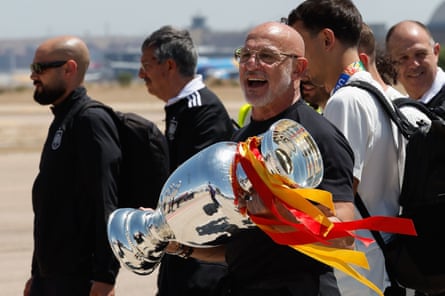
And then there’s Luis de la Fuente. He’s been working for the Spanish Football Federation for more than a decade, winning European Championships with various youth teams and in 2024 with the senior side. Three of the past five European Championship titles have gone to Spain. Not even Germany managed such dominance in the 70s and 80s. It was this era Gary Lineker was referring to when he said that in the end, the Germans always win. Nope, today it’s Spain. At this summer’s World Cup, De la Fuente’s side are of course contenders.
The Spanish school has replaced the Italian one as the superior model. Italy still produces coaches for the international market, even after Carlo Ancelotti. But the teams no longer win. One year ago I wrote in my column that Italian football lacks intensity, commitment, dynamism, athleticism and initiative, which is why it no longer has any world-class players. In response, the Süddeutsche Zeitung, a paper from my home town of Munich, accused me of spouting “cliches”.
Yet there are no Italian clubs in this year’s Champions League quarter-finals; by the skin of their teeth we even came close to having a last 16 without them for the first time had Atalanta not knocked Borussia Dortmund out at the last second. And the national team failed to qualify for the World Cup for the third time in succession. Four years ago North Macedonia proved too strong; this time it was Bosnia.
Italy has been left behind. If Germany goes down this new path the same could happen to us. I’m surprised that so many defenders in the Bundesliga are now once again shadowing their opponents to the toilet. Bayern do it too; Vincent Kompany sometimes relies on man-marking. In the Bundesliga where he faces no competition, mistakes aren’t punished. And he caught defending champions PSG off guard in the group stage with his style. At that moment, Europe was amazed.
But a few weeks later Arsenal were well prepared. To achieve big goals, a manager needs a distinctive style. Kompany, a protege of Guardiola, appears to be trying to switch from a possession-based defence to man-marking. Managing this switch without losing control would be the ultimate achievement. So far no manager has managed it. Not even the very best have dared to attempt it.
Philipp Lahm’s column was produced in partnership with Oliver Fritsch at the German online magazine Die Zeit.