.png)
 3 hours ago
1
3 hours ago
1
This summer’s World Cup will be a “bonanza of sportswashing” according to human rights organisations, who claim the Trump administration is using sport as a political tool to “cover up abuses”.
With supporter groups warning they have “absolutely no clue” what will happen to fans if they do “stupid stuff” in the US during the tournament, the Sport and Rights Alliance (SRA), which includes Human Rights Watch (HRW) and Amnesty International, has called for more to be done to ensure the protection of individual rights at the World Cup, which begins in six weeks.
HRW’s Minky Worden defined sportswashing as the “practice of using a beloved sporting event to attract fans and positive coverage that might also serve to cover up serious human rights abuses”, and argued the term – previously used in relation to autocracies or non-democratic regimes – should be applied to the current US administration. The US is co-hosting the tournament with Mexico and Canada.
“This was supposed to be the first ever World Cup with a human rights framework: key protections for workers, fans, players and communities,” Worden said. “Instead, the US administration’s brutal immigration crackdown, discriminatory policies and threats to press freedom mean the tournament risks being defined by exclusion and fear. I think we are here to say that the problem of sportswashing is alive and well, and this World Cup will be a bonanza for sportswashing.”
Worden, citing the administration’s use of the World Cup and Winter Olympics to promote its political messages, said: “In the United States, Donald Trump has made a singular effort to weaponise sports, both to cover up the aggressive immigration enforcement campaign and also to present the impression that this [World Cup] is a safe and fun event. Our message today is it’s neither safe nor particularly fun and probably quite unprecedented in the challenges that we’re seeing.”
This month HRW reported that of the 16 host cities only four – Atlanta, Dallas, Houston and Vancouver – had published mandatory “Host City Human Rights Action Plans”. There are also concerns over US travel restrictions on a number of nations, including four World Cup qualifiers, and the potential response to any protest in or around host cities in the country.
Martin Endemann, the head of policy at Football Supporters Europe, another SRA member, said his organisation was experiencing less engagement from US authorities than it had with their Qatari counterparts four years ago.
“People don’t really know what to expect,” Endemann said. “Normally we have some expectations, but I have absolutely no clue. I have no clue what happens after the first protest in the stadium. I have no clue what happens at the first protest outside of the stadium, maybe from civil society, maybe from the community, maybe from fans. And I have no clue how the police in the US reacts on misdemeanours. Let’s be honest, there will always be fans who do stupid stuff. What will be the response of the American police?” Fifa and the Department for Homeland Security have been approached for comment.
Fifa’s annual congress takes place in Vancouver on Thursday and Norway’s Lise Klaveness will be among a number of federation presidents seeking assurances that the World Cup poses minimal risk to travelling supporters. The US portion is of particular concern given the prospect of raids by Immigration and Customs Enforcement (ICE) operatives.
“We are very concerned that it should be inclusive and safe for everybody regardless of ethnicity, which country you come from, your sexual orientation,” Klaveness said. “This is something we know Fifa agrees with us on and we want to address to Fifa leadership how they are working to prevent, for example, ICE actions to make sure all fans can come to the stadiums safely. We hope to speak to Fifa leadership both in the congress and after it to address this issue and support their work in these matters.”
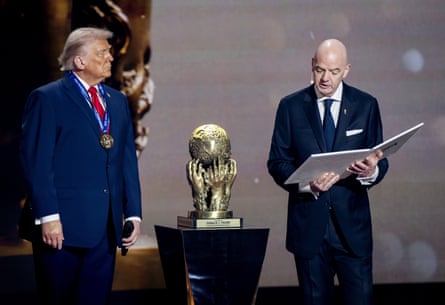
Klaveness also said the Fifa peace prize should be scrapped and that her association would support calls for an investigation into its awarding. The inaugural iteration of the prize was presented by Gianni Infantino, Fifa’s president, to Trump at the World Cup draw in December, without seeking approval from the Fifa Council. It led to FairSquare, which looks to promote accountability in sport, writing a letter of complaint to Fifa’s ethics committee.
FairSquare stated that the process for awarding the prize to Trump, along with comments made by Infantino about the US president, broke Fifa’s duty of political neutrality and were contrary to its statutes. Klaveness confirmed the Norwegian Football Federation would write a letter in favour of an investigation into the prize.
“We want to see it abolished,” she said. “We don’t think it’s part of Fifa’s mandate to give such a prize, we think we have a Nobel Institute that does that job independently already. We think it’s important for football federations, confederations and also Fifa to try to avoid situations where this arm’s length distance to state leaders is challenged, and these prizes will typically be very political if you don’t have really good instruments and experience to make them independent.”
Klaveness called for a thorough process to be followed in response to FairSquare’s complaint. “There should be checks and balances on these issues, and this complaint from FairSquare should be treated with a transparent timeline, and the reasoning and the conclusion should be transparent,” she said.