.png)
 1 month ago
33
1 month ago
33
Ben Steele, Mike Radfordand George Wright
"Anyone who runs is shot": Russian soldiers tell BBC they saw commanders order fellow troops' killing
Warning: This story contains details of extreme violence and reference to suicide.
Four Russian soldiers have exposed the horror and brutality of conditions on their side of the front lines in Ukraine, with two men telling the BBC they saw soldiers being executed on the spot for refusing orders.
One man told a documentary team he saw a soldier executed on the order of his commander, who was made a "Hero of Russia" in 2024.
"I see it - just two metres, three metres... click, clack, bang," he said.
Another soldier, from a different unit, says he saw his commander shoot four men himself.
"I knew them," he says of the soldiers executed. "I remember one of them screaming 'Don't shoot, I'll do anything!'"
One of them also says he saw 20 bodies of fellow soldiers lying in a pit after being "zeroed" by comrades. The term "zero" is Russian military slang for executing your own.
In the documentary, The Zero Line: Inside Russia's War, men give detailed accounts about how they were tortured for refusing to take part in assaults they describe as verging on suicide missions. Russian troops call these attacks "meat storms" as waves of men are sent across the front line relentlessly to try and wear down Ukrainian forces.
For the first time, the BBC believes, Russian soldiers from the front line say on the record how they witnessed commanders ordering executions of their own men.
One of the men, whose job was to identify and count dead soldiers, provided detailed lists showing that he is the sole survivor from a group of 79 men he was mobilised with. Because he refused to go to the front line, he says he was tortured and urinated on. Others in his unit who refused would be electrocuted, starved and then forced into meat storms unarmed, he says.
The four men, who are on the run, told of the horrors they witnessed at an undisclosed location outside Russia.
Almost all public opposition to President Vladimir Putin's invasion of Ukraine has been stamped out in Russia. Official casualty numbers are not released by Moscow, but the UK's Ministry of Defence says more than 1.2 million Russian troops have been killed or injured since the full-scale invasion on 24 February 2022.
The Russian government says its armed forces "operate with utmost restraint, as far as possible under the conditions of a high-intensity conflict, treating their personnel with maximum care".
"Information regarding alleged violations and crimes is duly investigated," it added.
"We are unable to independently verify the accuracy or authenticity of the information you have provided," it said.

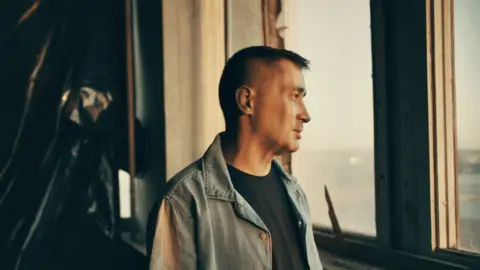 Ben Steele/BBC
Ilya, who spoke to the BBC from an undisclosed location, says he watched as four comrades were shot at point blank by a commander
The detailed first-hand testimony from all four men also verifies reports of a breakdown of law and order on the Russian front line.
Ilya, the soldier who identified and counted the dead, is one of the men who says he saw comrades being killed by commanders.
Before the war, the 35-year-old taught children with special needs and autism in Kungur, in the Ural Mountains. Then in May 2024, police turned up at his parents' house and told him he was being called up.
He was mobilised alongside 78 other men, he says, at a recruitment centre in the city of Perm.
"Nearly everyone was drunk," he says. "Forwards into battle! We'll get Zelensky and raise our flag!" he recalls them shouting.
"I was watching them and thinking 'How did I end up here?' I was so scared."
Upon arriving in Ukraine, Ilya says most of the men were sent straight to the front line. He says he did not want to shoot or kill anyone, and ended up at a command post.
Conditions were brutal, and he says he witnessed four people being shot at point-blank range by a commander - one in Panteleimonivka, and three in Novoazovsk, both in Russian-occupied Donetsk in eastern Ukraine - because they had fled the front line and refused to return.
"The saddest thing is that I knew them. I remember one of them screaming 'Don't shoot, I'll do anything!' but he [the commander] zeroed them anyway," Ilya says.
Zeroing is usually carried out as punishment for refusing orders, and acts as a means of intimidation for others who may be thinking of doing the same, the men told us.
"Your fate depended on your commander. The commander is on the radio: 'Zero this one, zero that one,'" Ilya says.
Executions of soldiers who refused orders were not confined to Ilya's unit.
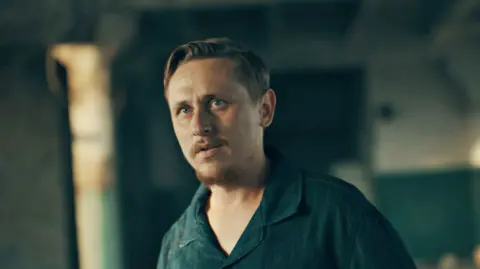 Ben Steele/BBC
Dima says he saw a fellow soldier executed on the direct order of his commander
"Of course they kill their own men, it's a normal thing," says Dima.
Before the war, the 34-year-old lived with his wife and daughter and worked in Moscow as a dishwasher repairman.
In October 2022, he says he was walking between jobs when a group of police called him over.
"They just see my passport, do something on their laptop and tell me 'if you don't go to army you are go to jail,'" he recalls in English.
Dima says he didn't want to kill anyone so, despite having no medical experience, he joined a paramedic unit. Later, he was moved to a brigade where he had to evacuate wounded soldiers from the front line.
It was here, in the 25th Brigade, that Dima says he saw his fellow soldiers executed on the order of his commander.
"I see it - just two metres, three metres. Just murders, just click, clack, bang. It's not a drama, it's not a movie, it's real life," he says.
Dima's commander, Alexei Ksenofontov, was awarded the Gold Star, the highest state medal, and made a "Hero of Russia" in 2024.
But Ksenofontov has been denounced by families of men who died in his unit. In a joint letter in January 2025, they appealed to Putin directly to look into allegations of brutality in his unit.
"They defended our Motherland with honor and pride!!! But in reality, they found themselves in the gang of these commanders, who received awards for tens of thousands of dead and missing!" the letter reads.
"And they continue to exterminate our men! Feeling their impunity!"
Dima calls Ksenofontov a "butcher".
"He give too many orders for killing soldiers, too much blood on his hands, too much."
Dima also describes how he saw bodies of 20 men, who had arrived at his base the previous night, lying in a ditch having been shot.
He says he spoke to several of the men, all ex-convicts, before witnessing them being taken away the following morning.
As a medic, the dead were routinely reported to Dima, and he says he was informed that these men had been shot dead by a commander and their bank cards taken.
"Twenty lads were brought to us. They just took their bank cards and killed them," he recalls. "It's not a problem to write off someone. You just make up a report."
Dima says he was told the bank cards had been taken by commanders.
The BBC documentary also hears from another former soldier - a senior staff officer, who says he served in the Russian military for 17 years. The former officer, whom we are not naming, says he spoke to a man who had helped kill a group of high-ranking officers.
The man said he had been part of a "liquidation squad sent to finish any survivors", the former officer recalls.
"I've never seen anything like this during all my years of service."
 Ben Steele/BBC
A senior staff officer says he spoke to a man who had helped kill a group of high-ranking officers
All four men told us in graphic detail about the dreaded meat storm missions - part of the Russian military's wider "meat grinder" tactic on the Ukrainian battlefields.
The storms are so deadly, they are likened to suicide missions.
"I saw them [commanders] send wave after wave, throwing men like meat at the Ukrainians, so they run out of ammo and drones and another wave can reach their objective," says another former soldier, Denis.
Every day in 2025, an estimated 900-1,500 Russians were killed or wounded in Ukraine, according to the UK Ministry of Defence.
Dima explains how the storms work in practice.
"You send three guys, then another three. It didn't work out, send 10. It didn't work out with 10, send 50," he says.
"Eventually you will break through. That's the logic of the military.
"We had 200 dead in three days. On our regiment's first meat storm they broke us, our regiment was destroyed in just three days," he says.
Dima then shows a video, uploaded to social media in October 2023, of mothers and wives of men killed in his unit speaking out against the huge losses.
One woman can be heard saying: "Our men were ordered to advance armed with only machine guns and shovels." Another says: "There are terrible losses. Our men are being slaughtered."
Those who are not killed for refusing a storm often face dire and dehumanising consequences, Ilya says.
He shows a video on Telegram of men from his unit in Panteleimonivka in Donetsk.
"Let's feed the animals," a man says, before pulling up a lid to show three men crouching in a pit.
"Oh, are you hungry? You want to be fed?" the man filming asks, before one of the men raises his head and nods, holding out his hands while some dry grains are poured into the pit.
"Look how it's eating," the man filming says, as the man in the pit eats the grain.
Some men would be "starved for days" and electrocuted, says Ilya, before being sent into meat storms unarmed.
He personally was tortured, he says, after refusing to take part in one storm.
"They tied me to a tree, hit me with a baton a couple of times and put a gun to my head.
"I don't know how to put it, they went to the toilet on me. The commander told everyone 'We've got a new toilet'. I was tied up for half a day."
After being untied, Ilya attempted to take his own life.
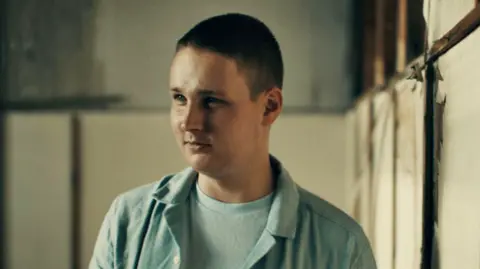 Ben Steele/BBC
Denis says he was beaten and had teeth knocked out after he refused to search for a missing drone
Denis, who says he once secretly brought food and water to soldiers in a pit, shows the documentary team a video of an accused deserter being urinated on, which the BBC has not been able to independently verify.
"It's a humiliation of a person's honour and dignity. In the Russian army this has become the norm," he says.
"It's illegal but no-one is punished for it. On the contrary, guys are even encouraged to do it."
Denis, 27, also shows a photo that he says was taken shortly after two of his front teeth were knocked out by one of his superiors, because he had told them he didn't want to search for a missing drone.
"It's terrible, I just had to carry on."
Dima was eventually promoted, despite having said he did not want to become an officer. He shows a photo of the ceremony where he was commissioned.
After his promotion, he would not send his men on a meat storm, he says.
"I refused to do it. I wouldn't have to go forward myself, but I couldn't just give them the order."
It led to his arrest by military police and him being taken to Zaitsevo, a makeshift prison, Dima says.
"[There] they are torturing me with electric shock," he recalls, adding that the power of the first shock made him defecate himself.
He was tortured every day for 72 days, he says.
"Just torture only, every day with stone face. No emotions, it's crazy," he says, referring to his torturers.
 Ben Steele/BBC
Ilya says he attempted to take his own life, after being tortured and urinated on
All of the men we spoke to are now outside of Russia, but have mental scars from the front lines in Ukraine.
"I have dreams. I see [a] forest full of dead bodies, just smashed people with faces, dirty white mouths full of blood. The smell… it doesn't smell, it tastes," Dima says.
"I'm a criminal, and nobody cares - my crime is just I don't want to kill," he says.
"In Russian army, too many guys who don't need this war, who hate commanders, who hate Putin, who hate our system, and they need to break us."
Ilya says he loves his country, "but not what Putin has done to it".
"They can break anyone there, it doesn't matter if you're strong or not.
"They almost broke me, but not completely."