.png)
 3 weeks ago
14
3 weeks ago
14

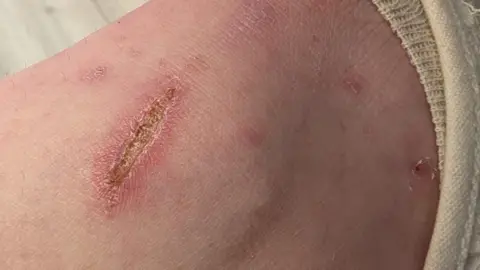 Jane Grandon
Jane said scabies caused her "intense itching" and was difficult to get rid of
A woman who had scabies has described the experience as a "nightmare" as figures show a rise in reported cases of the parasitic infestation.
Jane Grandon, from Caerphilly, said scabies - caused by tiny mites that burrow into the skin - had a "really bad impact" on her, after being misdiagnosed several times and losing out on earnings while being off work.
Dr Donald Grant, a GP who practises in a Welsh NHS surgery, said reported cases had risen steadily in recent years, with figures "massively exceeding" pre-pandemic levels.
The British Association of Dermatologists said scabies was still incorrectly perceived as a "medieval disease" and that breaking down the stigma was important.
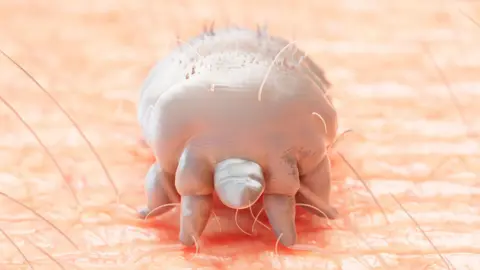 Getty Images
A stock illustration of Sarcoptes scabiei, the tiny mite which causes scabies
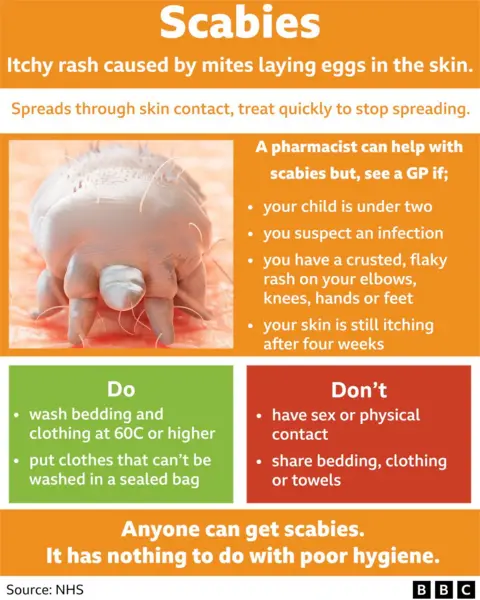
Scabies is an itchy rash caused by mites spread through close skin contact, according to the NHS.
It causes itching, especially at night, as well as a raised rash or spots which usually spread across the whole body.
Unlike bed bugs, scabies mites are not visible to the human eye and they are also not caused by poor hygiene.
Scabies is not usually serious but does need to be treated, normally by applying an over-the-counter cream or lotion to the entire body, with the treatment repeated seven days later. Every person in an affected household needs to be treated at the same time.
All bedding and clothing in the affected household also needs to be washed at 60C on the first day of treatment, and any clothing that cannot be washed should be placed in a sealed bag for at least three days until the mites die.
 Jane Grandon
Jane says there is a stigma that makes people not to want to admit they have scabies
Jane, 43, said the itching "drove her insane" and that the process of getting rid of it was a "nightmare".
"You are steaming, boiling the bed sheets - we even got a new washing machine," she said.
"The cost of it as well," she added.
"[Me and my son] lost a lot of money in that month because statutory sick pay doesn't meet what we get paid a month."
Jane said people should react quickly if they notice symptoms.
"Once you get it, it is really difficult to get rid of," she said.
Sasha McCabe, 25, from London, felt her scabies was "never going to end" after trying a variety of treatments over 16-months.
"I just had about a million different steroid treatments," she said.
"Different soaps and all kinds of things to try and treat it. Nothing would get rid of it."
After washing everything she owned, Sasha went back to her GP feeling helpless and in tears, after which she was prescribed an oral treatment that finally cleared it up.
"I felt like it was never, ever going to end," she said.
 Sasha McCabe
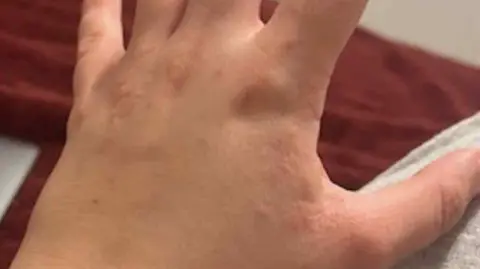
Sasha's hand pictured when with scabies
Sasha said the experience put a strain on her friendships.
"No-one would hug me for months," she said.
"Nothing was ever simple anymore. The mental side of it was like hell.
"Every day I wake up now, the first thing I'm grateful for is that I'm not itchy."
The latest published data in Wales shows there were more than 12,000 reported consultations for the condition in 2023-24, compared to 1,300 in 2018-19.
 Getty Images
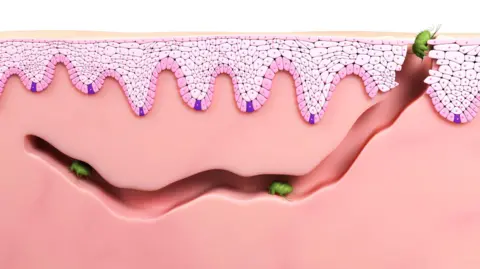
Scabies mites burrow into the human skin, as illustrated by this computer generated image
Dr Grant said there were plenty of factors that could be contributing to the rise.
"This includes treatment delays, closer proximity post-pandemic and a societal stigma towards the condition, which could impact people's behaviour to seek treatment when they experience scabies," he said.
"Feelings of embarrassment or shame can often lead to people delaying or avoiding treatment entirely," he added.
He said the condition was sometimes mistaken for eczema, dermatitis or dry skin, and that understanding the tell-tale signs is crucial.
'There's no shame in having scabies'
Prof Tess McPherson, of the British Association of Dermatologists (BAD), said while there was definitely evidence of cases increasing, the exact rise was hard to quantify.
"A lot of people don't necessarily go to a GP, so you don't get perfect data," she said.
"We're seeing more young people presenting with problematic scabies. Some of the issues is that people didn't recognise it before. A lot of people are not getting the right treatments.
She said scabies was still seen as a "medieval disease" and that breaking down the stigma was important.
"I think we can all do a job to make people feel that there's no shame in having scabies.
"It's just something which has been with humans forever, and it probably will be with humans forever."
She said the "majority of people" could get rid of scabies with topical over-the-counter treatment.
"If it's ongoing then there is a medicine called ivermectin. But the majority of people can still clear scabies with topical treatments that you can get over-the-counter at the pharmacy."
The Royal College of GPs (RCGP) said its members had reported residential and care homes as locations of recent outbreaks, as well as "particular prominence" in university halls of residence.
But the body said some caution should be applied when interpreting the statistics, as they "could be affected by one patient receiving multiple treatments".
Rhodri Thomas, the National Pharmacy Association's Wales Manager, said scabies was "a distressing and highly infectious condition".
He added: "Under the NHS common ailments service in Wales and some other parts of the UK, your pharmacist can offer a free consultation and treatment for scabies, if appropriate, without the need for a GP appointment."