.png)
 1 month ago
34
1 month ago
34
Katie RazzallCulture and Media Editor

 BBC
BBC
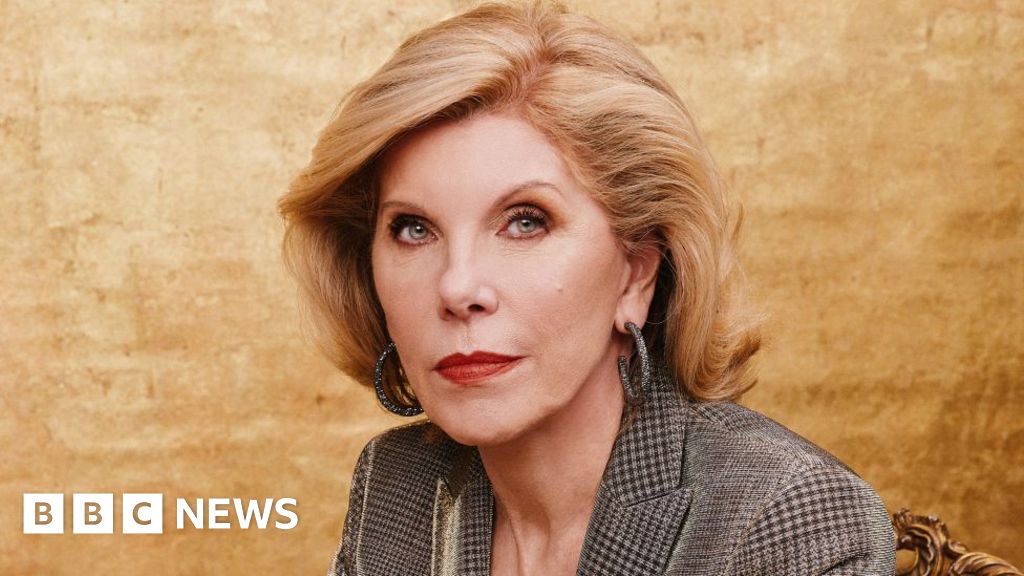
Rose Wylie, who only gained recognition in later life, says it's "wrong" that paintings by men still sell for more than those by women
If an artist's studio is a window into their world, what does Rose Wylie's tell us about the woman who is about to become the first female British painter ever to have a solo exhibition in the main galleries of London's Royal Academy?
The paint-spattered wooden floor is littered with pages from old newspapers, some scrumpled up, the black and white print obscured by vibrant splotches of colour. Wylie tells me when a painting's not working, she scrapes the paint off.
"It's constantly coming off, so a lot of paint is on the floor".
Brushes - some stuck fast - poke out of paint pots piled across the floorboards, table and chairs.
There's also a big bouquet of long dead flowers ("I can't bear to throw them away, they're so beautiful") and a bright pink and blue plastic lobster telephone.
Pete, the rescue cat she got more than a decade ago and who she thinks is 16 years old, prowls in, quite at home in the apparent chaos.
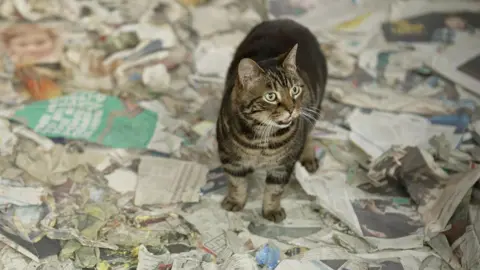
Rose's beloved cat, Pete, at home on the artist's studio floor which is covered with newspapers that provide her with a source of photographs
It all contributes to a sense of anarchy which is fitting for an artist who at 91 is a rebel in the art world, a woman who tells me she "possibly was an early punk," despite having Victorian parents who brought her up to be modest, even telling her not to wear lipstick. The child they produced had different ideas and deep red lipstick is one of Wylie's trademarks.
As for her captivating paintings, she tells me she's "perfectly happy" when people think they have been created by a much younger artist. "Who wants to paint like an old person? It's fresher".
Wylie even keeps the hours of a teenager when she works, painting late into the night ("twenty to four is probably my latest") when the village she lives in is quiet. "Nobody phones, nobody knocks at the door, only Pete at the window, so there's no interruption."
She never plans it that way, starting work at around 1700 in the afternoon, but "you go on and then it becomes the night, it gets dark and then you think 'oh well, that's fine' and then you look at it again and you think 'No, it isn't, it's not fine, it is bad'. Then you go on and suddenly it's late. That's how it happens".
I'm in her studio to talk about the new London show, but I'm also getting a private view of Wylie's latest paintings.
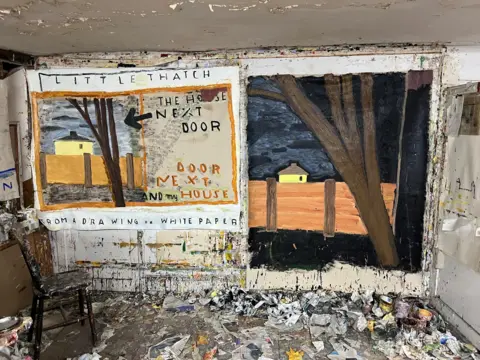
Big canvases cover every available wall space. One is, in fact, two side by side, with a version of a small yellow house behind an orange fence repeated on both. It's the house next door to hers here in Kent, framed by a tree she tells me is "reminiscent of Cezanne's Bathers". Wylie often references other artists as she paints, but with some relish she gestures to the work and tells me something I really wasn't expecting.
"One afternoon as I walked in and looked at this, it seemed to me that it had transformed into a meat cleaver. A jumbo meat cleaver".
She points to the orange fence on the right hand picture which looks like a handle and the entire white canvas of the left hand painting which resembles the blade.
I look again and agree immediately that she's right!
"You can see it as a domestic narrative and then you can see it as a jumbo meat cleaver".
It's typical of the jumps and changes in perspective that often characterise Wylie's work.
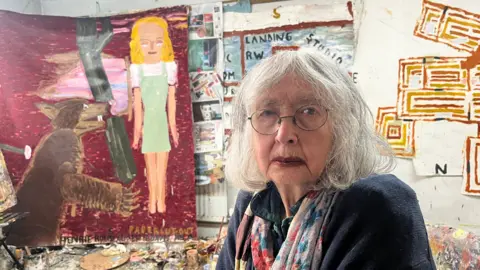
The artist reflecting on this bold vivid painting which she says was transformed from "a domestic narrative" into one with "a jumbo meat cleaver". She is known for featuring wording on many of her artworks.
She paints whatever inspires her.
"It could be a person, it could be an animal, a flower, a film, a photograph in the newspaper, just anything. A saucepan in the kitchen, boiling, you know, the steam coming…"
She's painted footballers, including Wayne Rooney, Thierry Henry and Ronaldinho - "they're public figures, it's the Greek idea of painting the Gods. People know what they're looking at and so they can see what the artist has done".
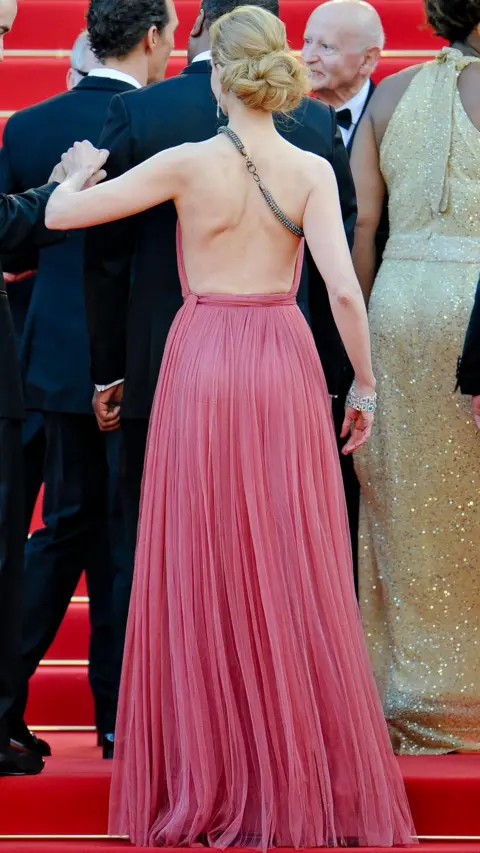
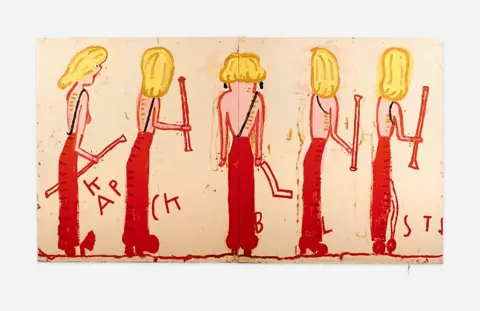
She also famously depicted Nicole Kidman in a one-strapped dress from a photo she saw of the actress at a film premiere.
 Getty Images
It was this image of Nicole Kidman, wearing a backless dress on the red carpet at Cannes in 2012, that inspired Wylie's painting of her
 Rose Wylie
In NK (Syracuse Line-up), 2014, Wylie says she made the image of Nicole Kidman correspond to early Greek sculpture
She's also been inspired by Quentin Tarantino films, including Kill Bill.
"I see something which I think is good. I mean, in Kill Bill, there was this woman lying down. Uma Thurman had sliced off her arm. She was lying down there, still - I don't know - alive or dead, but her arm was sticking up, blood was coming out of it, like a Renaissance fountain picture, so I thought great".
It's a visceral scene. But for Wylie, it was "the visual thing, the connection with fountains which I liked, not the goriness of it".
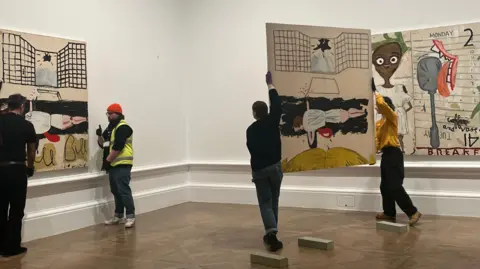
Art handlers carefully installing the second part of Kill Bill (Film Notes), 2015, which depict the same frame from different perspectives
She calls what she creates "poetic transformation" rather than "a slavish copy".
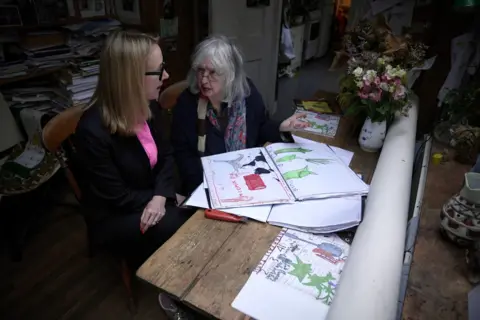
Wylie's paintings usually start as drawings. She shows me her illustrations for The House Next Door, Or, Jumbo Meat Cleaver painting and another that is also on the studio wall. It's of a brown bear with big claws and a blonde woman in a green pinafore dress beside it.
This was inspired by a combination of a painting by the artist Henri Rousseau, an advert she saw on TV about protecting bears and the actress Betty Davis, who she loves for her "special, hooded eyes".
 BBC/Adam Walker
Rose Wylie showing some of her drawings to Katie Razzall
 Rose Wylie/David Zwirner
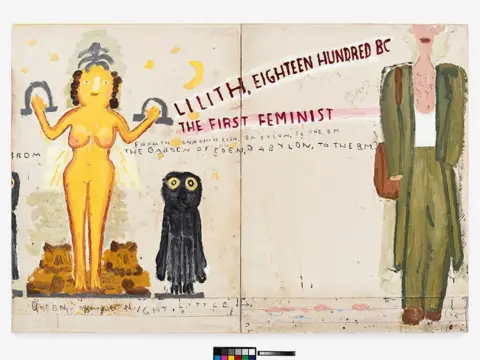
Wylie says when she first saw the ancient figure of Lilith, she was exhilarated to find "the first feminist", which she reflects in Lilith and Gucci Boy, 2024
There are 90 works in Rose Wylie: The Picture Comes First, a show she tells me was "heaven-sent".
The title, she tells me, is because although she's known for putting text on her paintings, "I want people to look at the picture, not the writing… the picture comes first".
When she's painting, she's "obsessed with it, I want to go on and I can't stop".
But she tells me she doesn't actually enjoy the experience because "it can go very horrid. It can be nasty, slimy and that's the torture. You're looking at something which you really don't like the look of."
Fortunately for the rest of us, Wylie perseveres. "It's OK when it's finished," she concedes.
 Rose Wylie/David Zwirner
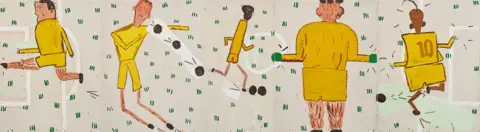
Wylie used to watch Match of the Day with her husband and says footballers are "accessible national interests", which she reflects in Yellow Strip, 2006
She's an artist who defies convention, not simply because of her age and her bold, irreverent work, but also because of how she got here.
She went to Folkestone and Dover School of Art but didn't paint at all once she married and had children, deciding to concentrate on raising her family.
Did she regret that decision? "No, I think it allows you not to get bored with it, and you've got a lot of stuff to work with."
She later did an MA at the Royal Academy in 1981 and only really started to come to the attention of the art world in her seventies, after she was part of a show of under-represented and emerging women artists at the National Museum of Women in the Arts in Washington.
It was called Women to Watch; there were seven US artists in the show and one 76-year old Brit. After it, Germaine Greer predicted "life may be about to change for Wylie. Word has got out that she is seriously cool".
 Rose Wylie
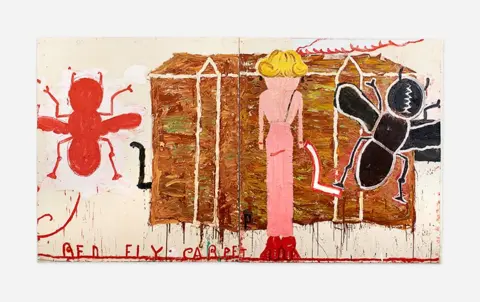
Black Strap (Red Fly), 2012 sold for £220,500 at auction, reflecting the artist's growing commercial appeal
She is seriously cool, but although Wylie believed she could succeed as an artist, "with every painting," she says, "you think 'I can't do this'."
She doesn't want to talk about what her works now sell for - "I could tell you but I'm not going to" - and says it's not something she thinks about. She doesn't do this for the money.
She does though point out the sexism still inherent in the art world when it comes to price. "Men's paintings are still much higher than women's. There's something very wrong there... that should be fixed".
And she doesn't mince her words about how long it's taken a female British painter to get a solo show in the Royal Academy's main galleries, calling it "obscene" and "historically quite extraordinary".
She is however delighted to have been chosen. "I love being the first woman painter".
 Rose Wylie/David Zwirner
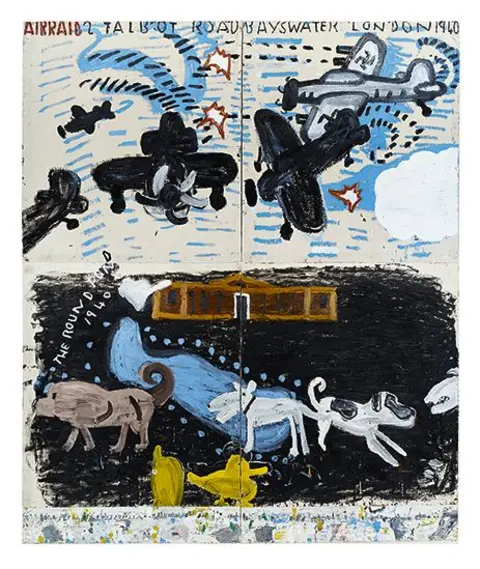
Rose Wylie has clear memories of bombs landing on the rood of her house in London during WWII, which she reflects in Park Dogs and Air Raid, 2017
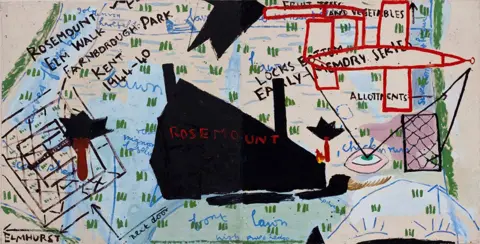
In one of the early rooms in the show, there are some of her paintings depicting the Blitz.
There can't be many artists living now who actually remember World War Two. Wylie does, recalling "the wail of sirens and then the release wail of the all clear and the smell of gas".
Her family left London for Kent in 1940 but their home was in the direct line of the German bombers and a bomb landed on the house.
 Rose Wylie
The artist's childhood family home Rosemount (Coloured), 1999, is pictured as a blacked-out triangle, above it is the red outline of a doodlebug plane
"I can remember the noise because it was quite extraordinary as it comes, not the explosion, the screech as it gets louder and louder and you think 'this is just impossible, it's noise', and then there's the explosion".
I ask her what the small child she was then would think of her success. "It would blow that little child's mind!" she replies.
Rose Wylie: The Picture Comes First, Royal Academy opens 28 February.