.png)
 1 month ago
30
1 month ago
30
At last, Morocco have arrived at the tournament they are hosting. For four games they had played scratchy, crabbed football. Finally, in a spiky, ill-tempered quarter-final, there was something more like the Morocco that reached the semi-final of the World Cup just over three years ago. If the game wasn’t fluent, that was largely Cameroon’s doing as they spoiled and sought treatment. But the hosts, for the most part, retained their cool, protecting a lead earned with verve in the first half with maturity in the second.
In previous games, Morocco had looked tense, limbs leadened by the expectation of a country that last won the Cup of Nations 50 years ago and has spent a vast amount on football-related infrastructure as it prepares to co-host the 2030 World Cup. The coach, Walid Regragui, was even booed in the 1-0 last-16 victory over Tanzania, his football deemed overly cautious despite a record of only four defeats in his 46 games in charge before this quarter-final. Images broadcast from the respective dressing rooms on the screens inside the stadium before kick-off showed Morocco pensive and focused while Cameroon sang and danced.
But once the game had begun, there was none of the anxiety that had previously characterised their play. Fuelled by an extremely noisy crowd in the magnificent Prince Moulay Abdellah Stadium, a key part of that investment in infrastructure, they pressed ferociously from the off, won a series of corners and free-kicks around the box, and reduced Cameroon to trying to break the flow of the game. Sadly for them, and for Stoke, at least one of their injuries was genuine, the right wing-back Junior Tchamadeu damaging a knee as he challenged Noussair Mazraoui. His absence, and the change to the marking structure, was perhaps a contributory factor as Ayoub El Kaabi got to Morocco’s sixth corner of the game and headed down towards the back post where Brahim Díaz nudged in his fourth goal of the tournament. Another set-play brought the second with 16 minutes remaining, Ismael Saibari slamming in an angled shot after a free-kick had dropped to him at the back post.
Cameroon, in obvious contrast to the hosts, may be five-time champions but arrived at the tournament with perhaps less expectation than ever before, given a chaotic build-up that featured two rival coaches each submitting squad lists to CAF. In the end, as Samuel Eto’o, the president of the federation, won his battle with the sports ministry, his candidate David Pagou prevailed. Pagou, a 56-year-old experienced in the Cameroonian league, has proved a punchy and drily amusing figure, his delivery in press-conferences as direct as the play of his young and highly motivated side.
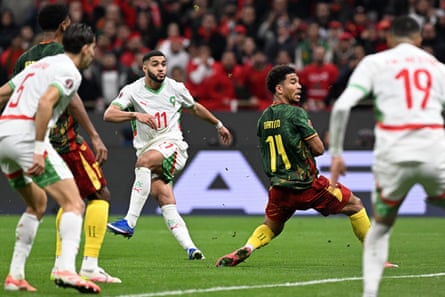
They have performed far better in this tournament than most had anticipated, their speed and coherence justifying a selection policy that culled many of the older players. But here they looked, if not overawed by the occasion, then certainly overwhelmed early on by the pace and aggression of Morocco. The suspicion is most teams in this competition would be. Regragui started the same lineup as had begun against Tanzania, a 4-3-3 that gives the wide forwards, Díaz and Ez Abde more freedom. Familiarity, perhaps, brought fluency; certainly they appear a more mobile side without Sofyan Amrabat.
The Mauritanian referee, Dahane Beida, who took charge of the final in Côte d’Ivoire two years ago, was only confirmed as the referee for the game on Thursday after the Moroccan football federation protested against the appointment of the Egyptian Amin Omar. Cameroon were furious at the late change, and were furious with a number of Beida’s decisions, but he wasn’t the reason Cameroon lost.
For those countries who have qualified for the World Cup, a Cup of Nations six months before the main event is a double-edged sword. On the one hand, it’s a great opportunity for fine-tuning in a competitive environment. On the other, as demonstrated by the case of Sami Trabelsi, sacked by Tunisia last week after their exit to Mali, it only takes a couple of poor performances in competitive games for the goodwill generated in qualifying to be forgotten.
Given his record, it seems absurd that Regragui should be under pressure but if Morocco don’t win the Cup of Nations there’s a very good chance he will be replaced before the World Cup, perhaps by Tarik Sektioui, who led what was effectively a B-team to glory in the Arab Cup in December.
Will they win it? Morocco could probably still do with a little more goal-threat, but this was a tight victory very different to the narrow win over Tanzania in the last round. This was less about nerves than about getting a lead and then holding a dangerous opponent at arm’s length. Their control of the game was hugely impressive. They looked potential champions at last.