.png)
 1 month ago
38
1 month ago
38
Hello and welcome to The Long Wave. I’m standing in for Nesrine today – and while this newsletter is not, and has never wanted to be, a digest of “the week in racism”, sometimes events are so egregious that they force our hand. In the past few weeks alone, there have been multiple high-profile reports of online racial abuse targeted at footballers, as well as a number of on-the-field incidents that have led to matches being halted as the victims have sought, and largely failed to get, support from the on-field authorities. So this week, I want to look at the rise of abuse in football to better understand whether the sport’s governing bodies and social media companies are even capable of standing by their repeated promises to tackle racism in the sport.
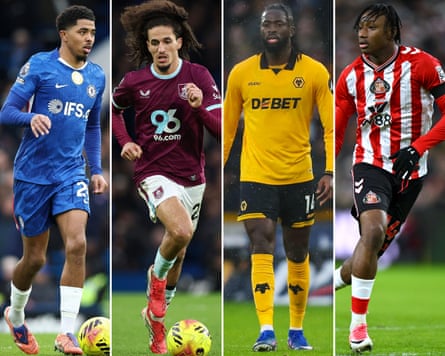
On the evening of 21 February, a few hours after Chelsea’s French defender Wesley Fofana was sent off in the 72nd minute of his side’s Premier League game against Burnley, his club was forced to release a statement. “Chelsea Football Club is appalled and disgusted by vile online racist abuse directed at Wesley Fofana,” it began. “[It] is abhorrent and will not be tolerated. Such behaviour is completely unacceptable and runs counter to the values of the game and everything we stand for as a club. There is no room for racism.” Chelsea went on to promise that they would “work with the relevant authorities and platforms in identifying the perpetrators and take the strongest possible action”.
That same evening, Burnley released their own statement, not to support Fofana, but to call out the online abuse that their own player, Hannibal Mejbri, had been subject to. “Everyone at Burnley FC is disgusted by the online racist abuse directed at Hannibal following today’s Premier League fixture.” Just as Chelsea had, Burnley said their next step would be to identify the culprits. “The Club has reported the post to Instagram’s parent company, Meta, and expects strong support from them, with the Premier League and the Police, and will work to ensure that the individual responsible is identified and investigated.”
That wasn’t it for what the anti-racism in football campaigners Kick It Out described as “an appalling weekend”. The next evening, Wolves said they were “disgusted by numerous instances of racist abuse, from multiple perpetrators, directed at Tolu Arokodare”. Sunderland condemned the “vile online racist abuse directed at Romaine Mundle”. The next day, in Scotland, Rangers announced that their players Djeidi Gassama and Emmanuel Fernandez were subjected to racist abuse on their Instagram accounts.
In their statements, Sunderland, Wolves and Rangers promised, almost word-for-word as dozens of clubs have done before them, that they would work with Meta and other social media companies to find and prosecute those responsible. We’re still waiting. Nobody has been identified, and if past experience is anything to go on, very little, if anything, will be done.
The victims should be the priority
Despite two decades of campaigns, saying the right things publicly, there remains a strong feeling across the game that world football is failing to protect its players from racist attacks – off and on the pitch.
“It’s still unbelievable to me that we’re playing in a time where people have so much freedom to communicate such racism without any consequences,” Wolves’s Arokodare said after his own abuse.
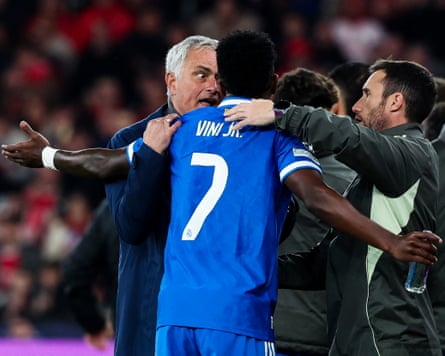
A week earlier, many felt this same sense of helplessnessover the responses to Real Madrid’s Vinicius Júnior, who accused his Benfica opponent Gianluca Prestianni of covering his mouth with his shirt and calling him “mono” (monkey) as he celebrated a goal during their Champions League match. (Prestianni has denied the accusation – claiming instead he called the Brazilian maricón, a homophobic slur). José Mourinho, Prestianni’s manager, was brazen enough to blame Vinicius’s celebration for inciting the confrontation.
Fifa have promised to investigate the incident, but there is little to suggest serious action is imminent. Its president, Gianni Infantino, reacted by proposing that players who cover their mouths when speaking to opponents should receive a red card. And more controversially, he suggested that players who admit to racially abusing an opponent have their punishment reduced. “Maybe we should also think about not just punishing, but also somehow allowing, changing our culture, allowing players or whoever does something to apologise,” he said. “You can do things that you don’t want to do in a moment of anger [and] apologise and then the sanction has to be different, to move one step further and maybe we should think about something like that as well.”
This could be read as an admission that, as things stand, the sport’s governing bodies are incapable of effectively policing racist abuse. But a spokesperson for Kick It Out tells me that this is simply a sign of misplaced priorities from football’s governing body. “We would always encourage players to reflect on their actions and advocate for further education,” Kick It Out says, “but any apology from a player should be in addition to accountability, not as a way of reducing potential sanctions. The victim, and the impact of the words or actions on them, regardless of the offender’s intent, should always be the priority.”
Social media companies are not doing enough
In the UK, social media companies are required to protect users from racist content, Dan Milmo, the Guardian’s global technology editor, tells me.
“There is the Online Safety Act, which requires tech firms to crack down on racist abuse, and the tech platforms’ own terms and conditions which, under the OSA, they have a duty to enforce,” Milmo says. After the reports of last month’s abuse towards Fofana, Mejbri, Arokodare and Mundle, a spokesperson for the prime minister, Keir Starmer, promised “the government will hold [social media companies] to account” to ensure they abide by the law and their promises to protect people from “abhorrent” abuse. So far, nothing has changed – and last weekend it was possible to find countless examples of racist abuse aimed at Black players.
In the meantime, until players and faceless social media accounts start self-reporting themselves for racist abuse, we are left hoping these long-running investigations start producing results. According to Kick It Out, reports of online abuse have risen by 45% compared to this time last season.
Nobody can complain about a lack of statements on the issue; and there will be plenty more before the season ends. But when it comes to action, football has reached a desperate place, where, as Kick It Out expects, players will soon have to start taking matters into their own hands and show “the type of leadership that those who have more power in the game and society should follow”.