.png)
 3 weeks ago
31
3 weeks ago
31
It was an opening which depicted more than a decade of toil. “I’d like to start this press conference with a question,” said Rory McIlroy. “What are we all going to talk about next year?”
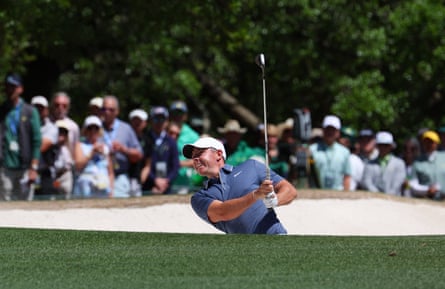
The wait was over. McIlroy had not only won the Masters, not only ended an 11-year wait for a fifth major, and not only become the sixth man in history to complete a grand slam. The ticking of all three boxes at once and in extraordinary circumstances was why the scenes at Augusta National in 2025 are unlikely to be matched as the 90th Masters staging approaches.
So what do we all talk about this year? The coming days will naturally bring further reflection on McIlroy’s achievement. The man himself bristles at the notion he could struggle for motivation on golf’s biggest stages now Everest has been climbed. “Not at all,” he says. “I still want to achieve things, I still want to win things. This isn’t the end.
“I feel like with the way I am playing and feeling … physically I feel better at 36 than I did at 25. I still have a lot left. If I can produce the golf shots that I needed to produce down the last few holes at Augusta, feeling the way I was feeling then, I am pretty capable of doing anything in this game.”
There was a lull, natural but not terribly stark, as the impact of Augusta last April set in. McIlroy peaked again for Europe’s Ryder Cup defence. Now, more majors are on his mind.
Tennis followed by dinner with Roger Federer in Dubai in January involved the topic of how to shoot for new targets. McIlroy has plenty of them in view; he is one shy of Nick Faldo’s major winning record for a European of six. Double figures in the same domain is far from impossible now the Masters gorilla has been removed from the Northern Irishman’s back. From the opening tee shot on Thursday, McIlroy will aim to become the first player since Tiger Woods in 2002 – and only the fourth ever – to defend the Green Jacket.
“The majors will still all feel the same to me,” McIlroy adds. “The majors are the biggest. I have played more majors in my career than I will do going forward, in the sense of having a really, really legitimate chance to win.
“I don’t think they will feel any different now. There will always be the intensity there. Maybe not the pressure but I will still have the intensity and work the same way towards them.”
In short, no sense of standing back and admiring what already sits in his trophy cabinet? “Once I am in that environment? Absolutely not.”
There will be a point at which McIlroy rides off into the sunset, content that his contribution to elite golf is complete. “Something has gone terribly wrong if I have to compete at golf at 50,” said McIlroy even before his Masters win. This draws contrast to the current, sad predicament of Woods. McIlroy’s idol has never appeared ready or able to let go of his sport. McIlroy has plenty to keep him occupied away from the course and an inquisitive, able mind he wants to use in other domains. Not quite yet, though.
“You look at what Justin Rose has done,” McIlroy says. “He is still competitive at 45 and I would like to think if I do the right things, pace myself and play the schedule that suits, not playing a ton of golf to stop me being burnt out every year, that I can get to that point as well.”
There has been one alteration in McIlroy’s mind. Run-of-the-mill tour stops have taken on a different form in the mind of a grand slam winner. “Yes, I think so,” he admits. “It’s a little bit more relaxed. I feel like I have done a really good job over the last five or six years of not living and dying by every shot or round.
“I don’t want to say the tour stuff is ‘less important’ but at the same time if I have 10 years left and I really want to prioritise the majors then the other tournaments are great to play in, you want to win them. It is just that every time I play in a PGA Tour event I have one eye on what I need to do for the next few weeks, leading into majors.”
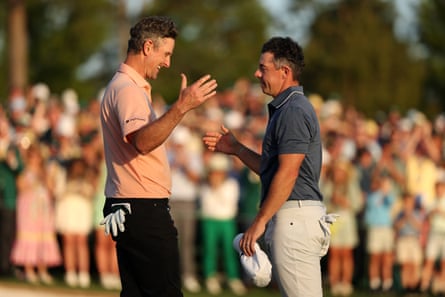
McIlroy’s form leading into this Masters is tricky to assess. Injury curtailed his involvement in the Arnold Palmer Invitational and undoubtedly affected his performance at the following week’s Players Championship. Four PGA Tour events in 2026 returning a single top-five finish has to be placed against the lack of a psychological burden at Augusta.
McIlroy has, to his great credit, focused on being a global golfer. He will match Colin Montgomerie’s European order of merit record of eight wins the next time he prevails in that season-long contest. Scottie Scheffler, the world No 1, is rarely spotted outside of the US. McIlroy took the Green Jacket to India and Australia in 2025 – he will return to the former this year – and strolled into the Association of Golf Writers annual dinner at Royal Portrush in the same clothing item. “I hope this makes up for skipping a few interviews recently,” said a smiling McIlroy.
He felt the “responsibility” of being a Masters champion and carried that exceptionally well. This weekend, it would be no shock to see him attend the Augusta National Women’s Amateur or the Drive, Chip & Putt contest for children each held as Masters precursors. McIlroy has spoken about how so many at Augusta felt “invested” in his journey; a nod to relationships he has within the club that contributed to him being such a popular champion.
There was also widespread acknowledgment, or fear, of what damage might have been done had McIlroy lost to Rose in last year’s playoff. “How many times did we speak about ‘Would your career feel complete if you don’t win at Augusta?’” McIlroy recalls. “And I’d say: ‘Yeah, you know, I would like to say that it would.’ But at the same time …” He does not have to say it. There would clearly have been a gaping hole that McIlroy no longer has to contemplate.
There are aspirations beyond the picture-perfect confines of Augusta National. “Winning certain majors at certain venues is pretty important to me,” McIlroy says. “I would love to win an Open at St Andrews one day.” He need only wait until next year for that opportunity.
Sitting at the end of the 2025 major season, McIlroy reflected with his caddie and best friend, Harry Diamond, about how well the pair had done since pairing up in 2017. Diamond shot back a point only partly in jest. “He said: ‘Yeah, but I haven’t won the grand slam …’” McIlroy says. “Stuff like that is cool; let’s try and do the grand slam together.”
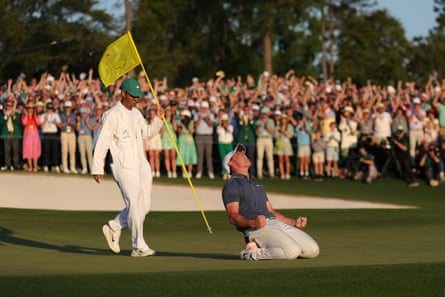
Diamond’s role in McIlroy finally bursting through the Augusta finishing tape should not be forgotten. Doubt had naturally crept into the golfer’s mind after concession of a winning position during regulation play. The turnaround between that and returning to the 18th tee for the playoff is a quick one. Diamond stepped in with a simple, penetrating message that sporting psychologists would have been proud of: “Well, pal, you’d have taken this position at the start of the week.”
It was sufficient to change McIlroy’s mood. Deliberately, and endearingly, Diamond has no interest whatsoever in public profile or praise. This can fuel criticism from back-seat drivers. “They don’t understand that he provides a level of comfort on the golf course for me that no one else in the world could,” McIlroy says.
On Tuesday, McIlroy will return to the Masters press theatre where he openly contemplated future discussion points. The time, inevitably, there will be glances 12 months backwards. There should also be acknowledgment of a fresh, intriguing chapter. McIlroy did what so many – in sport or in life – fail to accomplish by reaching his holy grail. Just do not mistake that for the conclusion of his sporting journey.