.png)
 3 hours ago
1
3 hours ago
1
At the beginning of the final training session before their biggest game in a decade, Atlético Madrid’s players lined up by the centre circle at the Metropolitano and waited for their coach to come. Diego Simeone arrived and ran through the middle of them, from Juan Musso and Jan Oblak at one end to Antoine Griezmann and Ademola Lookman at the other. As he passed, head down, they cheered and hit him – if not quite as hard as they do when it’s a player’s turn. Gauntlet run, applause echoed round the empty stadium. Happy birthday, mister.
Simeone turned 56 on Tuesday. He has spent almost 20 of those here: first as the captain who won the double, then the coach who lifted Atlético’s next league title, 18 years on, and now leads them into his fourth and their seventh European Cup semi-final, nine years since the last. What do you get the man who has it all? “Buah! You can’t imagine how good it is to be in the four best teams in Europe,” he said after the quarter-final; “I have no birthday wish,” he said before this semi-final, “just pure gratitude to be able to be with my three sons on my birthday, with my two daughters, my mum, my wife, my lifelong friends.”
One of the sons was hidden in the crowd somewhere, hitting him. The day that Simeone bade farewell to the Vicente Calderón as a player in December 2004, he carried his youngest son, two-year-old Giuliano, in his arms. The days before he came back to Madrid as coach in December 2011, he stopped in a cafe in Mar del Plata and, over a croissant and a glass of milk, asked Giuliano, then eight, what he thought. “You’re going to coach [Radamel] Falcao?!” the kid replied, excitement giving way to reality. “But … if it goes well, you won’t come back.”
It did and he didn’t, but that was all right. Fourteen years later, Giuliano’s dad is still there – no manager in Spanish history has lasted longer – and now so is he. Born in Italy in December 2002, Giuliano grew up in Argentina with his elder brothers, Giovanni and Gianluca, but they visited often and their dad visited them too. They would eat “together” via an iPad on matchday mornings. Football was their thing, of course, bound by a shared passion. Glasses would be moved round the table in formation and they would find bits of paper all over the house, Gio recalled: tactical scribblings their dad did.
During celebrations after Atlético’s 2012 Europa League title, Simeone Sr was caught on camera excitedly talking on the phone: “And did you see Falcao’s goal?!” On the other end was Giuliano. The night Atlético won the Copa del Rey in 2013, it was a school night, too late, but the brothers went through the usual routine at home, scarves draped around the room. When Atlético won the derby in January 2015, a tiny ballboy in a white bib and long hair came racing along the touchline – something he was going to be very good at – and leaped into the coach’s arms. That was Giuliano too.
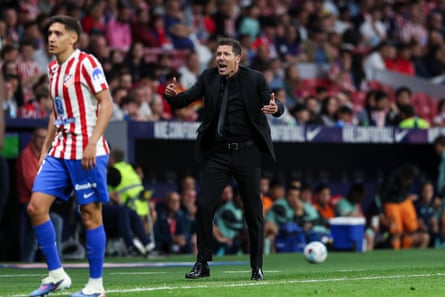
As a ballboy he was invariably by the bench and, yes, there were times his dad told him to slow down a bit if they were winning. He would visit training at Cerro del Espino in Majadahonda near the family home and have a kickabout. “It was crazy seeing the players up close,” he has said. “I always thought: ‘Imagine being out there; that would be mad.’” After Falcao, his idol became Antoine Griezmann.
Competition came closer to home. “They would kick me, throw me to the floor, and if I cried, I couldn’t play with them any more; I learned to be tougher,” Giuliano said of playing with his brothers. Gianluca and Gio were good, becoming professionals like their dad, and they suspected Giuliano would be good too. Just maybe not this good. He was 16 when he left River Plate’s academy and crossed the Atlantic to join Atlético’s youth system, living with his dad, watching him pore over formations every morning. When he turned 18, though, Simeone Sr kicked him out; it was time to be a man. Now, his dad is his manager and his hero is his teammate.
Which might make it sound easy, but it hasn’t been – in part precisely because it might sound easy. In a recent interview with Jorge Valdano, Giuliano admitted: “At times, it can feel strange to me, wondering what others might think.” When Valdano joked that the best thing is, when your teammates speak badly of the manager, speak even worse. The reply came back rapidly: “No doubt!” Giuliano admitted that had affected him when he was younger, telling Cadena Ser: “When I was 12 people said I was playing because I was my father’s son. I try to isolate myself from [that]. I know I won’t be gifted anything.”
Quite the opposite. Simeone Sr once said that there was no way he would sign his son because of the baggage it would bring: the suspicion, the pressure. “I don’t want to say never, but …” he said. “It would be very difficult to have a son in the dressing room. Very difficult for him, for the relationship, for everyone.”
But he said that about Gio not Giuliano, and Atlético didn’t sign the latter nor really plan for father and son to coincide. He was just another kid from the academy, trying to prove himself.
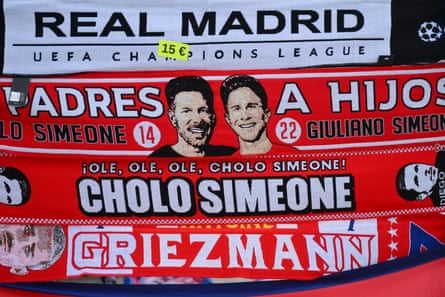
Having to do more to prove himself, in fact. Loaned out to Zaragoza first and Alavés next, Giuliano broke an ankle in 2023. His dad immediately went to his bedside, but the doubts about where his career went next were not limited to the injury, which he overcame with the determination that comes with the name. There was, it appeared, a reluctance in Simeone to open a pathway for his son. Simeone Jr, though, would end up opening it himself, as insistent and relentless as his old man was. Smashing down the door, he made it impossible for anyone to ignore him. Even his dad.
Giuliano used to be a centre-forward but his grandfather – Simeone’s father – said the wing would make him, and so it was: tearing up the touchline, veins in his head about to blow. “That Simeone, man … bloody hell”, Alavés’s then-coach, Luis García, said. “He runs for 90 minutes without stopping. He’s a pain. He’s got a very high level. He makes something out of nothing at any moment.”
“I see a player, not a son,” Simeone says. However proud he has felt he has been extremely careful not to talk effusively about his son even when he has done so for other players – before facing Barcelona he publicly told Griezmann: “I love you” – or even acknowledge him.
When Gianluca was at Rayo Majadahonda, who play home games at Atlético’s training ground, they would turn up separately, sit separately and leave separately. “Giuliano has a good relationship with his teammates; that’s the thing I’m happiest about in our father-son journey,” Simeone said.
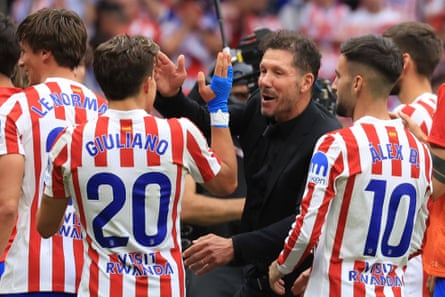
He would have to earn that, his place too. When Giuliano came back from loan, he started one of the opening 11 games. But when given a chance – basically because the coach had little other choice – he grabbed it and never let go, everything better with him. No doubts now, just a player worth every minute he gets and every minute he gives. And boy does he give.
Giuliano has a tattoo of the date he made his Atlético debut. They are the “team of my life”, he says and there can be no doubt about that either, a legacy from his father, something else shared, bound together from the beginning. Watch them and you see it: the same character, the same competitiveness, on either side of the touchline. Go to the club shop, ask for a No 20 shirt and it comes with “Giuliano” on the back, not “Simeone”. But that’s his dad, Tuesday was his birthday, and he has everything he would wish for. “I’m not in a position to ask for absolutely anything, just to be grateful,” he said.