.png)
 3 weeks ago
17
3 weeks ago
17
Soroush PakzadBBC Persian

 BBC
BBC
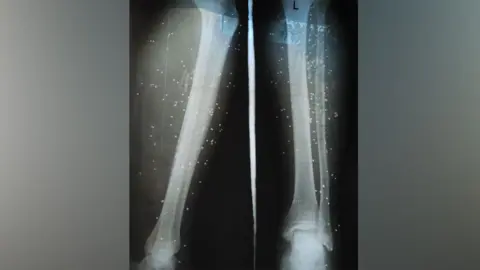
X-rays showed birdshot embedded in the legs of a wounded protester
"People helped us and we got into a car... I said, 'Don't take us to a hospital.'"
Tara and her friend were attending a protest in the central Iranian city of Isfahan when security forces arrived on motorcycles and began shouting at the crowd.
"My friend told an armed member of the security forces, 'Just don't shoot us,' and he immediately fired several shots at us. We fell to the ground. All our clothes were covered in blood," she said.
They were bundled into a stranger's car, but Tara said they were too frightened to be taken to the hospital because of the risk of being arrested. "All the alleyways were full of security forces, so I asked a couple standing at their front door to let us in."
They stayed at the couple's home until it was almost dawn and then managed to find a doctor they knew, who cleaned the birdshot wounds on their legs, according to Tara.
She said a surgeon was later able to remove some of the birdshot at home but warned them: "They cannot all be removed and will remain in your bodies."
All names in this article have been changed for their safety.
Warning: This story contains details and images which some readers might find distressing.
The full scale of the bloodshed resulting from the crackdown by security forces on the anti-government protests that swept across Iran this month is still not known because of an internet shutdown and a ban on reporting by most international news organisations.
But the US-based Human Rights Activists News Agency (HRANA) has said it has confirmed the killing of 6,301 people, including 5,925 protesters, 112 children, 50 bystanders and 214 affiliated with the government. It is also investigating reports of 17,091 more deaths.
At least another 11,000 protesters were seriously wounded, according to HRANA.
Some of them have told the BBC that they have avoided seeking treatment for their injuries at hospitals because they fear being arrested.
That has left them reliant on doctors, nurses and other volunteers willing to risk their own safety by treating them secretly at their homes.
Healthcare workers have also told the BBC that security forces are present in hospitals and that they are constantly monitoring patients' medical records to identify injured protesters.
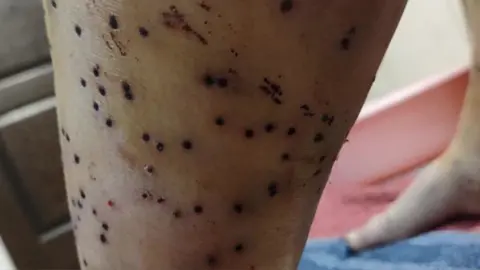
Tara was able to find doctors willing to treat her wounds at their homes
Nima, a surgeon in Tehran, said he witnessed many young people being injured in the streets on his way to work on 8 January, when authorities responded to the escalating protests with lethal force.
"I put one of the wounded in the boot of my car to take him to hospital, as I was worried that we would get in trouble if we were stopped by the police," he told the BBC.
Nima said armed officers stopped him but allowed him to go after seeing his hospital identification card.
"For almost 96 hours straight - without interruption, without sleep, without even closing our eyes for a moment - we were operating. We were crying and operating. Nobody complained."
"All our clothes and hospital gowns were covered in blood - our outer clothes, our underwear, everything was soaked in the blood of these young people."
Nima described operating on one man who had been shot in the leg and face at a protest.
"A bullet had entered through his chin, ripped through his mouth and exited through his upper jaw," he recalled.
Nima also said many of the young people treated at his hospital suffered gunshot wounds to their vital organs and limbs that required amputation and left them with permanent disabilities.
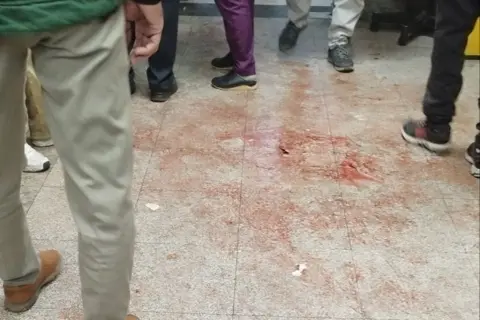
Blood was seen on the floor of a hospital in Tehran
Iranian authorities have said more than 3,100 people have been killed during the unrest, but that majority were security personnel or bystanders attacked by "rioters".
Health ministry spokesman Hossein Shokri was also quoted by the semi-official Tasnim news agency as saying that around 13,000 operations had been carried out during the unrest.
"Fortunately, people trust the ministry of health and hospitals, and confidence that all injured individuals are treated impartially in medical centres has led around 3,000 people who had been treating themselves at home over the past six days to seek care at hospitals," he added.
The head of the Farabi Eye Hospital in Tehran, Dr Qasem Fakhrai, told Isna, another semi-official news agency, that it had treated a total of 700 patients with severe eye injuries requiring emergency surgery as of 10 January, and referred almost 200 to other hospitals. He said almost all of the patients were admitted after 8 January.
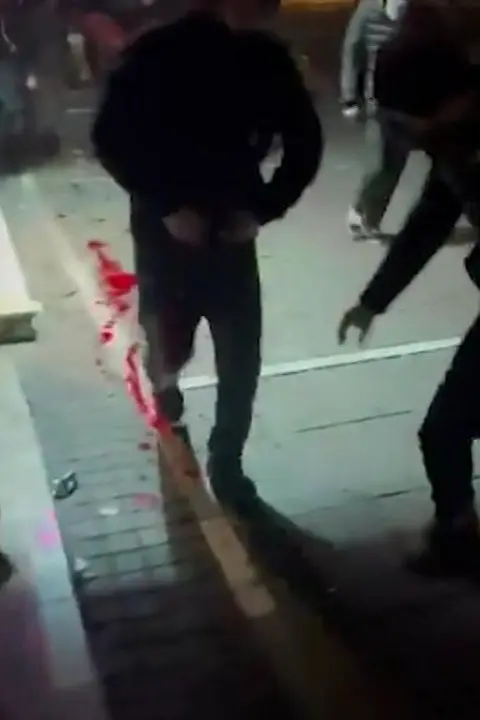 Imanemunmusic/X
Video footage from a street in eastern Tehran showed wounded people fleeing the sound of gunfire at a protest
Saeed told the BBC that his friend's eyes were hit by birdshot fired by security forces during a protest in the central city of Arak.
Local doctors told him to go to a specialist eye hospital in Tehran, he said.
Upon arrival, nurses took protesters with eye injuries to operating theatres through the back by using staff lifts.
According to Saeed's friend, around 200 people with eye injuries from different cities were being treated at that hospital.
"He had two operations, but the surgeon did not charge him," Saeed said.
A healthcare worker in Tehran also said that doctors were trying to avoid mentioning gunshot wounds in medical records because they were being constantly monitored by security forces.
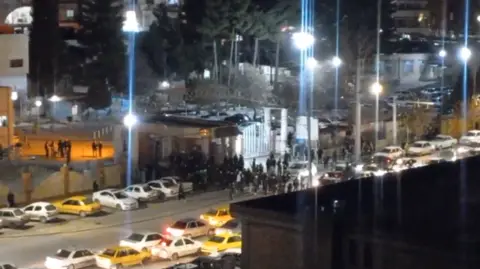 Vahid Online
Video footage from early January showed security forces storming a hospital in Ilam where activists said wounded protesters were being treated
Sina took his brother to a hospital after he was shot in the legs during protests in Tehran.
"It was like a battlefield hospital - there were so many wounded that there were no blankets or medical kits," Sina told the BBC.
"When I asked a nurse for a blanket for my brother, she told me to bring one from home because there were too many injured and not enough supplies."
Sina said they had no choice but to give their actual ID number in order to use their health insurance. "At any moment, the security forces could raid our home," he added.
In smaller cities, the situation is believed to be even more dire.
Reports received by the BBC said security forces had abducted patients from hospitals and that they had not been seen again.
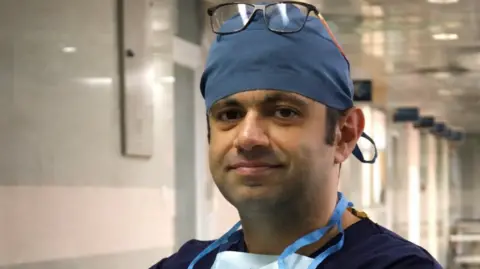 HRANA
HRANA
Dr Alireza Golchini, a surgeon in Qazvin, has reportedly been arrested for treating injured protesters
Human rights groups have also said that medics and others who have treated injured protesters are now themselves being targeted by security forces.
Iran Human Rights (IHR) said last week its sources on the ground in Iran had reported the arrest of at least five doctors and a volunteer first responder.
"Security agencies appear to be aiming to intimidate the public and obstruct treatment for injured protesters by arresting doctors and raiding makeshift medical shelters," the Norway-based organisation warned.
And this week, sources close to Dr Alireza Golchini, a surgeon from the northern city of Qazvin, said he had been beaten up at his home by security forces when they arrested him for treating injured protesters.
They added that he had been accused of "moharebeh" (enmity against God) - an offence that can carry the death penalty under Iranian law.
Additional reporting by Faren Taghizadeh and Maryam Afshang, BBC Persian