.png)
 1 month ago
31
1 month ago
31
England
Ben Stokes: 184 runs at 18.4; 15 wickets at 25.1; two catches
A body unable to match his will, a team unable to match his ambition and, surely, a screaming sense that he made mistakes when preparing for this challenging but winnable series all adds up to a horrible seven weeks for the England captain. His personal form inevitably buckled – and you have to feel a little sympathy for a man more guilty of giving too much rather than too little.
To be clean bowled three times, caught behind the wicket six times and run out once at least avoids the tragicomedy on a loop of finding the man in the deep put there for the slog. But, for the man 12th on England’s all-time Test runs list, it is not a good look.
His bowling was better and, as usual when fit, England’s most threatening. But he flogged himself to an injury, only Brydon Carse delivering more than his 101 overs. The workload was brave but a little ridiculous for a 34-year-old who was also batting at No 6 and captaining the side. That’s an indictment of the years leading up to the tour, when so much damage was done on, it has to be said, his watch. Grade C
Zak Crawley: 273 runs at 27.3; four catches
Crawley’s role is to load the pressure on to the bowlers from the get-go but instead he loaded the pressure on to England’s fragile No 3. His many critics would say his figures, the modes of his dismissals and his overall contribution were exactly as expected, 64 Tests into his quixotic career. It’s hard to argue otherwise.
Grade C-
Ben Duckett: 202 runs at 20.2; three catches
His cuts, slashes and pulls look good and move the scoreboard against lesser bowlers but, confronted with the nous and discipline of a seasoned attack playing at home, he floundered. A high score of 42 but with a strike rate of 91 speaks to a one-trick pony with sleight of hand too visible to fool the audience. He needs a good start to the home season now Jacob Bethell has shown there is genuine potential outside “the group”. He was also one of the many players guilty in the field.
Grade D
Ollie Pope: 125 runs at 20.8; two catches
Seeing England’s No 3 with hands, feet and head seemingly disconnected from the central nervous system, each darting about in different directions, was all too familiar. He managed to get everything aligned occasionally but he has significant work to do at domestic level if he is to recover his place in the England team. Grade D-
Jacob Bethell: 205 runs at 51.3; one wicket at 68.2; one catch
So we can believe the hype after all. The New Gower made an imperious 154 in an almost already lost dead rubber, but that ignores the fact that he took his chance with such panache that he’s surely here to stay. We knew he had the strokes but we didn’t know he had the defence and temperament required to bat so long against good bowlers in a hostile environment. Grade A
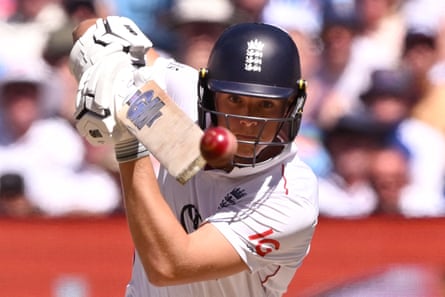
Joe Root: 400 runs at 44.4; no wicket for 50 runs; three catches
Tremendous centuries excepted it was a poor tour for England’s best batter, who didn’t need to get much from the Australia bowlers to give up his wicket far too often. That said, heaven help us if he hadn’t delivered such sublime transcendence of the wreckage around him in those two tons. Grade B
Harry Brook: 358 runs at 39.8; 11 catches
“Flash” – is that the right word? He has all the talent in the world to burn and, boy-oh-boy, did he burn it, too often so high on his own supply of outrageous strokes that he forgot that the currency of Test cricket is runs and time, not showreel content. Had he shown even a modicum of restraint in key moments, he might have shaped sessions, days and even matches. Nine starts out of 10 innings, in Australia, that yielded just two half-centuries is a criminal waste. If he captains England the next time they visit Australia, he will surely not stand for that from his No 5 – so he should not have stood for it this time, regardless of the “no consequences” coaching environment. Grade C-
Jamie Smith: 211 runs at 23.4; 15 catches
He became the vessel into which the media poured their frustration after his dismal swipe to be caught off one of Marnus Labuschagne’s clowning bouncers in Sydney. The same people also say his technique isn’t good enough to defend consistently – he seems to middle more attacking strokes than forward defences, so how stupid was it really to make quick runs before the new ball and Starc? His critics don’t want him in the XI, but 42 runs per innings at No 7 is a lot to discard. Maybe he needs some intensive coaching, allied to a lot of four-day cricket, if he is to answer them. The wicketkeeper, as the player who sets the tone, must bear some responsibility for a dismal collective fielding effort, catch after catch spilled. No team can remain competitive while being so comprehensively outplayed in that undervalued aspect of the game. Grade C-
Will Jacks: 145 runs at 20.7; six wickets at 53.7; one catch
The classic all-rounder’s dilemma – in seeking to make half a bowler and half a batter into a whole player, both units are weakened, as Jacks is not good enough at either discipline to strengthen them. That said, he did well at times, his three-hour stay at the crease in Brisbane and occasional sharp turn being highlights. He took one sensational catch, but finished the series with a near-farcical drop at cow corner and then a second-ball slog to get out with Bethell on a 106 at the other end. Grade C-
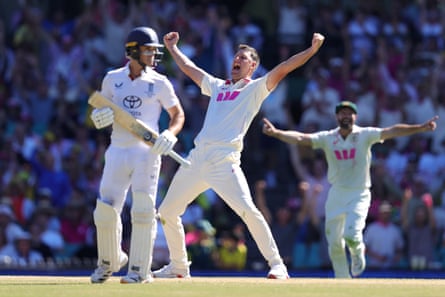
Gus Atkinson: 73 runs at 14.6; six wickets at 47.3; one catch
After a summer blighted by injury, he probably needed the preparation that never came more than any other player in the party. He failed to find his top-of-off-stump line and length until Melbourne, by which time it was too late. Grade C
Brydon Carse: 99 runs at 11.0; 22 wickets at 30.3; seven catches
The wholehearted pacer retained the belief of his captain and rewarded him with five Tests and a decent haul of wickets. The figure missing above tells a more complete story, his propensity to go short and wide leading to an economy rate pushing five across nearly 140 overs. That shows that he was overbowled (but that’s what happens when there’s no specialist spinner), and that batters just had to wait for a four ball and one would arrive soon enough. Grade B-
Jofra Archer: 102 runs at 25.5; nine wickets at 27.1; one catch
In a reflection of his career as a whole, it was good while it lasted, but also not quite as good in terms of the hard currency of wickets as watching him bowl howitzers would suggest. He batted with great heart, shutting up a few misguided critics, putting to bed juvenile jibes about his dressing-room pillow, and bears no blame from playing only in the three defeats that decided the series. His figures would look considerably better had England caught well or even competently. Grade B+
Josh Tongue: 15 runs at 5.0; 18 wickets at 20.1; one catch
His apparent immunity to the loss of morale around him and his unusual release point, arced past the perpendicular, that troubled the Australia batters helped to enhance his reputation amid the rubble of a 4-1 defeat. He still needs to be less susceptible to bowling on both sides of the pitch, but in his last six Tests (three each against India and Australia) he has five or more wickets in five of them. Grade A-
Mark Wood: four runs at 4.0; no wicket for 44 runs
The strike bowler failed to strike and was, not unexpectedly, struck by injury, playing only in the Perth debacle. Grade D
Matthew Potts: 19 runs at no average; no wicket for 141 runs; one catch
With so little cricket behind him, and coming off a poor season at domestic level, he was sold a hospital pass with his call-up for the fifth Test. Sure enough, he ran straight into a juggernaut and was wiped out. Grade D-

Australia
Steven Smith: 286 runs at 57.2; 14 catches
He stepped into Pat Cummins’ shoes and captained his side without fuss once he got that strange press conference about Monty Panesar out of his system. Smith is not quite the batter he once was, but he made his share of the runs and caught like a man 10 years his junior in the cordon. He is on the way down in terms of career trajectory but, when you have been that high, it’s a very long slope. Grade A-
Jake Weatherald: 201 runs at 22.3; one catch
His second ball in Test cricket knocked him off his feet and, once he dusted himself down, he found that he was lbw – an inauspicious start. He took some time to find his feet metaphorically too, but an important 72 in the first innings at Brisbane mattered more than the score suggests, laying the platform for a crushing lead. Weatherald is probably not the second coming of Chris Rogers, but he outperformed his opposite number’s average and dropped fewer catches. Grade C
Travis Head: 629 runs at 62.9; no wicket for 107 runs
Head volunteered to open in place of the incapacitated Usman Khawaja and never looked back. He played as England fans hoped Ben Duckett would, the left-hander slashing and driving boundaries and stealing quick singles. Bazballing better than its apostles, scoring at a strike rate of 87, the initiative was his from the first ball. Never more so than in the charge to the line to win in Perth. It all comes packaged with a gunslinger’s moustache and shambling gate, an Aussie who embodied the spirit of Allan Border. In other words, an Englishman’s nightmare. Grade A+
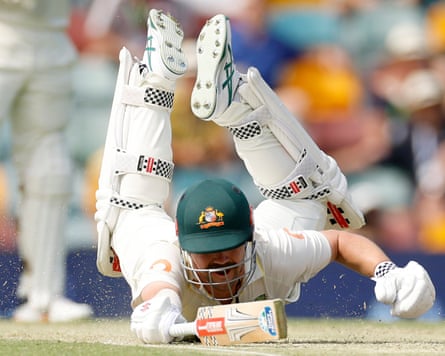
Marnus Labuschagne: 259 runs at 28.8; one wicket at 39.0; 10 catches
He is at risk of becoming a caricature of himself with his continual chatter in the field, the kind of thing you can get away with more easily when averaging 50-something rather than 20-something. His 51 in support of a rampaging Head was quietly effective in sealing the first Test win and he backed it up with a 65 in the second as his team squeezed any hope out of the visitors. His biggest contribution was his catching which, alongside Alex Carey’s, opened up a gulf in this key element of the game. Grade B-
Usman Khawaja: 176 runs at 25.1; three catches
Rumours of his demise as a Test cricketer proved unfounded when he returned from injury to make 82 and 40 in the series-winning victory at Adelaide. He didn’t do much more – but he didn’t need to. Grade B-
Cameron Green: 171 runs at 24.4; four wickets at 70.8; four catches
Aged 26 and with 37 Tests under his belt, he still has the air of a gawky teenager drafted in to have a go because he can bowl fast and smack boundaries. Add to that the Australian unease at picking all-rounders – as evidenced by his inability to nail down a permanent slot in the order – and one feels his race, in this format at least, may be nearly run. Grade D
Alex Carey: 323 runs at 46.1; 27 catches, one stumping
Rishabh Pant, six years his junior, had already been playing Test cricket for three years by the time Carey made his debut but, 48 matches on, it’s a coin toss as to who keeps for the World XI v Mars. He was damn near perfect either side of the stumps (especially when it mattered most), his keeping standing up to the fast-medium men instrumental in knocking batters out of their stride whenever they threatened to find a rhythm. His series answered the wild criticism he attracted for the Jonny Bairstow run-out at Lord’s last time out in the most satisfying way possible. Grade A
Josh Inglis: 65 runs at 21.7; one catch
The Yorkshire-born keeper-cum-batter missed out on being the best English batter in the series by failing to convert three starts to a score above 32. He also missed his chance to stake a claim for a slot in Australia’s wobbling middle order. He effected a superb run-out of England’s captain at Brisbane, another indicator of the crucial gap in fielding standards between the two teams. Grade C
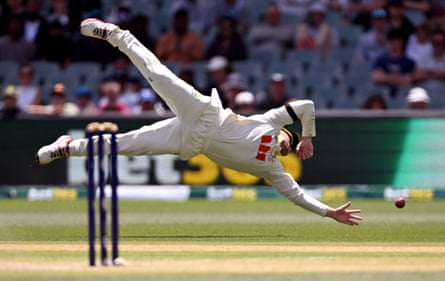
Beau Webster: 71 runs at no average; three wickets at 28.0
He made both Test cricket and bowling in an alternative style (spin in his case) look very easy in only his eighth Test, in Sydney. I’m not sure whether that speaks to a system that provides a short bridge from domestic to international level or Webster’s skills and temperament, but he delivered exactly what his captain wanted. Grade A-
Michael Neser: 75 runs at 18.8; 15 wickets at 19.9; four catches
The definitive county all-rounder who would once have played 10 seasons in the Lancashire Leagues bowling 24 overs every Saturday and batting at No 3 as the club pro. Late in his career, he answered the call and bowled line and length with just enough movement and zip to keep the batters honest. With a predatory Alex Carey hovering over the stumps, he built pressure and took wickets, proving much too clever for too many batters. Grade A-
Pat Cummins: 19 runs at 9.5; six wickets at 19.5; one catch
Australia barely missed him when he was away but he still made a difference when he came back for the series clincher. If everything is in working order physically, his action is so grooved he seems to run in on rails. Some of the zip has gone, but all of the nous has been retained. Five of his six victims were top-four batters. Grade A-
Mitchell Starc: 156 runs at 26.0; 31 wickets at 19.9; one catch
Starc lost one of his fellow musketeers before the series had even started, then another (his captain) for four Tests and the third gun for three Tests. No matter, he kept getting an opener out in the first over of the innings and then plenty more batters thereafter. Even made important runs to boot. He bowled fast but did not need to do too much for his wickets (though possessing the humility to acknowledge that, and simply bowling it across right-handers for nicks and moving it off the seam to lefties is wonderfully disciplined). At nearly 36 years old, it was as remarkable a physical achievement as it was a feat of skill and temperament. He was the player of the match in the first two Tests, when it absolutely mattered most. Grade A+
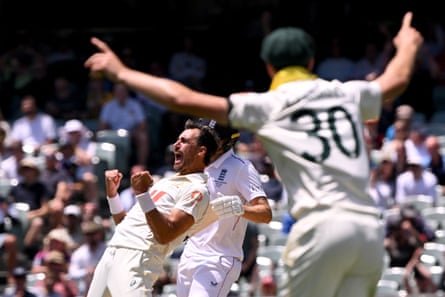
Jhye Richardson: seven runs at 7.0; two wickets at 15.0
Richardson was one of a phalanx of fast-medium bowlers either side of 30 who knew exactly where to pitch the ball on the helpful strips and to the helpful batters. He did not get as many as 10 overs at the MCG but that was the fault of the opponents rather than due to his lack of skill. Grade B+
Nathan Lyon: 13 runs at 4.3; five wickets at 31.4
Spin, like fifth days, good commentating and adequate technology, was largely absent from this series, leaving spectators with an unsatisfactory experience. The old warhorse did go second on the Australia all-time Test wickets chart and did not let his captains down when tossed the ball, even if he only played a walk-on part. England’s 349 was 82 runs short at Adelaide and Lyon’s victims in that chase? Crawley, Brook and Stokes, who might just have got ’em were they still at the crease. Grade B+
Brendan Doggett: 20 runs at 20.0; seven wickets at 30.7; one catch
Stokes asked England to show some “dog” at Adelaide. Australia had already shown some Doggett at Perth and Brisbane where, inevitably, the experienced seamer let nobody down. If he never plays for Australia again – they are his sole appearances to date – he’ll always be an Ashes winner. Many much more exalted Englishmen are not. Grade B
Scott Boland: 42 runs at 8.4; 20 wickets at 25.0; two catches
Boland is proof that there is more to a grade than the numbers. After a poorish first session in Perth, when he appeared to be acting under instruction to go a bit short, the big-hearted veteran reverted to a top-of-off-stump line for the rest of the series and tortured England’s batters with his relentless discipline and positive attitude. He proved a perfect foil for the peerless Starc at the other end, two nice-guy fast bowlers dissecting Englishmen like cruel schoolboys once did insects. For a 36-year-old to deliver 160 overs across all five Tests (the most on either side), with 27 maidens against a team guaranteed to get reckless after a handful of dots, was magnificent. Grade A
This article is from The 99.94 Cricket Blog