.png)
 1 month ago
19
1 month ago
19
Early on the morning of 8 October, the Provincial Command of the Carabinieri in Belluno put out a press release announcing three arrests, in the culmination of a year-long investigation they called “Operation Reset”. Two of the three were brothers, were both known members of the notorious SS Lazio Ultras, the Irriducibili, it was stated in the release, and had boasted of having personal ties to former boss Fabrizio Piscitelli, who was murdered in 2019. The crimes the brothers had been arrested on suspicion of had not been committed in Rome, but 400 miles north, in the small alpine ski resort of Cortina d’Ampezzo, high in the Dolomites, and home, for the next three weeks, to the Winter Olympics.
The brothers are still awaiting trial, but the local public prosecutor’s office has alleged that they were running an operation in three phases. The first was taking control of the drug distribution network in Cortina, the second was to take control of three local nightclubs, and the third was to extort the local council into awarding the construction contracts for the works being done for the Games. Among the evidence the prosecutor says it possesses is a note on one of the brothers’ phones saying: “We want the cemetery area for the garages, the former pastry shop, the slip road and the new ring road, the construction of the tourist village.”
According to the Italian government’s Antimafia Investigative Directorate (DIA), 38% of all the anti-mafia measures taken in Italy in 2024 were related to the construction sector, when about 200 public works sites were investigated for suspected infiltration by organised crime. The last mega-event held in Milan, the World Exposition in 2015, was blighted by corruption around construction contracts. The Expo cost €2.6bn. The bill for the Winter Olympics is currently running at well over double that amount.
The DIA also reported to parliament that “the Winter Olympics represent a significant event … for criminal syndicates interested in gaining a foothold in the tender awarding procedures”. In 2024 “50 anti-mafia interdiction measures were adopted” in Lombardy alone. One was issued against a construction company working on the construction of an underground car park included in the “Plan of Works for the Milan-Cortina 2026 Olympics”, after the “company’s directors were found to have personal and professional relationships with members of several “Ndrangheta gangs.”
The two brothers were not members of the mafia, according to the prosecutor, but have been charged with using the “mafia method”: extortion, coercion and intimidation. The claims allege the men threatened and beat rival drug dealers, dragged a nightclub owner into the woods at gunpoint, and attempted to corrupt a councillor by offering to secure him votes in exchange for construction contracts, and then threatening him when he refused to cooperate with them. “This is Cortina, we’re in charge here,” the men are claimed to have said during their arrest, “I’m not a small-town criminal, I’m the boss and we’ll solve this thing with guns.”
If Italy has problems, it also has solutions. “It’s sort of circular,” says Leonardo Ferrante, who is on the national board of the anti-mafia organisation Libera. “Italy is known as the country of the mafia, but it should also be known as the country of the anti-mafia movement.” Libera was founded in 1994 by the streetwise priest Luigi Ciotti, with the initial aim of collecting a million signatures to petition for a new law permitting the reuse of goods confiscated from criminal organisations. They have joined together in a radical programme called Open Olympics 26, in an effort to make the public procurement procedures around the Games more transparent.
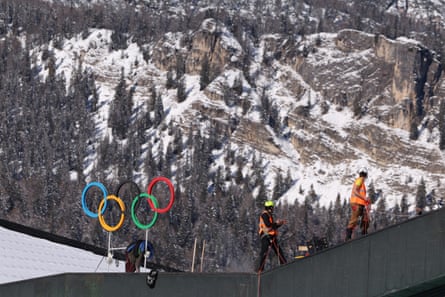
Open Olympics 26’s signature achievement has been to get the Games organisers to commit to publishing all their financial dealings on a single, public portal, which is updated every 45 days. Because of that, we know that only €1.6bn is being spent on the realisation of the Games, the remaining €4.12bn is on related works, including an astonishing €2.816bn on road projects, and that more than half of the projects won’t be completed until after the Games are over, with the latest scheduled for completion in 2033.
“The initiative originated in the autumn of 2023, emerging from a significant rift between Italian civil society and the institutional bodies. And well, after years of this attempted dialogue, we started to organise a community and a network of associations asking for transparency and accountability,” explains Ferrante. “Everything currently known about the Olympics in terms of data is the direct result of the action of the Italian civic groups.” It is thanks to their work, for instance, that we know 60% of the 98 Olympic projects listed on the portal have been done without any environmental impact assessment.
“In Italy, we have strong laws on transparency but we have a lot of exceptions, and one of these exceptions is the Olympics and Paralympics.” Ferrante’s colleague Elisa Orlando adds: “It is a very Italian problem. We have seen it in other mega events, like the Universal Exposition in Milan 10 years ago. We get into a position where it becomes an emergency. We have to deliver before the opening date of the event, and this provides for exemptions, not only to transparency, but sometimes also to procedures in the public procurement processes.”
The more transparent the dealings are, the less inviting they become for organised crime. It has been only partly successful. Libera has pushed for more disclosure around subcontracting, and an entire tranche of the Olympic project exists off the portal, in the hands of private companies. “The Fondazione Milano Cortina is the black hole of transparency.”
Three of the last six Olympic Games, in Sochi, Rio and Tokyo, involved enormous corruption scandals. At a time when fewer and fewer cities are willing to follow through on mooted bid proposals because of public scepticism about costs (Krakow, Oslo, Stockholm, Innsbruck, Sion and Calgary all withdrew from the competitions to hold the 2022 and 2026 versions) the Open Olympics project represents a radical step towards addressing some of these longstanding problems. The team is already working with organisations in France to replicate this work before the 2030 Winter Olympics, which are being held on the other side of the Alps.
“The risk of criminal infiltration exists everywhere, not only in Italy. But here in Italy, we have lenses that allow us to recognise criminal infiltration when it occurs,” says Ferrante. “Our third aim is to build an international civic legacy. We want to create an international movement for the transparency of the Olympics.”