.png)
 1 month ago
73
1 month ago
73
3 hours ago
Ian Hamilton,BBC Scotlandand Daniel Bennett,BBC Scotland

 PA Media
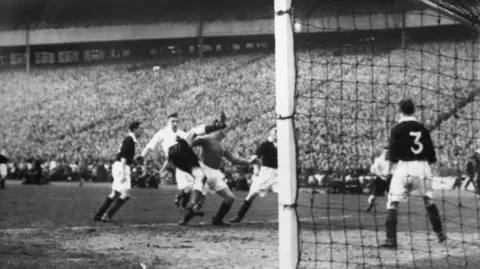
The April 1950 British Home Championship saw Scotland finish second to England, and qualify for the World Cup
It's the dream scenario - lining up in front of more than 133,000 of your own fans.
Qualifying for the World Cup, ready to face some of the greatest teams on the planet.
That was what happened in April 1950, as Scotland finished second in the British Home Championship.
That would have been enough to secure their place in the 1950 World Cup, held in Brazil. But things didn't go to quite to plan for the squad.
Bosses in charge of the Scottish FA at the time did what would be unthinkable to the modern football fan - They gave up their place at the first World Cup after World War Two.
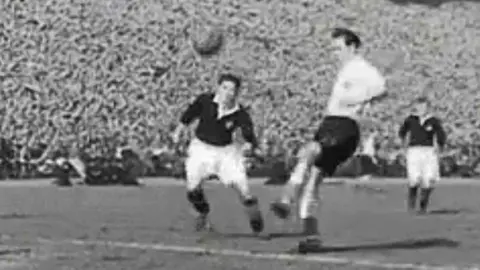
The 1950 World Cup was the first after WW2
The 1950 tournament was set to be the fourth iteration of the competition – and a return to South America since the first tournament in 1930.
The UK nations had never previously sent teams to the World Cup, for a variety of complex reasons.
There was a perceived superiority of the British Home Championship, fallouts over player payments, and a reluctance to play other European teams following the First World War.
But there was supposed to be "a lot of reconciliation" in this tournament, "albeit Germany weren't invited," says Andy Kerr, visitor attraction manager at the Scottish Football Museum.
That sense of peace and harmony didn't extend to the internal politicking at the Scottish FA.
The overriding feeling among bosses was that the Home Championship would be pivotal for Scotland competing at the World Cup.
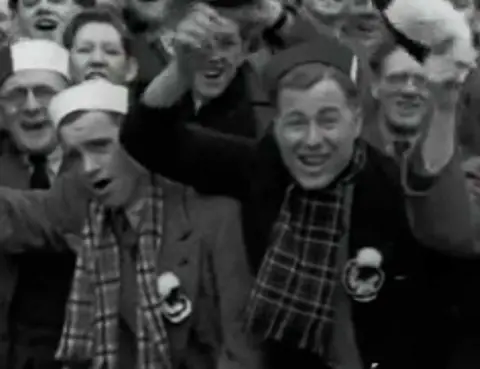
More than 133,000 fans watched Scotland finish second in the British Home Championship in 1950
FIFA offered the UK nations two places, for the top two teams, which ended up being England and then Scotland.
But there was reluctance to send Scotland to the tournament after finishing behind England in qualifying – a decision resulting from England's 1-0 win at Hampden in the Championship. It was a feeling that seemed to confuse and outrage Scotland's players.
"The reasons are still slightly ambiguous to this day," says Andy.
"I believe the official reasoning was that we only wanted to send our best and we didn't believe that a second-best team in a tournament was worthy of sending to a World Cup," he says.
Although the practicalities and cost of sending a team to South America in 1950 was daunting.
"They might not have really viewed the cost as a benefit."

Andy Kerr, visitor attraction manager at the Scottish Football Museum.
It's believed Scotland's players tried to petition their bosses to let them go to Brazil. George Young, the Rangers right-back and Scotland captain at the time, is believed to have personally approached George Graham, chief executive of the SFA.
The stance of the directors meant that Young, the first Scotland player to reach 50 appearances, never played at a World Cup.
The Scottish team featured players that played in Scotland as well as in England, for teams like Arsenal, Derby County, and Liverpool.
The relationship between players of both nations were close. So close in fact, that help to travel to Brazil came from an unlikely source.
The Scottish FA had remained steadfast in refusing their place in Brazil, at which stage the English FA entered with an opportunity.
"They offered to split the cost with us for travelling, since a lot of the players would have got on with each other," says Andy.
"But they still said no, and at that point other countries were offered Scotland's place."
Finances and football are now so intertwined that it seems hard to separate the two. In some ways, it was the same in the early years of the World Cup.

Scotland made it to the World Cup in Switzerland in 1954 but ended up in the wrong kits for the weather
Prior to a change in FIFA presidency in 1974, the organisation was still "amateur" with the focus on "sporting merit and the pride of winning the World Cup", says Andy.
Four years after 1950, though, things had begun to change. Perhaps attitudes were softening among decision-makers.
Scotland again finished second in the British Home Championship, but decided that they would send the national team to the 1954 World Cup in Switzerland.
That wasn't without its controversies, as a lack of planning meant Scotland were wearing winter kits during the summer, in the heat of Zurich and Basel.
"We had decided that a country like Switzerland with all the mountains and ski holidays that it's famous for should be cold, therefore we're going to take the winter kit, which was a bit like a school jumper," says Andy.
But the decisions in that decade laid the foundations for more successes in the future.
Hibs got to the European Cup semi-finals in 1956, Rangers were finalists in the 1961 European Cup Winners' Cup, Dundee got to the 1963 European Cup semis, and Celtic were the first British side to win the European Cup in 1967.
The 1950s "made people look outwards more and try to broaden their horizons," says Andy.
"It changed the way we view the game. It brought the game to a wider audience through innovations like floodlights, European football, and a general clamour to see more than what your own country has to offer."