.png)
 1 month ago
91
1 month ago
91

 NurPhoto via Getty Images
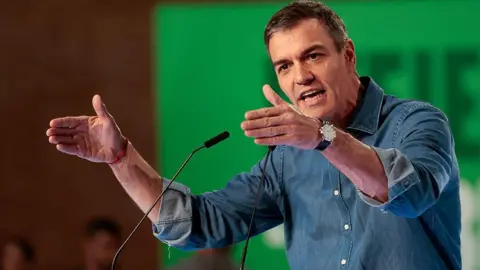
Pedro Sánchez has not been directly implicated in any of the investigations, but allies and relatives have
1 June marks exactly eight years since Pedro Sánchez became prime minister of Spain, but with his government and Socialist Party besieged by corruption investigations he is more likely to be plotting his political survival than celebrating.
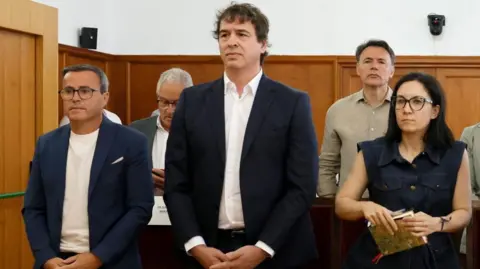
His musician brother, David, has just gone on trial accused of influence peddling.
Former Socialist prime minister and close Sánchez ally José Luis Rodriguez Zapatero has been named in an investigation into alleged money laundering.
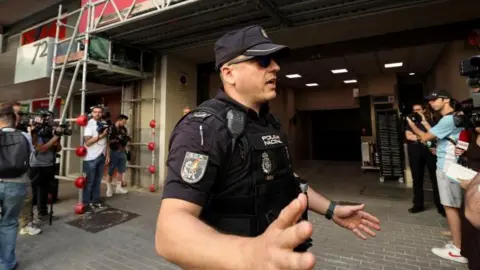
And police have raided the Socialist headquarters in Madrid as part of a probe into allegations of a dirty tricks campaign that the opposition has dubbed "the Socialists' Watergate".
These probes and others have generated a growing clamour by the opposition for Sánchez's resignation and speculation that his government might soon collapse.
 AFP via Getty Images
Spain's centre-right opposition has called on the prime minister to step down and call elections
"The accumulation of cases makes clear that these are not isolated episodes or the fruit of dark conspiracies," warned centre-left newspaper El País, traditionally sympathetic to the Socialist Party. "The investigations are linked to the nucleus of power which has governed for the past eight years."
The Socialist Party has been under scrutiny since 2023, when José Luis Ábalos, a former transport minister and deputy party leader, was implicated in an investigation into a network that allegedly received kickbacks from the sale of €50m (£43m) worth of facemasks during the Covid-19 pandemic.
Ábalos, who denies involvement but was expelled from the party, recently went on trial and is awaiting the verdict.
Last year, he was also implicated in a broader kickbacks-for-contracts case, along with Socialist Party number three Santos Cerdán.
That case came as a huge blow to Sánchez, who had vigorously defended Cerdán from allegations in the media until evidence from the probe was made public. "The Socialist Party and I should not have trusted him," the prime minister said.
Both Cerdán and Ábalos deny wrongdoing.
 Reuters
The headquarters of Sánchez's party was raided earlier this week
The case against Zapatero, in which he is accused of using his influence to secure a €53m government bailout of Plus Ultra airline in 2021 and receiving a commission in return, is also extremely damaging for the Socialist Party.
That is in great part because Zapatero is a close Sánchez ally who has commanded enormous respect on the left for reforms he introduced during his 2004-2011 administration, including in areas such as same-sex marriage, historical memory and gender violence.
The separatist group Eta ended its four-decades-long campaign of violence during his tenure.
"Symbolically speaking, this is very significant," said Paco Camas, head of public opinion in Spain for polling firm Ipsos. "The fact that this is the first former prime minister [to be investigated] makes it extremely serious. But also because he has been a moral reference for the party."
Zapatero, who is due to be questioned in court on 17 June, has insisted he has done nothing illegal and for now, at least, he has Sánchez's "full support".
The investigation that led to a 12-hour police raid on Socialist Party HQ in Madrid this week adds an extra dimension to Sánchez's woes.
The allegation is that the party paid member Leire Díez to carry out a campaign to discredit police, judges and prosecutors who were investigating existing cases, such as that affecting Cerdán, who has been named as a suspect in this probe. Díez has denied that she performed this role.
While Sánchez himself has not been directly implicated in any of the investigations, family members have.
The allegations against his brother, David, who went on trial on Thursday, are that he was appointed to a musical post in Badajoz in south-west Spain without undergoing a selection process, and that once in the role he did not carry out his duties.
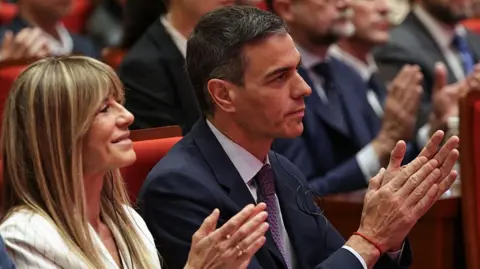
Also, a judge has been investigating the business affairs of the prime minister's wife, Begoña Gómez, since 2024, and has proposed she go on trial for misuse of funds and influence peddling.
She has been summoned for a preliminary hearing on 9 June.
 EPA
EPA
David Sánchez went on trial this week in Badajoz
Pedro Sánchez has criticised the cases against his brother and wife, pointing to the fact that they originated in accusations made by far-right organisations.
So far, at least, Sánchez has not cast in doubt the cases against Zapatero or Leire Díez.
However, his combative transport minister, Óscar Puente, appeared to make a broader point about the investigations cornering the Socialists when he said "there is a government that some want to bring down, not through the ballot box, but with other dark arts, with undemocratic methods".
The leader of the conservative People's Party (PP), Alberto Núñez Feijóo, described the litany of scandals as "a criminal carousel". He called for Sánchez to resign and bring forward next year's general election.
But Sánchez, who has become renowned or infamous for his resilience, has insisted he will see out the parliament's full legislative term.
 POOL/AFP via Getty Images
Begoña Gómez has been summoned for a preliminary hearing on 9 June
His minority coalition government has struggled to manage its parliamentary partners – an array of regional nationalist and left-wing parties – preventing it from approving a single new budget this legislature.
The question now is whether the remaining allies will continue to support him.
One of them, the Basque Nationalist Party (PNV), hinted that its patience is wearing thin, suggesting that waiting until 2027 for the next election would be an "irresponsibility".
However, loss of parliamentary support does not necessarily mark the end of the road for Sánchez.
There does not seem to be enough support for the opposition to win a no-confidence vote – which was how Sánchez himself came into power in 2018.
That is partly because parties that want more autonomy for their regions, such as the PNV, fear the centralising intentions of a PP government, possibly in coalition with the far-right Vox.
"I don't see an incentive for the government to call elections, however blocked the situation may be and however much it is affected by scandal," said Paco Camas. "It can dig in."
He believes that, like last year in the wake of the Ábalos-Cerdán kickback scandal, the summer break could provide the government with a badly needed respite, allowing it to recover some political initiative in September.
Another question is whether ill-feeling within Socialist ranks at so much scandal could spread.
The president of the Castilla-La Mancha region, Emiliano García-Page, and former Prime Minister Felipe González, both regular Sánchez critics, have called for early elections.
"There would have to be an internal rebellion of mayors and regional leaders who are concerned that the contagion effect of the reputation of this government could have an impact on the May [2027 local] elections," said Lluís Orriols, a political scientist at Carlos III University.
"But right now we're not seeing that kind of revolt," he said.
Sánchez's future is likely to depend to a great extent on how the investigations develop.
Further explosive cases, or evidence of illegal financing in the Socialist Party, could trigger an exodus of parliamentary partners and make the pressure unbearable, even for the great survivor Sánchez.
"This is a government which has been in a very delicate situation for some time now," said Orriols. "Don't rule out the possibility of it running out of air soon."