.png)
 1 month ago
85
1 month ago
85
3 hours ago
Kate McGoughEducation reporter

 Getty Images
Sixteen-year-old Chloe is certain that if she hadn't received early support, she would likely be one of the million young people in the UK who are not in education, employment or training today, also known by the acronym Neet.
Chloe suffers from severe anxiety and left school when she was 14 to be educated at home in Sefton, Merseyside.
But Chloe found that she was growing increasingly anxious about leaving the house and was unsure about her next steps.
"I was only doing my maths and English at home; I wasn't going out of the house or anything, I was just doing that."
She was then identified by her local council as needing early support to avoid becoming Neet.
Before 2019, Sefton Council had only offered careers support to the over-16s, but seven years ago they decided to try something different and target under-16s who were most at risk of becoming Neet, with one-to-one support delivered through a charity called Career Connect.
The aim was to build a trusted relationship between the young person and a careers adviser, who helps them stay engaged with learning and plan for their next steps.
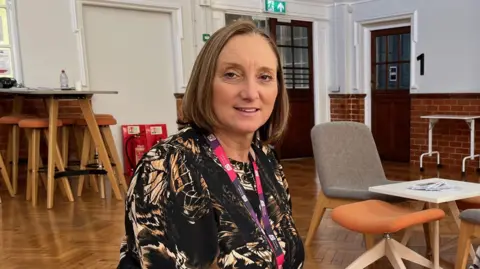
Chloe's careers adviser, Kate Timmins, met her at home, took her on open days at a local college and helped her secure a place on a vocational childcare course. She also gradually built up her confidence to be able to travel there independently.
Now Chloe is enjoying college life and is on her way to her dream career working in a nursery.
"I wouldn't have been able to go to college now if I didn't have Kate's help," she says. "It was great because she knew everything and I didn't have to keep repeating myself and keep explaining how it was making me feel."
 Career Connect
Kate Timmins, a careers adviser for charity Career Connect, has been offering guidance to under-16s in Sefton
This personalised early intervention approach means Sefton is bucking the national trend in their Neets figures, particularly for younger ages. In the most recent stats for March this year, just 3.8% of 16- to 17-year-olds in Sefton were Neet, a figure that has halved since they started the scheme in 2019.
A major review published this week by former Labour minister Alan Milburn has warned that Britain faces a "lost generation" without urgent action to help more than one million young people in the UK between the ages of 16 and 24 who are not earning or learning.
Milburn warned that young people were being failed by the whole system and too often put on "a path to a life not in work, but on benefits".
But for many, the journey towards becoming Neet starts well before their 16th birthday.
 Ahead Partnership
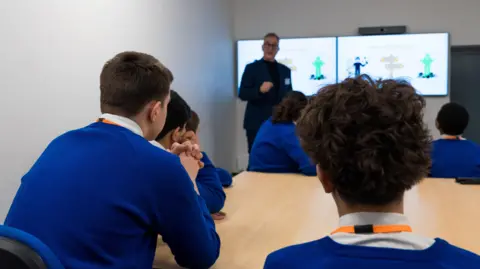
Year 8 students in Leeds visited a FirstBus depot to learn about local jobs in their area as part of a pilot scheme run by Ahead Partnership
In Leeds, one multi-academy trust is adopting a similar preventative approach to Neets as Sefton Council, but this time targeting students from the age of 12.
Three schools from the Cockburn Multi-Academy Trust have been working with the charity Ahead Partnership since the end of February on a pilot scheme involving around 60 Year 8 students who have either got poor school attendance, special educational needs, or other risk factors like growing up in poverty.
Every half-term for the next four years, this group of students will go on visits to local businesses to learn about employment opportunities in their area, attend workshops aimed at improving employability skills like communication and teamwork, and get one-to-one support with the aim of motivating them to improve their attendance and stay engaged with school.
Terri Nelson, assistant head at Cockburn School, says that in the three months since the pilot started, over half of the students taking part (58%) have already improved their school attendance.
"It's about them being able to see the end game and being able to work back from there. Part of our development plan as a school is raising aspirations for students," Nelson says.
"If they haven't seen a family member or a friend go down a professional route or go on to study at college then they won't follow suit."
So far the students have visited a bus depot and a youth charity, with plans to visit a construction site next. Nelson says the key has been involving pupils in what they want to learn about, with students asking for workshops on wellbeing and handling stress.
"I've had pupils involved asking me on the school bus 'When's the next one?' and 'Can we talk about this still?'" Nelson says.
 Ahead Partnership
One multi-academy trust in Leeds is offering students as young as 12 workshops from local businesses in an effort to prevent them becoming Neet
Preventing young people from having to wait until they turn 16 for support is one of the main reasons Sefton Council decided to start intervening earlier, says Claire Maguire, who's the service manager for Employment and Learning at Sefton Council.
She says there is too much opportunity for "drift and delay" in the old system, which meant that "in lots of cases before we were able to provide any support, months could have drifted past".
Today, nearly a third (31%) of Sefton Council's career support interventions are with those under the age of 16.
The council uses data from schools and other services to identify children who are at risk of becoming Neet. They could be struggling with their attendance at school, have special educational needs or disabilities (Send), have experience with the care system, be involved with the youth justice system or be home-educated.
Sarah Vaughan from Career Connect, who runs the scheme for Sefton Council, says they have worked with around 5,000 under-16s since 2019, often knocking on doors and making multiple home visits to track down young people and engage them in the support on offer.
"We're finding more and more social isolation. Sometimes on home visits the young person is talking to us from the top of the stairs," she says.
"Our staff are really good at giving young people hope. There's a lot of fear among young people that they've failed at the age of 14, 15, 16 and that's the rest of their life."
The UK's Neet rate is one of the worst in Europe and recent Resolution Foundation research suggests that the education system might be one of the key reasons why.
Nye Cominetti is principal economist at the Resolution Foundation and says the recent rise has been driven by a weaker labour market and a rise in poor mental health, but the UK's Neets crisis has been "decades in the making".
"The UK's poor performance relative to other countries is mainly down to a lack of education, rather than employment, and particularly poor non-university routes into work," he says.
Education Secretary Bridget Phillipson told the BBC that schools did have an important role to play in solving the Neets crisis, but that we "can't expect schools to do this alone".
She said the Milburn Review was right to point out that what happens in the early years and outside of school were some of the biggest drivers of why we're seeing so many young people ending up Neet.
Phillipson said there was "far too much snobbery around technical and vocational routes" and the government was expanding the options for young people with T-levels and new V-levels, and is changing the apprenticeship system to work better for younger people.
For Chloe's mum, Danielle, the impact of getting early help on her daughter's life is clear.
"There's been a big difference. She's gone from being stuck in her bedroom all day to now getting up and going to college every day. She's got more confidence now."