.png)
 1 month ago
22
1 month ago
22
Bea Swallow,West of Englandand Fiona Lamdin,West of England home and social affairs correspondent

 Handout
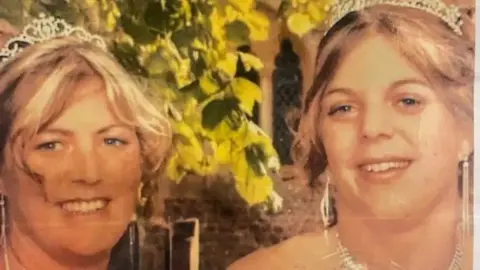
Emma King's sister, Julie Butcher (left), was murdered by her ex-husband in 2005
There may be a limited exclusion zone around your home and place of work, but step outside of that and you risk coming face to face with the person who tore your family apart.
That is the current reality for many families whose loved ones have been murdered.
But in August, the government announced plans for new "restriction zones" which instead confine serious sexual and violent offenders to specific areas via mandatory GPS tagging.
Emma King, whose sister Julie Butcher was murdered in 2005 by her ex-husband Richard Butcher, was part of the campaign that triggered the legislation change.
Butcher was jailed for 13 years but after his release in 2020, he was allowed to move back to Chiseldon, near Swindon in Wiltshire, where Ms King was living.
"I pretty much had a circle around my house for safety," Ms King said.
"We were scared and fearful for the children. All I kept on thinking is 'I can't live like this'. It was horrific.
"I just knew I either wasn't going to survive this process or I was just going to stay in my house forever."
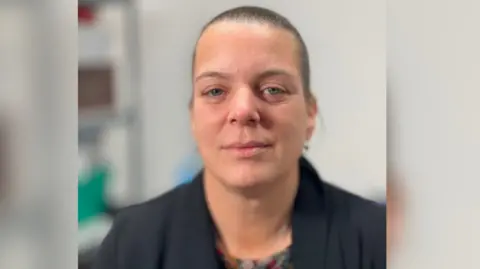
Ms King said victims should not have to rebuild their lives after losing a loved one
Ms King was told by parole officers that Butcher had a "human right" to return home, but she felt the needs of her sister's killer were being prioritised over hers.
"Initially we had a very small area, we're talking feet around your house and your workplaces and schools," she explained.
"We were already saving [money] for that worst case scenario, that we would have to leave.
"But we shouldn't be the ones having to live elsewhere and trying to rebuild back our lives, yet again."
Butcher was eventually given a 2.5 mile (4km) exclusion zone, but Ms King says that was still not enough reassurance to allow her to "live freely".
"Seeing the email drop to say that this is going be looked at in Parliament really hit home, and it felt like my fight was over," she added.
Grieving sister says it "felt like my fight was over" after receiving the news
The new restriction zones are part of the Sentencing Bill 2025, which is currently under consideration in Parliament.
Presently, serious sexual and violent offenders can be ordered upon release not to enter the area where their victim lives.
But under the new plans, the onus would shift to confining the offender to specific areas tailored to them.
These zones are created with input from probation officers and victims, aiming to protect survivors by shifting the burden of restriction from victims to offenders.
Upon release from prison, perpetrators will be electronically tagged for real-time monitoring, with any breaches leading to potential recall.
A Ministry of Justice (MoJ) spokesperson said: "We must protect victims, which is why new restriction zones will curb the freedoms of the most serious violent and sexual offenders and give victims the peace of mind they deserve."
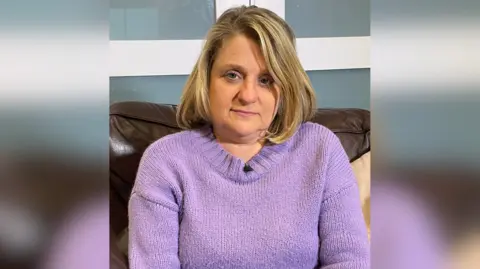
Carole Gould described the thought of bumping into her daughter's killer as "traumatising"
Co-campaigner Carole Gould, whose 17-year-old daughter was murdered her ex-boyfriend, says it is a "big relief" that she will not have to fear crossing paths with her killer.
"It's like a cloud lifted off our shoulders," she said.
"It means we can stay in the area if we chose to and we aren't being forced to leave."
Thomas Griffiths admitted stabbing Ellie Gould to death at her home in Calne, Wiltshire, in May 2019 after their three-month relationship ended.
Griffiths had walked out of school, driven to Ellie's home, and attempted to strangle her before stabbing her 13 times in the neck and face with a knife taken from the kitchen.
He pleaded guilty to her murder and was handed a life sentence with a minimum of 12-and-a-half years. He will be eligible for parole in May 2032.
 Family Handout
Ellie Gould, 17, was stabbed to death at her home in Calne, Wiltshire, in 2019
Ms Gould said his time served has gone by "too fast" - meanwhile she has spent the last six years fighting to improve protection for victims and their families.
She said Griffiths's parents "still only live up the road", just a few miles away.
"The thought of him getting out is huge anyway, but the thought of him then also being allowed to come back into Wiltshire, it's like a double blow," she said.
"It would be like he's won again. It would mean that we would have to move away, because the thought of bumping into him would just be too traumatising.
"Whereas if he can't come anywhere near us, it feels like a small victory."