.png)
 1 month ago
35
1 month ago
35
Orla GuerinSenior international correspondent, northern Iraq

 Getty Images
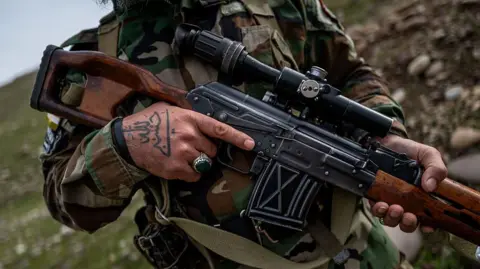
For a sixth day, the US and Israel are battering targets in Iran, waging war from the air. Could there soon be boots on the ground? Maybe. But not American ones.
Iranian Kurdish opposition groups in exile in northern Iraq have told the BBC they have plans to cross the border - and have had them for decades - but they flatly deny claims that their fighters have already done so.
"We have been preparing for this for the past 47 years, since the age of the Islamic Republic," said Hana Yazdanpana, of the Kurdistan Freedom Party (PAK), which claims to have the biggest armed force.
But she insisted that "not a single Peshmerga has moved". The Kurdish word peshmerga means "those who face death".
Yazdanpana told us that six opposition groups - which recently formed a coalition – were co-ordinating with each other politically and militarily. "No-one moves alone," she told us. "We will know if our brothers are going to move."
She does not expect fighters to advance this week. First, the US needs to pave the way.
"We can't move if the air above us is not cleaned," she said. "And we need the regime's weapons depots to be destroyed. Otherwise, it would be suicidal. The regime is very brutal, and the most advanced weapon we have is a Kalashnikov."
She wants the US to impose a no-fly zone to protect Kurdish fighters. "We have asked for this many times," she said. "I was the one who sent the emails saying 'we need it urgently'."
The White House has denied a report that US President Donald Trump was considering arming the Kurds - many of whom were trained by US forces in the past to fight against the Islamic State (IS) group in Iraq.
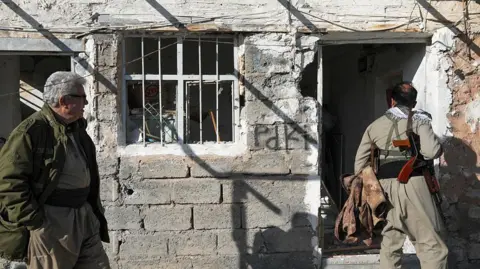
But as the chatter about a possible advance by Iranian Kurdish forces increases, so do Tehran's attacks on them. We saw the aftermath of strikes on two different groups, including a ballistic missile attack which tore through a PAK base, killing one fighter.
Some groups have emptied their bases and moved their forces to try to shield them from attack.
Joining the battle against the regime would be a huge risk, and it's unclear what Trump may be offering in return.
The Kurds, which are the fourth largest ethnic group in the Middle East, are scattered between Iran, Iraq, Syria and Turkey. They have a long history of being persecuted and betrayed. As the Kurdish saying goes, "we have no friends but the mountains".
Can the US be trusted to keep any promises it may make? Many Kurds in Syria - staunch US allies in the battle against IS - were angered recently when Trump sided with the transitional government in Damascus against them.
But some senior Iranian Kurdish leaders take a pragmatic view.
"America and Israel did not begin this war for our hopes, but for their own interests," said Mustafa Mauludi, vice-president of the Kurdistan Democratic Party of Iran (KDPI). "But they are targeting bases of the Islamic Revolution Guard Corps [IRGC], and this will be good for us and help us to go in."
At 67, he has been waiting most of his lifetime for the fall of the Islamic regime.
Wearing traditional Kurdish dress, he recounted a painful family history - one cousin killed by the regime aged 13 and another who remains in prison after 31 years on suspicion of collaborating with the opposition. He said 60% of his family had been arrested and badly treated because of his political activities.
Mauludi already has a mental picture of his first moments back on home soil.
"When I get to the first village," he told us, "I will say with a loud voice: 'I have been fighting for you, you are my people, and now I will fight even more.'" He believes he will be there in time to celebrate the Kurdish new year festival, Nowruz, which falls on 21 March.
The Kurds account for about 10% of Iran's population of 90 million. Their leaders here are calling on the international community to back Trump, and to back them.
"We are the most politically organised group in Iran," said Abdullah Mohtadi, secretary general of the Komala Party of Iranian Kurdistan. "And we won't let this opportunity [for change] be wasted."
He is disappointed with the UK's stance.
"I'm astonished that Britain is the only country in the continent [of Europe] that has not registered the IRGC as a terrorist organisation," Mohtadi said. He also criticised Britain's "hesitation" over allowing the US to use its bases to strike Iran.
 Getty Images
A KDPI camp was attacked this week in the Irbil area of Iraq's Kurdistan Region
It is hard to gauge how many troops the Kurds could muster. "It may be several thousand, including some already inside," according to one local journalist, who is Kurdish himself.
"They want to be part of the change in Iran, to ensure they are part of the future. Despite the lessons of history, they continue to hope."
Some Iranian Kurds say it is time to act - without or without American promises.
"If we have the slightest hope of seeing our homeland, that is ok for us," said one woman in the city of Sulaymaniyah, close to the Iranian border.
"We call it [Iran] the Islamic regime of the executioner. We hate them so much. They have killed so many people."
All of this leaves Iraq in a difficult position, fearful of getting dragged into the war next door. The government in Baghdad has said it will not allow groups "to infiltrate or cross the Iranian border to carry out terrorist acts from Iraqi territory".
If Kurdish forces cross the border, it will be a bittersweet moment for the PAK's Hana Yazdanpana.
"Going back to my land will be very emotional," she said. "My uncles and grandparents died here [in northern Iraq]. I don't know how to feel, happy or sad, because those who really deserve to see this day are gone."