.png)
 5 hours ago
3
5 hours ago
3
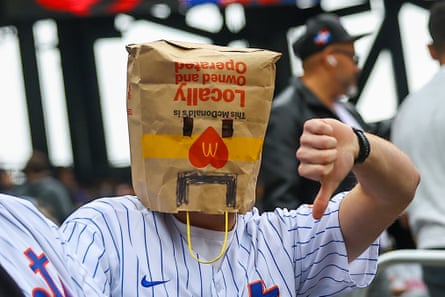
A franchise once known as baseball’s lovable losers are, for the moment, merely baseball’s most expensive losers.
The New York Mets wrapped a shocking April by losing 5-4 to the Washington Nationals on Thursday, dropping to a major league-worst 10-21 and burrowing even deeper into last place in the National League East – making them somehow even worse than their old rivals the Philadelphia Phillies, another wealthy-yet-terrible team. The Mets will (probably) not play at their current 52-win pace all year but their sordid first month has done immense damage to their postseason hopes. Their chances at October baseball were 87% on Opening Day, according to the analytics site FanGraphs. They are now less than three-in-10 to make the playoffs, and that projection seems pretty generous for a team who have lost 17 of their last 20 games.
“Not good enough,” Mets manager Carlos Mendoza said after Thursday’s loss. “Obviously not a secret. That’s not going to do it. We got to start winning series. Period.”
Zoom out, and the picture gets worse. Last season on 2 August, the Mets led the East by half a game and had a 62-47 record. They finished on a 21-32 run to miss the postseason and are now an extraordinary 31-53 over their last 84 games. That’s more than half a season’s worth of games at a 102-loss clip. This would be bad if the Mets were a spendthrift team composed of journeymen and rookies, but under multibillionaire owner Steve Cohen – who fans hoped would turn the team into serial winners when he bought the club in 2020 – they have the second-highest payroll in baseball, at around $380m.
These Mets raise interesting questions about baseball economics. For everyone who claims the also-wealthy Los Angeles Dodgers are “ruining baseball” with their high payrolls and back-to-back World Series, the Mets are proof that hefty roster expenditure will not do the job on its own. Why not? And what will become of the Mets over the next few years if the club doesn’t quickly right the ship?
As when any team starts this miserably, there is no single cause for the Mets’ horrendous April. Quiet bats are at the front of the line, though. Aside from a few moments of inept defense, the Mets are boring as well as bad. They have the league’s worst offense by weighted on-base average and a host of other team statistics. The great Juan Soto – seen as symbolic of the kind of superstar the Mets could attract in the Cohen era – has hit well but has only recently returned from injury.
No other Met has hit seriously in any significant sample size. Outfield prospect Carson Benge has been a little better in recent weeks but is yet to figure out big league pitching. Catcher Francisco Alvarez is the least of the team’s problems but has slumped hard after a scorching start. A wide variety of pricey veteran acquisitions have so far failed to launch: Third baseman Bo Bichette, second baseman Marcus Semien, and injured first baseman Jorge Polanco are earning a combined $85m. Not one of them has an on-base percentage north of .275. Franchise shortstop Francisco Lindor had started to heat up after a mediocre start before he went down with injury.
Every one of these hitters should improve, but they also show the limits of a “throw money at it” strategy of roster-building. That approach can work – just look at the baseball god Soto, who is still only 27 and playing on the largest contract ever signed – but most elite talents don’t reach free agency or get traded away until they’re exiting their prime. Semien is 35 and Polanco is about to turn 33 – ages at which players decline rather than get better. Bichette is 28 but with a lot of recent injury history. The Mets will not get the best versions of most of these hitters. The younger bats they expected to be good – in particular Benge, Mark Vientos and Brett Baty, all in their early to mid-20s – have not picked up the slack. Hence, the Mets have scored MLB’s second-fewest runs.
Mets fans have given the franchise a lot of grace over many decades of Metsiness, some even saw their failing as part of their charm. But the team cannot be an affable second fiddle to the cross-city Yankees when they are a financial heavyweight that enters spring training each year gunning for a pennant with a roster that, on paper, could do it.
At some point, though who could guess when, accountability would fall to general manager David Stearns, who put together the plan for this season that is already on the verge of doom. Stearns, the type of Ivy-educated geek-genius who has become prized in baseball front offices, was welcomed by fans when he joined the team from the Milwaukee Brewers, who he had made a serial contender on a small budget. But some have wondered if his approach works at a franchise with larger resources, and more pressure. Many of his signings – many of them former Brewers – have wilted in the crucible of New York. Some of the start is bad luck, but some of it is a calculated plan going poorly in ways that lots of people could have predicted: For example, center fielder Luis Robert, who has hit and fielded his position decently, just hit the injured list for the 10th time in seven big league seasons. That’s less misfortune for the Mets than what you’d expect if you sign an injury-prone player.
Not everything is a disaster. The Mets’ farm system is well-regarded, Soto is still Soto, and rookie pitcher Nolan McLean is a genuine revelation who looks primed to win a Cy Young Award in his career. (He could even be in the mix this season, if the Mets don’t severely tamp down his innings count.) Benge is a smooth outfielder who will eventually be able to hit his way out of a paper bag. Almost nobody who’s struggled in this lineup will stay this bad for another month, let alone another five. But the losses the Mets have already banked have moved them from a 90-win team to one that will scrap to finish .500 and would need a real surge to reach October. It’s all compounded by the fact that being a losing team in the snakepit of New York sports is the opposite of fun. And they no longer have the shield of claiming poverty compared to the Yankees.
No team in baseball is delivering a lesser return on investment. Cohen won’t tolerate that for long. He could fire Mendoza, who has made some poor decisions but isn’t responsible for the players he’s given. He could fire Stearns, but that would mean disrupting the long-term plan the two have in place as they attempt to build a talent pipeline to produce young talent that can complement highly paid superstars, a method the Dodgers have perfected. Cohen needs to think of something different though because he’s learned the hard way that throwing money at a problem doesn’t always work.