.png)
 1 month ago
77
1 month ago
77

 Getty Images
Health authorities across the globe are racing to trace dozens of people who disembarked from a cruise ship before an outbreak of hantavirus was detected, and anyone who has come into close contact with them since.
Five cases have now been confirmed, including three deaths, following an outbreak on the Dutch vessel MV Hondius, the World Health Organization has said.
But given the incubation period of this disease - which can be up to six weeks - it is possible more cases may be reported, the WHO said.
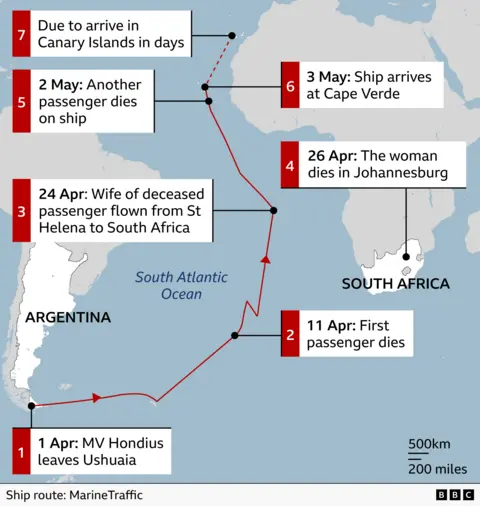
About 150 passengers and crew from 28 countries are reported to have initially been aboard the vessel, but dozens got off on the island of St Helena on 24 April.
The luxury cruise, operated by Oceanwide Expeditions, began its journey on 1 April in Ushuaia, Argentina, and is expected to arrive in Spain's Canary Islands on 10 May.
Hantavirus typically spreads from rodents, with people infected by breathing in air contaminated with virus particles from rodent urine, droppings, or saliva.
Rare instances of human transmission have been documented with the Andes strain, which is behind this outbreak. It is the first known transmission of the virus on a boat, the WHO said on Thursday.
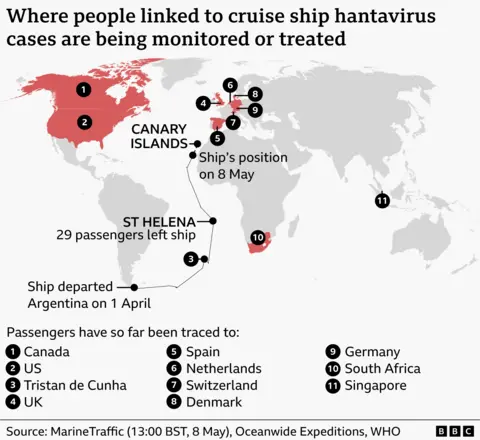
The WHO is in touch with officials in at least 12 countries who are monitoring citizens that were on the ship or had returned home.
Those countries include Canada, Denmark, Germany, the Netherlands, New Zealand, Saint Kitts and Nevis, Singapore, Sweden, Switzerland, Turkey, the United Kingdom and the United States.
One expert told the BBC the outbreak response has been "highly chaotic and uncoordinated" but there was little general risk to the public.
Here is what we know about the countries affected so far:
Three British nationals have suspected hantavirus.
Seven Brits disembarked the MV Hondius in St Helena on 24 April before the first confirmed case of hantavirus was reported on 4 May, with four remaining there.
One patient is on the remote Atlantic island of Tristan da Cunha, where the ship stopped in mid-April.
Two other British men have confirmed cases. One is Martin Anstee, a 56-year-old retired police officer, who remains in a stable condition in the Netherlands after being evacuated from the ship on Wednesday, while the other remains in intensive care after being flown to South Africa last month.
They do not have symptoms but are in contact with health officials. It is understood that medical staff will be sent to the islands to provide support.
Two other British nationals are already self-isolating at home in the UK after potential exposure. They are doing so voluntarily and do not have any symptoms.
The health agencies of five states have said they are monitoring people who were on the ship: two each in Georgia and Texas, one each in Arizona and Virginia, and an unspecified number in California, according to the BBC's US partner, CBS News.
None of the individuals were showing symptoms, the health departments said.
The US Centers for Disease Control and Prevention has classified the hantavirus outbreak as a "level 3" emergency response, its lowest level.
Before boarding the cruise ship on 1 April, the Dutch couple had taken a bird-watching trip through Argentina, Chile and Uruguay, visiting sites where the species of rat known to carry the Andes strain of the virus was present, according to the WHO.
The source of the outbreak has not been confirmed, but the Argentine government is looking into whether infections began in the country.
The MV Hondius was denied its plans to dock in the West African archipelago, and remained anchored off its coast for several days before it set off towards the Canary Islands on Wednesday.
The French Ministry of Health said it has identified eight French nationals who had contact with the Dutch woman who died from hantavirus on her flight from Saint Helena to Johannesburg.
One of those individuals has shown mild symptoms and testing was pending, the agency said on Thursday. The others were offered isolation measures and access to testing, according to the agency.
One of the women who died was a passenger from Germany.
According to the WHO, the woman initially developed a fever on 28 April and eventually presented with symptoms of pneumonia.
Her body was still on the ship, according to the cruise operator.
Thirteen people on the ship are Dutch, including eight passengers and five crew members.
The three deaths so far include two Dutch nationals, a husband and wife. The woman tested positive for hantavirus and died in South Africa.
A Dutch woman was admitted to a hospital in Amsterdam after showing possible symptoms of a hantavirus infection, the country's health ministry said on Thursday.
Dutch broadcaster RTL said the woman was a stewardess at Dutch airline KLM, who had been in contact with a woman who died from a hantavirus infection in Johannesburg.
However on Friday, a WHO official told CBS News that she had tested negative for the virus.
Among the crew of the MV Hondius are 38 people from the Philippines.
There are currently no recorded cases of hantavirus in the country, with officials stressing the risk remains "extremely low".
The MV Hondius is expected to dock in Spain's Tenerife, in the Canary Islands, by Saturday.
All in, 146 people from 23 countries remain on the MV Hondius as it sails to the Canary Islands, where they will be medically assessed before being able to travel home.
Spanish authorities agreed to the move, but the Canary Islands' president has opposed the plan.
"I cannot allow [the boat] to enter the Canaries," Fernando Clavijo told Spain's Onda Cero radio.
"This decision is not based on any technical criteria and nor have we been given enough information."
Once in Tenerife, if they are still healthy, all non-Spanish citizens will be repatriated to their countries, while 14 Spanish passengers will be quarantined in a military hospital in Madrid.
"I don't think it's a good idea... but people do need help", said one of the residents.
On the mainland, a suspected hantavirus case has been detected in Alicante.
It involves a woman who was a passenger on the same flight as a patient who died in Johannesburg after contracting the virus on the cruise ship, Spanish health minister Javier Padilla said on Friday.
A Swiss man who disembarked the cruise ship in Saint Helena tested positive for the Andes strain of hantavirus, according to Swiss health officials and the WHO.
The man developed symptoms and underwent testing in Zurich, where he is receiving care, officials said Wednesday.
Are you on board the ship or do you know someone who is? If it is safe to do so, please get in touch by using this link or the form below.
Correction 8 May: An earlier version of this story reported that transmission between people had been documented for the first time in this outbreak, according to the WHO. In fact, the WHO said on Thursday that this is the first time human transmission has been documented on a boat. Human transmission is rare but has previously been seen with the strain of the virus behind this outbreak. The article has been amended to reflect this.