.png)
 3 weeks ago
28
3 weeks ago
28
1 hour ago
Paul SeddonPolitical reporter

 Getty Images
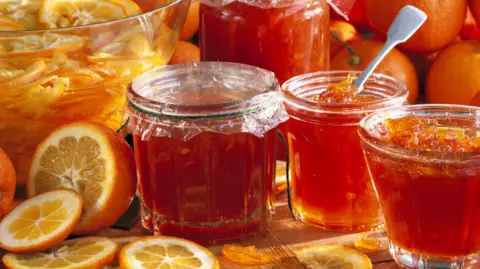
British marmalade is traditionally made with bitter Seville oranges
Marmalade has long been a quintessential British condiment, with some recipes handed down between multiple generations.
But jars of the fruity spread could look a little different on shop shelves under the UK government's planned EU food deal, it has emerged.
The breakfast favourite will have to be sold as "citrus marmalade" if the agreement goes ahead, when Britain will readopt new EU food regulations in a bid to boost trade and reduce red tape for British exporters.
The name change is required because Brussels is relaxing its labelling rules, widening the legal definition of marmalade across Europe for the first time.
Decades-old European regulations incorporated into UK law before Brexit mean only preserves made from citrus fruits can be sold as "marmalade" in shops, with other kinds of fruit spread named "jam" or equivalent terms in other languages.
It is a product of British lobbying in the 1970s for a special commercial status for marmalade cut from bitter Seville oranges, a concoction that has become strongly associated with Britain around the world thanks to Paddington Bear.
But the naming rule laid a linguistic minefield that has been a source of friction with food regulators around Europe ever since.
In 2004, the EU agreed to relax the rule for producers selling fruity wares at farmers' markets in Austria and Germany.
It has continued to flummox consumers in countries such as Spain and Italy, where "mermelada" and "marmellata" respectively are commonly used for spreads made from other kinds of fruit, such as plums and figs.
A German MEP who had been pushing for a change after Brexit told the BBC in 2017 that the naming rules were "contrary to German linguistic tradition".
Now Brussels has updated its rules after the UK's departure, allowing all EU countries to permit non-citrus spreads to be marketed as "marmalade" from June.
A German MEP told the BBC in 2017 why 'marmalade' is confusing for Germans
However, in line with international norms, citrus-based conserves will need to be distinguished as a separate type of product, and will have to be sold using the new legal name "citrus marmalade".
The new name was already set to take effect in Northern Ireland this summer, under the 2023 Windsor framework deal that sees the province align with EU food laws automatically.
But the UK government has now revealed the updated marmalade decree is among 76 updated EU food-related laws that will apply in England, Wales and Scotland too if its wider food deal is agreed.
A timescale for the rule change in Britain is also yet to be confirmed, and it is unclear whether the updated rules will need to be in force before or after mid-2027, when Labour ministers hope the wider agreement will come into effect.
However, it is not clear whether regulators will allow products with names like "strawberry marmalade" to be sold in British supermarkets. This is not currently planned in Northern Ireland, under the legislation delivering the changes.
A previous assessment by the Department for Environment, Food & Rural Affairs (Defra), responsible for labelling rules in England, found such a rule change "could be confusing for UK consumers".
The department declined to specify whether it planned to relax labelling rules in this way, but told the BBC it was in touch with businesses affected by the new rules and would consider alignment "where it makes sense to do so".
The extent to which consumers will notice a difference on shop shelves is not exactly clear. The new rules say product descriptions containing the name of a citrus fruit, such as "lemon marmalade", will be allowed as an alternative.
One manufacturer told the BBC they had already changed the name of one product to comply with the new rules, whilst another said all their labels would have to be altered as a result.
But it remains to be seen whether the long arm of jam law will change the perception of marmalade in the British imagination.
Dalemain Mansion in Cumbria, which has hosted the World Marmalade Awards since 2005, said it plans to keep its competition reserved to citrus-based spreads, irrespective of whether the naming rules are relaxed in the UK.
Beatrice McCosh, director of the awards, said the competition aimed to set the bar for "rock solid British standard marmalade, the type which has been eaten for centuries from Elizabeth I to James Bond".