.png)
 1 month ago
38
1 month ago
38
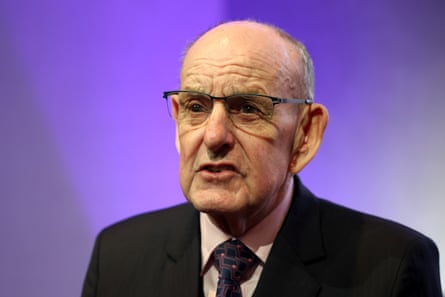
The wait continues for confirmation that Charles Allen’s brief, troubled – and ultimately ineffectual – tenure as chair of the British Horseracing Authority is over. In racing terms, however, he is nine-tenths out of the saddle, his backside inching towards the turf and gravity is about to take over.
Even in the thankless and intractable world of racing politics, few stars have waned as rapidly as that of Lord Allen of Kensington, a former businessman and senior broadcasting executive who arrived in September at the BHA promising to restructure the sport’s governance and, in the words of his day-one mission statement, “develop British racing into a modern commercial and cultural powerhouse”.
There were hints of the struggles ahead even before the new chair’s seat was warm. Allen’s appointment had been announced in November 2024, with an intended start date of 1 June, but his arrival was delayed as he delved deeper into the tangled web of factional interests he had been hired to unite, and sought assurances that his plan for a fully independent BHA board of directors would be implemented.
He is now poised to leave with even that ambition potentially thwarted, having first raised the hackles of the Racecourse Association and one of its key members, Arena Racing Company, which controls around one-third of the fixture list. He then lost the backing of the participants – owners, trainers, breeders, jockeys and other licensed employees – when he is understood to have caved to demands for assurances over the continued low-cost supply of BHA-owned race-day data.
The BHA charges a relatively nominal fee for race-day data – principally on non-runners, off-times and going changes – which the tracks then bundle with key information on runners, riders, weights and more to be sold to betting firms by racecourses’ media rights companies, along with live coverage of the action on their tracks.
Precisely how much money racecourses are making from media rights remains unclear, however, as individual contracts are commercially sensitive and confidential. This situation has in turn led to long-standing and deeply-held suspicions among participants that tracks are not diverting as much as they could into prize money, and instead putting in the bare minimum.
ARC, which operates 16 racecourses with a business model that depends heavily on poorly-attended meetings supplying live action to off-course operators, has long been the principal target of the complaints. It is also believed to have been a key mover behind the Racecourse Association’s insistence on cast-iron reassurance that tracks would not face a major hike in the cost of race-day data when the current contract between the two sides expires in 2028.
Allen was something of a surprise appointment when he emerged as the new chair from a recruitment process overseen by the BHA’s nominations committee. His business background and longstanding affiliation with the party of government were seen as key assets, despite little evidence of any significant interest in the sport.
It was possible, though, to spin it as a positive: a “clean slate” appointment unencumbered by partiality to one side or the other. Having apparently lost the confidence of so many key stakeholders, however, Allen now seems to be just the latest leader of a fractured industry to sink without trace into the quicksand of factional interests.
So what now for an industry that supports 10s of thousands of livelihoods, the length and breadth of the UK? If a well-connected operator from the business world cannot knock heads together and convince all sides to pull in the same direction, who can? Who would even be mad enough to try?
Beyond the obvious embarrassment of losing its chair just a few months into his term, Allen’s brief tenure at the BHA could also be seen as further – and perhaps conclusive – evidence that the sport’s structural problems are, for the moment at least, unsolvable.
On this analysis, Allen’s vision of a board of directors thinking only about what’s best for the sport was sensible and progressive, but ran into the same immovable obstacles that have frustrated other attempts to move things forward for more than 20 years.
The British Horseracing Board, the BHA’s predecessor, had two disastrous regulatory and legal setbacks in the early years of the century. A ruling by the Office of Fair Trading in 2003 effectively meant that it ceded control of the fixture list to the racecourses, while a ruling by the European court of justice a year later stripped away any hope of selling the most significant racing data directly to betting firms.
The combined effect of the two rulings was to hand almost complete control of the media rights revenue stream to the racecourses, and while Jockey Club Racecourses, the UK’s other major racecourse owner, operates under a royal charter to return all profits to the sport, ARC has shareholders to consider.
Greg Wood's Tuesday tips
ShowNewcastle 2.05 Green Bonnet 2.35 Huit Reflets 3.05 Silver Hill 3.35 Parish Quiz 4.05 Passing Pleasure 4.35 Rainbow Tara
Wolverhampton 5.25 Dance Time 6.00 Welcome Retreat 6.30 Initial Blue (nap) 7.00 Militzie 7.30 Dayman 8.00 Hamaleel 8.30 Silkies Sib (nb)
As such, it is hardly a huge surprise that it would defend its position so fiercely, and since the RCA operates a one-track, one-vote system to determine its policy decisions, ARC and its allies among the smaller, independent tracks wield considerable power.
Unless, or until, it is in not just their long-term, but also their short-term, interest to cede some power and co-operate with JCR and others, ARC will surely continue to stage nine-race meetings with declining fields racing for rock-bottom prizes.
The threat of a Premier League-style breakaway by JCR and big independents such as York and Ascot, which was floated last year by the former Jockey Club chief executive Nevin Truesdale, might get its attention.
It may also consign many smaller tracks to extinction and ignite all manner of legal, regulatory and contractual disputes as a centuries-old industry tears itself in two.
The obvious concern is that if, or when, gravity takes over and Allen hits the turf, the best chance to avoid civil war may well have gone with him.