.png)
 1 month ago
33
1 month ago
33
It was the coffee bar at the training ground, installed by the Fenway Sports Group’s chief executive, Michael Edwards, after he got the idea from visiting Roma. It was Sultans of Swing by Dire Straits, added to the post-match playlist by Alisson and which could be heard booming out of the Liverpool dressing room after victories. It was the video analysis. It was the data. It was the pre-season fitness tests. It was the close collaboration between the football and sports science departments. It was everything that changed from the Jürgen Klopp era. It was everything that stayed the same from the Jürgen Klopp era.
Victory brings a dazzling clarity. Particularly a victory as resounding as Liverpool’s unexpected 10-point romp to the Premier League title last season. It turns the cogs, powers the houses, confers a sunlit aura of genius on everyone involved. So with a certain uncharitable hindsight, it is instructive to go back to late April 2025 and read about how everyone thought Liverpool had done it. And why everyone – wrongly – thought they were going to do it again.
It was the AI-driven load management model devised by Conall Murtagh, the head of physical performance. It was the unfettered happiness of Mohamed Salah, the accidental masterstroke of Ryan Gravenberch as a linchpin midfielder. And, of course, it was the cerebral genius of Arne Slot, this enlightened son of the Dutch soil with the pate of a newborn baby and the manner of your favourite teacher, and who around 11 months ago was being talked about very seriously as one of the best coaches in the world.
Alas, it appears Slot now has to go. Sorry, that’s just how it works. The performances have simply been too unsatisfying, the pace of play too slow, the vibes too stale. Against Tottenham on Sunday the final whistle was greeted with boos from the Liverpool fans who had not already left. The mood has gone from skittish to mutinous. Jamie Carragher has felt things and, like Walter Cronkite during the Vietnam war, if you’ve lost Carragher then you’ve lost Middle Liverpool.
Liverpool are fifth in the Premier League, still in the Champions League, and have accumulated more league points since the start of last season than anybody bar Arsenal. On the other hand, Liverpool are fifth in the Premier League, on the verge of elimination from the Champions League, and on pace to drop 22 points from last season. How much of this is on Slot? What even is it in the first place? What can be fixed and salvaged and what demands to be changed?
The short answer – spoiler alert – is that nobody really knows. Nobody can judge the extent to which Slot is responsible for the decline of Salah or Alexis Mac Allister, for Liverpool’s skittish summer transfer business, for the injuries, for the inability to convert a four-on-two breakaway or clear a simple long ball. We can certainly say he was not responsible for the death of Diogo Jota and the emotional turmoil that followed, but we have no real way of knowing whether it had any material effect on results.
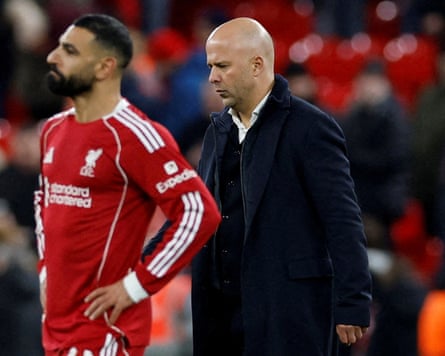
But there does seem to be a basic assumption that the job he inherited in 2024 – improving an unbalanced squad while evolving its style in a high-pressure environment with an impatient fanbase – and the job he now has in 2026, improving an unbalanced squad while evolving its style in a high-pressure environment with an impatient fanbase, are basically two entirely separate functions, as different as IT support and cosmetic dentistry. In its cruder forms it finds voice in the view that last season was basically “Klopp’s title” with “Klopp’s team”.
And, really, the Slot discourse cuts to the paradox of modern coaching. The lines of authority are diffuse. Recruitment is done by committee. The broader strategy is decided upstairs. Tactics are basically an unsatisfactory palimpsest of multiple factors: what the last guy did, what the players feel comfortable doing, what part of a footballing vision can realistically be conveyed to limbs on a pitch. The coach is basically a flavour, an aroma, an ambience, and when a team that won the league by a wide margin last season looks so far off the pace next time round, perhaps it is no wonder people will reverse-engineer the easiest route back to salvation.
Naturally, everyone will have their own pet theory for Liverpool’s regression. The failure to reinforce in midfield or at centre-back. The turbulence of the summer. Dominik Szoboszlai at right-back. The lack of leaders. There have been weird selections and questionable substitutions. Perhaps it is Slot’s misfortune that his doctrine of extreme control and elite pressing happened to collide with the Premier League’s 17th-century village football era; long throws and long balls being hurled into the penalty area like giant scotch eggs fired from a trebuchet. But what we have no real way of knowing is how much of this is noise, snap reactions to short-term disappointment.
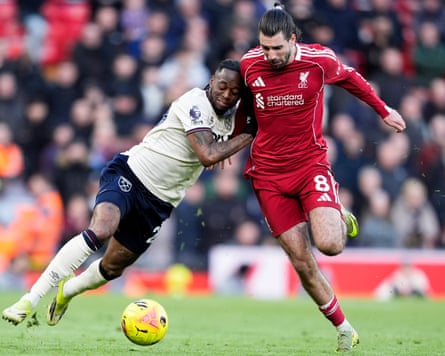
In a way the modern big-club coach takes the job with the full awareness that they are basically a narrative device, a reset button to press when things get sticky, a meat sacrifice that allows everyone else to indulge the illusion of renewal. You can’t shift the owners and you can’t sell an entire playing squad. So the purpose of the manager is essentially to be fired: to be responsible for the things they’re not really responsible for, to be immediately disposable, to provide the illusion of a simple solution where none exists.
Indeed, to take the most cynical view, you could argue that Slot has already served his purpose. The post-Klopp cliff-edge was spectacularly avoided. Liverpool fans are in various shades of disgruntlement, for reasons often only tangentially related to the 22 guys they’re watching on the grass. A few Liverpool-supporting friends have mentioned the beefed-up security checks at Anfield, generating long queues outside the ground and perhaps even contributing to so many of this season’s slow starts.
Slot is not responsible for this, either. But he will be made to carry the can nonetheless, the price for being the simplest target in an incredibly complex sport. It isn’t the security checks, any more than it was the coffee bar or the data or the Dire Straits. But in an age of overanalysis and short-term solutions, he will have to go anyway, largely because nobody can think of a better idea.