.png)
 1 month ago
35
1 month ago
35
Alice Cuddy,Senior international reporter, Beirutand David Gritten

 Reuters
The Israeli military has ordered hundreds of thousands of people to leave Beirut's southern suburbs, a stronghold of Hezbollah, as it steps up strikes targeting the Iran-backed armed group across Lebanon.
"Save your lives, evacuate your homes immediately," the military's Arabic spokesperson wrote on X, apparently signalling plans for intense bombardment.
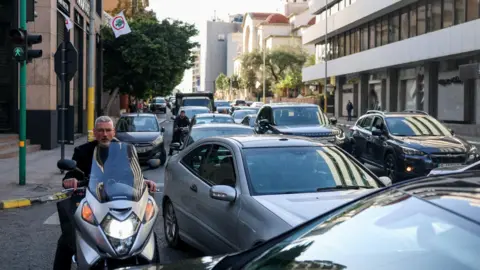
Huge traffic jams formed on main roads heading north and south as panicked residents complied with the unprecedented blanket order covering the area.
The military told all residents of a huge swathe of southern Lebanon near the Israeli border to leave on Wednesday, ahead of a much-anticipated ground incursion.
Mohammed al-Khaouzam was among those stuck in traffic trying to flee Beirut's southern suburbs on Thursday afternoon.
"We're coming from Bir Hassan. They [the Israeli military] issued a warning so that's why we're leaving," he told the BBC.
Khaouzam, who is originally from Syria, is heading north with his wife and children. He described Lebanon as his "second country".
"May God help everyone. May God help all of the Lebanese," he said out of his car window.
A woman driving north said her children were in Beirut and had called her telling her about the warning to leave the suburbs of Chiyah, Burj al-Barajneh, Haret Hreik and Hadath.
She said she was going to stay with them, hoping it would be safe.
"Is there any place to go? What should I do?" she asked.
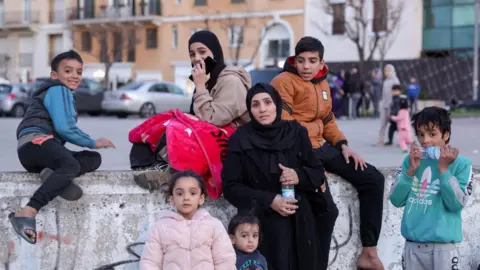
Food kitchens and shelters in the capital have warned that they cannot support the number of people being displaced.
 Reuters
Some displaced families from the southern suburbs headed for Martyrs' Square in central Beirut
Lebanese authorities have said at least 102 people have been killed in Israeli strikes over the past four days. There have been no reports of fatalities by Israeli authorities.
Israeli aircraft have carried out waves of strikes targeting Hezbollah in Beirut's southern suburbs, southern Lebanon and the eastern Bekaa Valley since Monday, when the group launched rockets and drones over the border in retaliation for the assassination of Iran's Supreme Leader Ayatollah Ali Khamenei.
It pulled Lebanon into the war between Israel, the US and Iran, only 15 months after a ceasefire deal ended more than a year of full-on fighting between Israel and Hezbollah that devastated the country.
On Wednesday, Hezbollah leader Naim Qassem vowed the Shia militia and political party would confront Israel "to the point of the utmost sacrifice, to the furthest limits", adding: "We will not surrender."
It came a day after the Israeli military's chief of staff, Lt Gen Eyal Zamir, said it was "determined to eliminate the threat Hezbollah poses and will not stop until the terror organisation is disarmed".
Israeli strikes in Beirut's southern suburbs overnight caused heavy damage to a building
The Israeli military said on Thursday that it had carried out strikes overnight on several Hezbollah command centres in Beirut, which it alleged were intended to be used to plan and carry out attacks on Israeli troops and civilians.
The Lebanese health ministry said at least three people were killed in Israeli air strikes on vehicles on the main road to the city's airport.
A residential building on the outskirts of Beirut was struck late on Wednesday, but locals said they believed no-one had been there at the time.
Several people told the BBC on Thursday morning that they had left the building at the beginning of the week and were staying elsewhere because of safety concerns, noting that the area had been targeted in the past. They said they did not know, or would not comment on, what the target may have been.
"We moved away on Monday because of fears that something would happen. Today, we were supposed to come for a shower and to pick up our stuff and we found this," one woman said, as she and her husband looked at the wreckage.
"Thank god it was just our things and not us."
The Israeli military has not commented on the strike.
It did, however, say that it had killed "several Hezbollah terrorists" who were operating in southern Lebanon overnight.
Lebanon's state-run National News Agency later reported that the mukhtar, or mayor, of the southern town of Kfour and his wife were killed in an air strike on their home.
It said a Hamas official, Wasim Attallah al-Ali, and his wife were also killed in the Baddawi Palestinian refugee camp near the northern city of Tripoli.
The Israeli military said it targeted Ali because he was a commander of Hamas's military wing and was responsible for training its fighters in Lebanon.
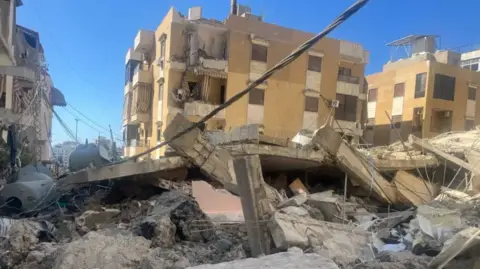
In Sidon, the Israeli military destroyed an apartment building it said was "Hezbollah military infrastructure"
The BBC also visited the southern city of Sidon, where an apartment building was destroyed in an Israeli strike.
The Israeli military issued an evacuation order in advance, describing the building as "Hezbollah military infrastructure".
People living nearby said they believed everyone left the area following the warning and that no-one was killed.
"There was nothing here. Only people," cafe owner Ahmed called down from the balcony of an apartment next to the destroyed building.
"Show the Israelis there's nothing. Show them we're civilians," a woman said as she walked past.
A man sitting nearby said: "There are displaced people who came so maybe that's why?"
French President Emmanuel Macron has called for an end to the hostilities, describing this as a "moment of great danger" for Lebanon.
"Everything must be done to prevent this country, so close to France, from once again being drawn into war. The Lebanese have a right to peace and security - like everyone in the Middle East," he said in a post on X.
Macron added that he had spoken to Lebanon's "highest authorities in order to establish a plan to bring an end to the military operations currently being carried out by Hezbollah and Israel on either side of the border".
"Hezbollah must immediately cease its fire toward Israel. Israel must refrain from any ground intervention or large-scale operation on Lebanese territory," he said.
The president also said that France would immediately dispatch humanitarian aid for the tens of thousands of civilians who had been displaced.
On Monday, Lebanon's Prime Minister Nawaf Salam condemned Hezbollah's actions as "irresponsible" and said his government had banned the group's military activities.
Hezbollah's leader Qassem insisted it had a "legitimate right" to bear arms and accused the government of turning "against the resistance to complete its error and align itself with Israeli demands".
Under the 2024 ceasefire deal brokered by the US and France, Hezbollah was to move its fighters north of the Litani river, about 30km (20 miles) from the border, and dismantle its military infrastructure there. Israeli troops were to withdraw from southern Lebanon.
The Israeli military continued to carry out near-daily strikes on targets it said were linked to Hezbollah after the truce, accusing the group of trying to recover its military capabilities. Israeli troops also continued to occupy at least five positions in the south.