.png)
 1 month ago
77
1 month ago
77
5 hours ago
Lily JamaliNorth America Technology correspondent, Oakland, California

 Reuters
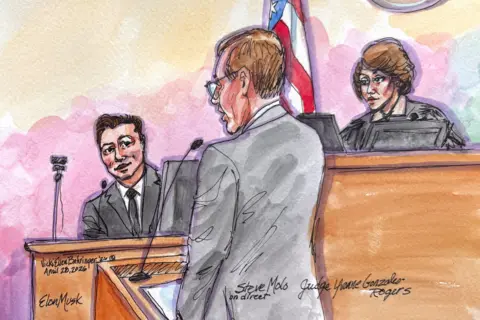
Gonzalez Rogers told Musk: "Let's remind everyone in the courtroom that you are not a lawyer."
As the world's richest man, with a net-worth of over three-quarters of a trillion dollars, Elon Musk's resources and connections often make it easy for him bend Silicon Valley to his will.
But that's not always the case, as evidenced by his $150bn (£110bn) lawsuit against OpenAI, currently playing out in a California court.
Musk co-founded the company in 2015 with CEO Sam Altman, and left three years later after a power struggle.
The feud has fuelled a costly showdown between two tech titans – but in this courtroom, there is no doubt who is calling the shots.
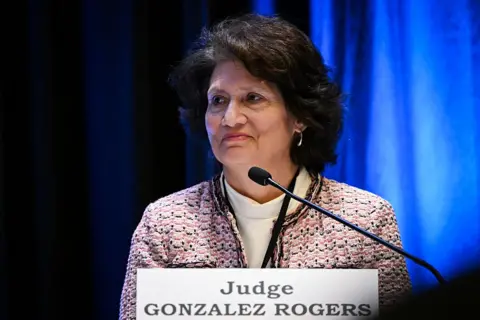
Musk vs Altman is just the latest high-profile Big Tech case to cross US District Judge Yvonne Gonzalez Rogers's bench.
The 61-year-old federal judge, who originally hails from southern Texas, is known for her no-nonsense approach in the courtroom.
"I think it's a function of the fact that she's now so experienced – nothing's going to faze her," Michael Rhodes, a retired lawyer and former partner at Cooley LLP, where Gonzalez Rogers was once also a partner, told the BBC.
Musk has accused Altman and OpenAI president Greg Brockman of a breach of charitable trust and unjust enrichment.
He objects to OpenAI's decision to open a for-profit arm in 2019, three years before it debuted the software ChatGPT which ignited the commercial AI market.
OpenAI says Musk is suing to give his own AI startup, xAI, a leg-up.
During his testimony last week, Musk tried at one point to play the part of his own legal counsel, accusing OpenAI's lawyer William Savitt of asking him leading questions.
Gonzalez Rogers quickly shut him down.
"That's not how it works," she interjected.
Unlike a lawyer conducting direct examination of their own client, Savitt was allowed to lead, she instructed Musk.
"Let's remind everyone in the courtroom that you are not a lawyer," she told Musk.
"I am not a lawyer," Musk acknowledged. "Well, technically I did take Law 101 in school," he added, drawing laughter from the packed courtroom gallery.
But he reaffirmed her point: "Yes – I am not a lawyer."
In Gonzalez Rogers, Musk may have met his match.
"It does make an interesting juxtaposition. He's the wealthiest man in the world. He's used to being on top. She's definitely on top now. She's in charge," said veteran courtroom artist Vicki Behringer, who has covered several cases overseen by Judge Gonzalez Rogers, including this one.
Commentators have described Gonzalez Rogers as a tough but fair judge who is in total command of her courtroom.
"She wants everybody to be treated exactly the same under the law," said Rhodes, who has also represented Musk and OpenAI in the past.
While the nine-person jury is expected to decide the case by the end of this month, their decision is not binding. They serve in an advisory role. Ultimately, Gonzalez Rogers will be the final arbiter.
"That changes the whole landscape," said Jay Edelson, a plaintiffs lawyer who has wrongful death lawsuits pending against OpenAI. "It really means that this is completely her show."
The cases that have crossed Gonzalez Rogers' bench are among the most closely-watched and complicated cases brought by and against big tech companies.
"There are certain judges who, if they're on the case, you kind of stand up a little bit straighter," said Edelson. "You want to make sure everything's right, that your tie's on straight, and that you don't mis-cite a case."
In addition to the Musk v Altman case, she is overseeing a multi-district litigation, in which social media addiction lawsuits brought by school districts and states against Meta, Snap, TikTok and Google have been consolidated.
She also handled an antitrust case brought by Epic Games against Apple, a highly technical matter in which the Fortnite-maker accused Apple of forcing developers to use the tech giant's payment system in the App Store.
Last year, in a stunning court filing, Gonzalez Rogers wrote that an Apple executive "outright lied" under oath and referred the matter to the US Attorney for the Northern District of California.
An appeals court upheld her finding of contempt, but found that she went too far when she barred Apple from collecting any commission from sellers who use third-party payment systems.
This week, the Supreme Court declined Apple’s request to stay the appeals court ruling. The case will go back to Gonzalez Rogers to determine a fair commission rate.
 Getty Images
Judge Gonzalez Rogers has presided over a number of high-profile cases
Gonzalez Rogers was appointed to a lifetime seat on the federal bench in Oakland, California, in 2011 by then-President Barack Obama.
She attended Princeton University, spending school breaks and weekends cleaning houses and cutting grass to pay for her tuition, according to testimony by then-US Senator Dianne Feinstein at her confirmation hearings.
After attending law school, Gonzalez Rogers spent more than a decade in private practice, achieving the status of partner in her law firm before then-Governor Arnold Schwarzenegger appointed her as a local superior court judge.
Through a spokesperson, she declined the BBC's request for an interview.
Gonzalez Rogers has run a tight ship since the Musk v Altman trial began in late April. She starts proceedings on the dot at 08:00 each morning. There is no lunch – she allows for just two 20-minute breaks.
She appears warm to jurors, routinely thanking them for their public service and for paying such close attention during the proceedings.
"If you get cranky with family, just know it's because you're tired," she told them at one point.
Rhodes, who has appeared before his former law partner in court, has described her as "wickedly funny" although she can be self-deprecating about her sense of humour.
She recently told the court that her kids remind her that her jokes are bad – "and that lawyers just laugh because they have to".
She seemed to draw genuine laughter after a microphone in the courtroom stopped working last week.
"What can I tell you?" she said, with perfect comedic timing. "We are funded by the federal government."
 Getty Images
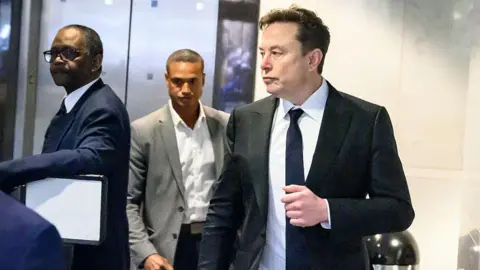
Gonzalez Rogers has allowed Musk and others to go through a security check away from the public eye
But when it comes to the parties in the case and their counsel, she is all business.
In the first week of trial, she chided Musk for recent posts to his social media platform X, in which he spoke disparagingly of OpenAI and Sam Altman, whom he referred to as "Scam Altman".
"How can we get this done without you making things worse outside the courtroom?," Gonzalez Rogers asked him. Musk replied that he was only responding to OpenAI's public statements about the case.
"How about a clean slate? Beginning today," she asked him. "Yes," Musk responded.
And her request wasn't limited to Musk. She then asked Altman and Brockman to do them same.
"Let's just try it, gentlemen. Let's just try it and see if we can make things work."
At a pretrial hearing in March, she said the high-wattage players in the case would not receive special treatment – although she has given some ground there.
Musk and others go through a standard security check but they are given access to a building entrance not used by the public, allowing them to avoid interacting with reporters and curious onlookers outside the courthouse.
And although everyone these days seems to have an opinion on AI, she has tried to keep scientific theorising out of the courtroom.
When Musk compared AI to The Terminator movies, Gonzalez Rogers told him after jurors left her courtroom: "You've made your little statement. But that's it."