.png)
 1 month ago
35
1 month ago
35
If the first months of Harry Brook’s captaincy of England’s white-ball teams have taught us anything, it is that Joe Root knows him well. Looking back now at the teams’ progress since he took over, the run to the T20 World Cup semi-finals, and also at the scandal caused by his notorious drunken escapade in Wellington, the words of Brook’s Yorkshire teammate soon after his appointment seem more astute than ever.
“He’s still an idiot, that’s not changed,” Root said. “But as much as he’s an idiot, and I can say that because I’ve known him forever, he’s very cricket intelligent. He might not always be the most intelligent away from cricket, but he understands the game exceptionally well and that’s why he’s so consistent as a batter, and I think that’s what will make him a really good leader.”
Root joked about Brook’s stupidity, but for all England’s obvious imperfections one thing that has stood out in this tournament is the absence of it. England’s last few World Cup campaigns, when they were led by a captain in Jos Buttler who has never been tarred by the word, have all been marked by outbreaks of rank idiocy: packing the team with seamers for a T20 semi-final on the most infamously turning pitch in the Caribbean and then not bowling one of the spinners you do have; winning the toss before an ODI being played on a boiling Mumbai day and choosing to make your own team suffer; enjoying the absolute certainty that rain is going to interrupt a T20 in Melbourne yet making no attempt to get on the right side of the DLS calculations before it does so. This is not a great team, and it has not produced great performances, but neither has it been hobbled by obvious and avoidable errors. It is a humiliatingly low bar for an England side to have to clear, but it is progress.
Will Jacks memorably spoke during the tournament about this being “the era of Harry Brook as white-ball captain”. “I think the environment around the group, led by him, is absolutely brilliant,” Jacks said. “I think that’s why we’ve had some success.”
Eight years ago, Brook was captaining a team that also included Jacks and Tom Banton at the Under-19 World Cup, and a feature of this squad is the number of players who already have strong relationships with the captain. “They have to be good enough cricketers to get in the team,” Brook said this week. “But I do think it makes a big difference when you know that someone has your corner and will fight for you until the last ball.” This faithfulness is mutual: Brook obviously erred when he lied that he was out on his own that night in Wellington, but that his instinct was to risk his own reputation to protect his friends and teammates will only have helped build trust.
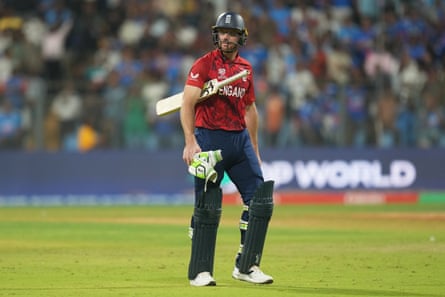
This may be a strong group, but this tournament has been one of impressive individual performances and disappointing collective ones. Jacks returns home with four man of the match awards and obviously stood out: he is in the side to rescue it from dismal situations, but that he was able to do it so reliably was extraordinary. In the semi-final, Jacob Bethell again demonstrated his thrilling potential. Brook himself produced one of the great T20 innings against Pakistan. Jofra Archer bowled excellently everywhere but Mumbai, where for some reason he seems unable to. Rehan Ahmed bowled 18 balls and faced seven, but what a cameo.
It is not quite a band of brothers: there are several groups within the group and members of the squad tend to gravitate towards others of similar ages or backgrounds. But perhaps this too will change as the squad goes through a period of rejuvenation before the next World Cup – the 50-over version in South Africa, Zimbabwe and Namibia in 18 months – and the one after that, back to the shorter format in Australia and New Zealand a year later.
At the start of the next T20 World Cup, Buttler will be 38, and even if his performances here had been less woeful it would be time to talk about succession. On flat pitches, England’s seam bowling, as India ruthlessly demonstrated, is not good enough to be anything but fodder for the opposition batting machine. If Adil Rashid is slowing down it is entirely by design – he has deliberately reduced his bowling speeds and had his most prolific T20 World Cup – but he is 38 already. This year Jamie Overton seems a sensible answer to an obvious question, but by 2028 there will hopefully be a better one.
And then there is Brendon McCullum. The feeling when he was first appointed to coach England’s red-ball side was that he was more suited to shorter formats and that remains the case. This tournament, for all that England were often unconvincing, has helped revive a dimming reputation. He is flawed, but he is positive and widely liked. As, in turn, was his team.