.png)
 1 month ago
75
1 month ago
75
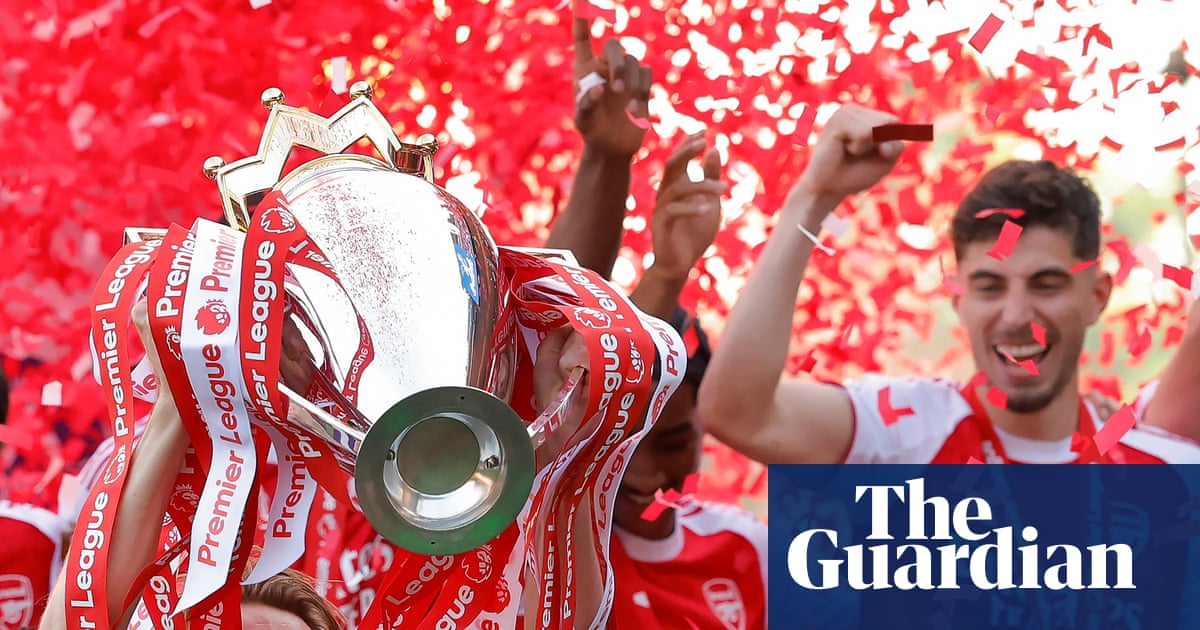
Kai Havertz is recalling the cocktail of feelings that swirled around his head in Budapest three-and-a-half weeks ago. Arsenal could not have lost the Champions League final in more agonising circumstances but the only available option was to straighten up and start smiling. They were due to set off on a bus around Islington for the Premier League trophy parade at 2pm the following day. Was this really the moment to bathe in a million onlookers’ adulation?
“To be honest, it was tough,” says Havertz, whose early goal against Paris Saint-Germain had looked a possible winner for nearly an hour. “After the match, I initially thought we would call the whole thing off. By the next morning, things looked different.”
The mass of joy, colour and sheer emotional release proved resoundingly that the north London tour was appropriate. “We had a huge season behind us,” Havertz says. “The club had gone 22 years without a league title so that had to be celebrated properly with the fans. I have to say I’ve never experienced anything like it. So many people on the streets, so many supporting us. It ranks among my top three experiences as a professional.” Now he is immersed in the prospect of extending the list to four.
Havertz is speaking at Germany’s World Cup base in Winston, North Carolina, where a sense of momentum is building. For one thing, Germany have a monkey off their back. Group stage eliminations in 2018 and 2022 added to this year’s mental burden, but they have already been confirmed winners of Group E.
In the second of those exits, Havertz scored twice against Costa Rica but they still tumbled out. “Qatar was anything but successful for us as a team and for me personally,” he says. “There’s a different energy in our squad now. I was quickly convinced that things would go better this year. We knew we had a duty not to fail early on again. We are Germany. But now the tournament is really just beginning.”
Nobody is performing cartwheels around the Graylyn Estate, the splendid castle-like facility where Julian Nagelsmann’s side have taken residence, after a demolition of minnows Curaçao and a late win over Côte d’Ivoire. But Germany managed 42 shots across those matches and Havertz feels the fun has returned. “We radiate a real joy in playing,” he says. “We move a lot, play offensively and create scoring chances. And we bounce back after conceding goals.”
Havertz scored twice against Curaçao; a penalty and a neatly-dinked late finish, to maintain a formidable strike rate with the national team. The 27-year-old has 24 goals from 60 caps and is established as Nagelsmann’s starting centre-forward, even if it was the substitute Deniz Undav who swung the Côte d’Ivoire game with his own brace. There have been calls for Undav to start against Ecuador on Thursday and perhaps they are of a piece with much of Havertz’s career: the sense has often been that, for many in his home country, his gifts fly under the radar.
“Probably because I don’t play in the Bundesliga,” he says. “It was the same at times with Toni Kroos and Ilkay Gündogan, who were abroad for years. It is often said about me: ‘Havertz didn’t score again, he’s useless!’. And when I do score, they say: “Well, he’s supposed to, it’s about time!” I don’t hold it against anyone; that’s perfectly normal.”
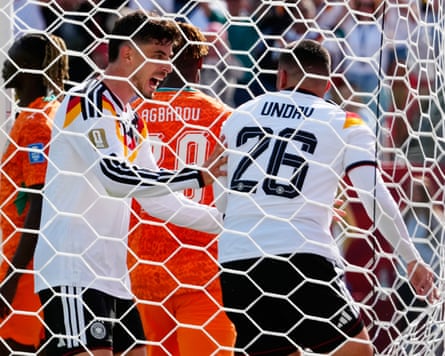
Maybe it is Havertz himself who tends towards the unconventional. He is a unique footballer: a blend of movement, tactical awareness and timing whose ruthless streak is more quiet than bombastic. “Defenders should never know where I am, where I’m going, what I’m planning, or where I’ll be at any given moment,” he says during an interview arranged in collaboration with Die Zeit. “That’s the worst for them. I try to be like a ghost to defenders.”
With that comes a selflessness that has made him a manager’s dream. Mikel Arteta, in particular, rarely spurns a chance to wax lyrical about Havertz. “I can’t just wait around in the penalty area, I need to be involved,” he says. “I also make runs which I know sometimes look pointless, but I’m creating space for the players coming up behind me.”
It helps that Havertz, for all that decisive finishing ability, has often been the definition of plug and play. He began as a winger and largely played in midfield until Peter Bosz began deploying him as a spearhead at Bayer Leverkusen. There was even the night in 2023 when Nagelsmann started him at left-back in a friendly against Turkey; it spoke volumes when Havertz nonetheless scored after five minutes. “If he were to ask me to do it again, I would,” the player insists.
An unfussy demeanour can sometimes be misinterpreted as casual but Havertz is simply one to crack on with the job in hand. “I’m aware of the debates that I’m too laid back or my body language is wrong,” he says. “That always comes up when I’m not playing well. But I’m not the sort of person who dwells on it too much. It used to be different. I don’t brood on things any more..” Nonetheless, nerves occasionally strike. “I know it doesn’t show from the outside, but I feel it,” he says. “Before a Champions League final, or at a World Cup. Or before penalties. I need that tension to stay focused.”
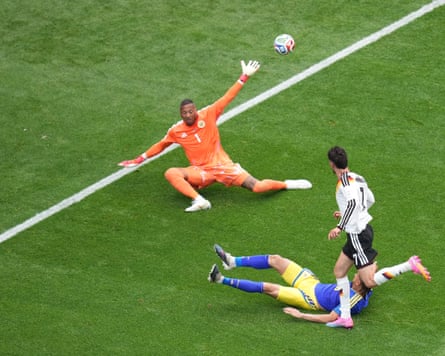
Pure instinct may be the key to delivering Germany a first World Cup title since 2014. That cannot be discounted despite a buildup fraught with question marks and the prospect of a last-16 showdown with France. Havertz is fit and well after a season whose early months were derailed by knee surgery. “The last year and a half has gone badly for me,” he says of problems that also included a hamstring injury in 2024-25 and make his contributions for Arsenal all the more commendable. The desire burns to cast old frustrations aside.
Havertz was in the Germany team that, amid a tide of host country fervour, narrowly fell to Spain in the quarter-finals at Euro 2024, and he has detected an even higher-octane environment in North America. “The atmosphere is amazing. I was really excited before the Euros in Germany, too. A World Cup is even bigger. There’s incredible energy in the stadiums.”
Havertz says he is yet to be desperate for a drink in the 23rd minute of a game, perhaps because Germany have hardly sweltered when playing in Toronto and the air-conditioned arena in Houston. He is not on the side of Fifa’s so-called hydration breaks. “They’re usually annoying, especially when you’ve just had two or three good situations and feel your flow is being interrupted,” he says. “But others decide that.”
More firmly in his gift is the chance to shape Germany’s fortunes. When he was 17 and gearing up for stardom at Leverkusen, Havertz wanted to drop out of school and forgo the Abitur, Germany’s university entrance exam. He was put straight by a staff member at his club, who saw it as a critical test of willpower. “At 17, you don’t think you need school any more,” he says. “At that age, you also don’t think about injuries or how things can suddenly take a completely different turn. It was a life lesson for me: seeing things through to the end instead of just quitting.”
Perhaps that is also the model for a winning World Cup campaign and a less conflicting victory tour.