.png)
 1 month ago
90
1 month ago
90
1 hour ago
Ruth CleggHealth and wellbeing reporter

 Getty Images
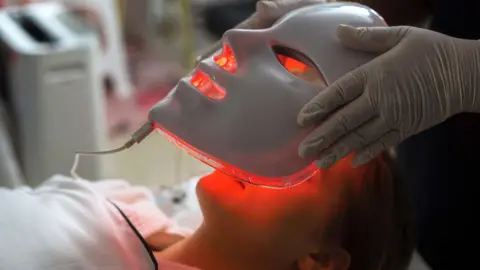
LED masks are just one of many different devices currently on the market
At first glance, it reminds me of a tanning bed I used to cook myself on as a naive teenager (which I heartily do not recommend). But I'm reassured I won't be turning a crisp brown.
"It's red light," Dr Cal Shields explains. "This is going to repair cells - not fry them.
"Just 15 minutes," he says, as he closes the lid of the red light therapy bed and leaves the room in Thriyv, a wellness suite in Manchester.
There's a distant whirr, the bed glows and I'm left alone with my thoughts - and supposedly some hastily repairing skin and muscle cells.
Over the past few months, the wellbeing industry has been turning red. Whether you want to look younger, live longer, feel happier, or recover more quickly, it's being claimed red light therapy is the way to go.
 Ruth Clegg/BBC
But what is red light therapy, and can the warm scarlet hues beaming out of red therapy mats, LED masks and sauna sleeping bags really boost our health?
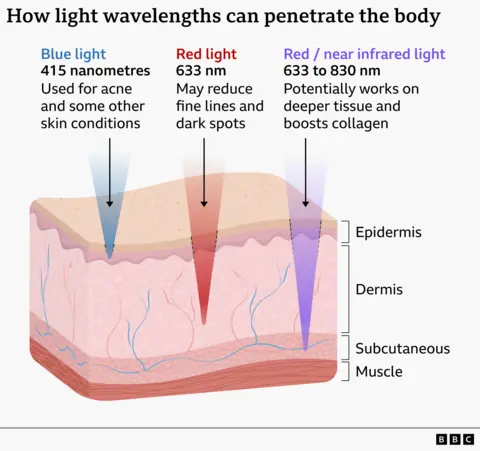
Red light therapy impacts the body using different wavelengths.
Red light is what we can see with the naked eye, with wavelengths measuring between 630–660 nanometres - that's millionths of a millimetre. As the wavelengths get longer, the light starts to become invisible.
The longer the wavelength, the deeper it reaches in the body. While shorter wavelengths target the top layers of the skin, longer ones are aimed at muscle tissues and are said to help with recovery.
Depending on wavelength and intensity, these little red light particles can speed up energy production in cells and help damaged cells repair and reproduce.
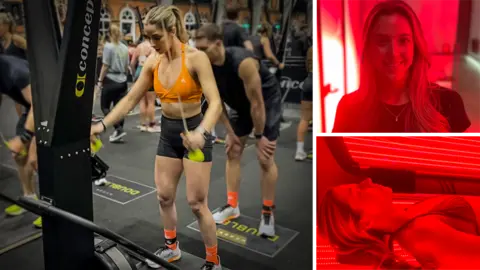
Back at Thriyv, one of Dr Shields's regular clients, Kate McLelland, jumps off a red light therapy bed. She's been using red light since fracturing her neck two years ago, when a barbell landed on her while CrossFit training.
"I had intense physiotherapy for my injury," McLelland says, "but I combined it with red light therapy."
The 32-year-old - who believes this has helped her muscle tissues heal more quickly - is back training and she's just competed at a Hyrox fitness event. Red light is still a part of her recovery routine.
"It used to take me a week to recover from Hyrox," she says. "Now it's just a few days."
McLelland is such a fan, she also has an LED face mask. These sell for hundreds of pounds, if not thousands, with manufacturers claiming that use of red light stimulates collagen production and reduces fine lines. Some also use blue light, a shorter wavelength on the light spectrum, which some studies suggest helps with acne.
"My skin does feel like it's got more of a glow," McLelland says. "I had a lot of sun damage, but I can see that's definitely lifted."
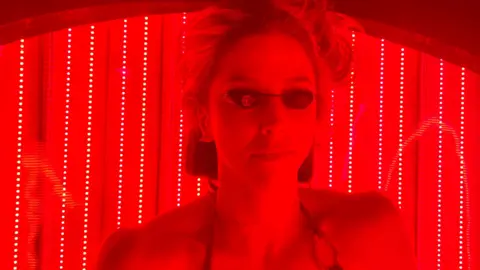 Ruth Clegg BBC
Kate McLelland has been using red light since fracturing her neck two years ago
So how effective are the red light devices you can find on the market?
"Blasting yourself with an expensive red light device off the internet will not necessarily give you the results you want," says Prof Glen Jeffery, a neuroscientist based at University College London.
While there are encouraging signs that red light therapy may help in some different areas - from skin rejuvenation to muscle soreness - Dr Sophie Weatherhead, from the British Association of Dermatologists, is also cautious.
"We have lots of different studies, which tend to be quite small, which use various combinations of light, and very different doses of light.
"It also depends on other factors: the way light interacts with different skin colours, the thickness of the skin, which part of the body is being targeted, the amount of energy used to power the devices."
Here's how you can get your dose of red light therapy:
These use mostly visible red light and some longer wavelengths.
Weatherhead says the thickness of the skin affects how well red light can penetrate. There maybe marginal gains on the face, she explains, because the skin is naturally thinner there than other parts of the body.
But, she stresses, it depends if there is enough power from the device.
"The red light should be able to reach the dermis," Weatherhead says, which means, in theory, there may be some change to the mitochondria - where energy is produced in the cell, which could help with rejuvenating the skin.
It also depends on where the red light is coming from. Home devices, she says, may be less effective than medical grade ones.
These use some visible red light but more longer near-infrared wavelengths.
Prof Jeffery, the UCL neuroscientist, says his studies show that near-infrared light can penetrate right through the body - so the light could reach deeper tissues.
However, he doubts whether beds currently on the market are effective, explaining they don't have the right mix of wavelengths needed to successfully target cells' energy production.
He adds it's very difficult to judge how much red light skin needs, and it differs from person to person.
Prof Zubair Ahmed, a neuroscientist at the University of Birmingham, agrees, but he says if the wavelengths and intensity are suitable, beds could be good for skin rejuvenation, reducing inflammation and aiding muscle recovery.
These use much longer wavelengths than beds and masks. Instead of targeting the powerhouse of the cell - the mitochondria - like red light therapy beds and LED masks, the main benefits come from their heat.
The molecules in the cells that respond to heat stress become energised, which Prof Chris Minson, a physiologist from the University of Oregon, says can have a multitude of benefits, including reducing inflammation and "sweeping up damaged proteins" - which can help the cell to repair itself.
Research suggests heat can also help the cardiovascular system, ease stiff joints and even help with our sleep.
 Third Space
Eloise Alexia uses infrared light to help her yoga clients warm up
For Eloise Alexia, who teaches yoga and pilates at a wellness hub in London, the infrared light in her studio provides something other heat can't.
"My clients love it," Alexia says. "The infrared is more targeted, it heats their bodies rather than just the air around them, and helps warm them up more quickly.
"They also don't get as exhausted as quickly as they would do with normal heat."
While red light therapy is generally considered to be safe, those with certain skin conditions, autoimmune conditions, sensitivity to light, or whon are receiving treatment for cancer, should consult their doctor.
Experts recommend against overuse, and to follow manufacturer's guidance. They also recommend wearing eye protection and advise making sure devices have the CE or UKCA product safety mark.
Back at the wellness suite, I put the lack of clinical evidence for red light therapy beds to the medical director. Until recently, Shields was an NHS doctor, using treatments that had been rigorously tested in a world of randomised controlled trials. So it's quite a change for him.
He counters that "we know the mechanism is there, it makes sense". Like other preventative medicine, he continues, "there is limited evidence but that does not mean it doesn't work".
When I climb out of the red light therapy bed, I feel a bit lighter, as though I've had a very gentle massage. Or it might just be the fact I've been lying down for 15 minutes after a stressful morning.
From a clinical perspective, pioneering work is under way.
There are a growing number of studies that suggest red light therapy in medicine has real promise - from helping us control our glucose levels to potentially healing damaged spinal nerves.
But right now "there is not the clinical evidence to back up the wild claims being made by the industry", says Prof Ahmed.
"But that's not to say we won't have the evidence in the future."