.png)
 4 weeks ago
42
4 weeks ago
42

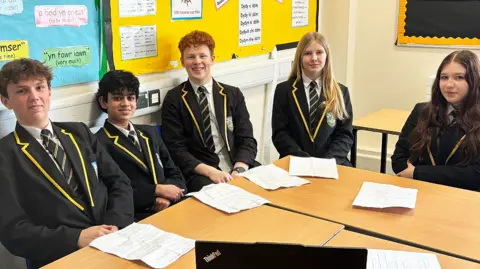 Ysgol Penrhyn Dewi
Year 10 GCSE French students Kit, Jake, Hugo, Cali and Maisy encountered Chinese, Japanese, Tamil and Spanish when they did the mentoring project in Year 9
When Hugo signed up for a project to help him decide if he wanted to study French at GCSE, he had no idea it would lead him to learn Mandarin.
The Year 10 pupil is one of a growing number who are helping turn around years of decline in language uptake thanks to a more novel approach to learning, courtesy of the Cardiff University-led modern foreign languages (MFL) mentoring.
Project head Lucy Jenkins said it "takes the language learning out of language" by exposing pupils to ideas to make them think about the reasons for learning another language, rather than the traditional vocabulary and grammar.
Sport, performance and culture, body language and even gestures are all used in the course and, until a few years ago, no language was taught at all.
"It's not so you can order a baguette in a boulangerie. It's so that you can understand that other people have different perspectives to you and they see things, feel things, taste things, experience in a really broad way their whole world in a different way," said Lucy.
MFL mentoring figures showed increases in uptake for two consecutive years, rising 3.6% in 2023-24 and 9.6% in 2024-25, with 4,292 entries in 2025 according to the British Council.
But as Hugo and fellow pupils at Ysgol Penrhyn Dewi in St Davids, Pembrokeshire, discovered, this innovative programme has helped turn the tide.
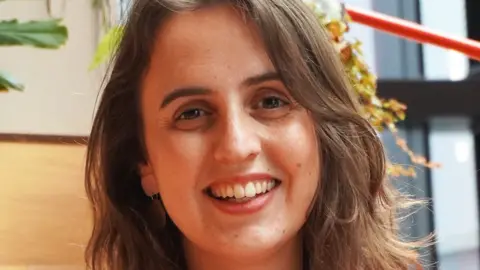 Lucy Jenkins
Lucy Jenkins says the purpose of the course is "not so you can order a baguette in a boulangerie"
It deliberately targets pupils who are undecided about taking a language, which is assessed by a questionnaire, and focuses on learning about identity.
"We get them to think about the world in which they live, the things they do, the food that they eat, and then we start to think about the language learning," said Lucy.
When the scheme began in 15 schools in 2015, it was much more functional.
University students studying French, German or Spanish were recruited as mentors to teach school pupils, but then there was an overhaul to try this novel approach.
When student mentor Firial Benamer began volunteering on the programme five years ago, there was no language teaching component whatsoever.
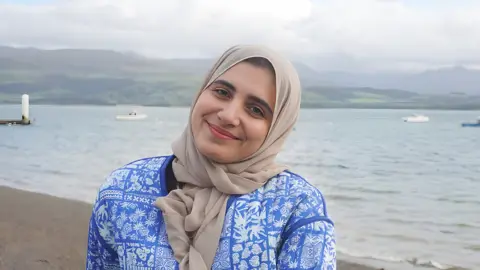 Jacob Lloyd/MFL Mentoring
Student mentor Firial Benamer was inspired to learn other languages because she was interested in the cultures they represented first
The Cardiff University PhD student said the programme, now in 111 schools, had evolved and some sessions have a "mini-taster" of languages.
A native Arabic speaker, born in Libya before moving to Swansea as a teenager, she can also use herself as an example – she has learned Japanese and Turkish and is looking to become fluent in Welsh.
She chose Japanese initially because she liked anime and Turkish because she started watching programmes from Turkey, which feeds perfectly into the concepts behind the course, that culture and experiencing language as a real part of people's lives is the draw to encourage people to learn.
Hugo and his fellow Year 10 French students can attest to the success of this method.
Kit said: "I think because we were learning about so many things like culture, food and all the other things around the language, we could know more about it.
"They put a picture on the board and we had to guess which country the food was from.
"Some of them would look like they were from one country. They'd just be from somewhere completely different."
Jake said one of the fun parts was learning letters in different scripts: "We learnt some in Chinese and Japanese and it was really fun trying to draw it. It's a lot harder, but it's more fun."
Hugo enjoyed it so much that he decided to include Mandarin as part of his Duke of Edinburgh award as it was "such a vastly different language from English".
Prior to the course, he saw languages as "almost irrelevant".
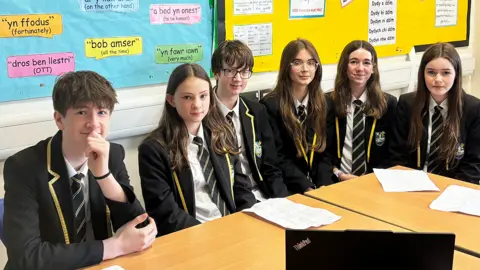 Ysgol Penrhyn Dewi
Oscar, Ella, Ifan, Ariana, Bethan and Isabella are some of the Year 9 cohort who did the course
Jake also had a change of heart after realising the importance of languages: "In the future if I go to France or somewhere that speaks French, I can socialise with them instead of wondering what this is about. I can learn about their history."
Cali thinks people don't take languages because they assume "most people speak English, I'll be fine" but feels studying another language "opens up your opportunities".
Maisy agreed, adding: "I think it does create new avenues for you to go down in terms of jobs or if you want to go to further education."
This year's cohort, the Year 9s who took the course while approaching GCSE choice time, explained what had previously made them uncertain about opting for languages.
Ariana thought it would be a "cool skill to have" but "found it hard to learn" whereas Bethan found them "quite boring... and I wasn't really excited to go and do them".
Like the Year 10s before them, playing games and getting to know more about different cultures brought the idea of language alive.
Isabella, who wants to be a pilot, said it would allow her to "communicate with other pilots from different nationalities and passengers from all over the world".
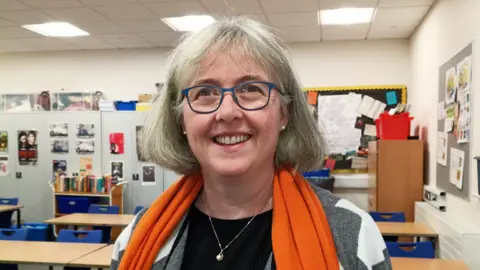 Victoria Rowe
Victoria Rowe says the impact on the number of pupils taking languages at GCSE has been "noticeable"
Ysgol Penrhyn Dewi's French teacher Victoria Rowe thinks having mentors who are relatively close in age to the pupils has helped changed perceptions.
"One year we had a mentor who was on placement in Paris so she would join from wherever she was in Paris, so would come with all these Parisian backdrops, which was quite lovely."
In total, more than 40% of Victoria's pupils have opted to take language at GCSE, compared to about 23% previously.
"We've had a dramatic increase the past couple of years. So it's very, very noticeable."