.png)
 1 month ago
70
1 month ago
70
Did anyone inside the sold-out Allianz Stadium, or watching around the world, really expect Ben Donaldson to slot the game-winning kick at the death? A few minutes earlier, when his team still held a slender five-point lead, he had the ball on a tee a little closer to the poles and a little further away from the right touchline. That effort curled across the face of goal and never threatened to sneak inside the upright.
This one was more of a challenge. Just about the toughest challenge a right-footed kicker can encounter. He struck it better but started it too far to the right without the requisite bend. And as the ball sailed wide, it seemed to carry with it the story of Australia’s afternoon. Brave and brilliant, frenetic and entertaining, but ultimately still missing some crucial ingredients as they went down 31-33.
This 10-try thriller should not have come down to a single kick from row Z. Australia were the better team. They made 141 carries to Ireland’s 125. They broke the line 11 times and won more turnovers. They made a mess of Ireland’s lineout and dominated at the scrum. Len Ikitau and Joseph-Aukuso Suaalii fizzed in midfield. Carter Gordon ran it straight from fly-half as the ruck speed violated Sydney health and safety codes. Josh Canham produced one of the best all-round games by an Australian lock for some time.
Most striking of all was the handling. There was a technique that appeared too often to be accidental and was performed by too many players to be merely instinctive. A Wallaby carrier would catch the ball, push his arms forward as if teasing the tackler, then flick the pass left or right to a teammate running hard off his shoulder.
Angus Bell did it. Rob Valetini did it. Max Jorgensen did it. It did not seem to matter whether the carrier was a prop, a lock, a flanker or a centre. The trick was the same. Catch, extend, commit the defender, pass. Again and again there was another man in gold, another runner, another crack appearing in Ireland’s defensive line.
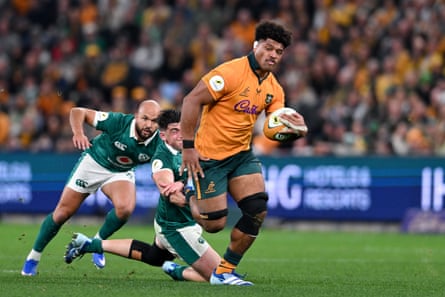
It was too ubiquitous not to carry the fingerprints of Joe Schmidt. The same was true of the line speed. Jorgensen’s intercept before Ryan Lonergan’s first-half try was not simply a case of a winger gambling and getting lucky. It was the product of pressure. Australia were up quickly, thinking quickly and acting quickly. Ireland missed 13 tackles, which is not a number normally associated with an Andy Farrell side.
And yet Ireland stayed in it. They kept hammering away at the line, kept squeezing penalties, kept asking Australia to defend one more phase, one more carry, one more close-range assault. Jamison Gibson-Park’s try just before half-time changed the temperature of the match. Australia still led, but Ireland had stolen oxygen from a half that had mostly belonged to the home side.
This is where the buts begin. Australia were wonderfully sharp when the game was quick. They were less convincing when it slowed down. They had Valetini, who was typically excellent. They had Bell, who carried hard. Taniela Tupou won a huge scrum penalty late on. But they did not quite have the enormous presence who can turn a tight carry into a dent, a dent into panic and panic into points.
That is why Will Skelton remains such an alluring prospect. He gives Australia what they still seem to lack. It’s not ambition, it’s pure blunt force. If you cannot regularly stop momentum with dominant collisions, you are more often forced to fight for the ball from compromised positions. Against a team as patient as Ireland, those tiny losses soon morph into five-metre lineouts.
after newsletter promotion
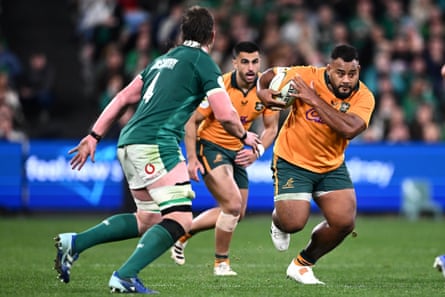
Tadhg Beirne, off the bench, offered the contrast. His introduction on 51 minutes coincided with a shift in momentum, not because Ireland suddenly became more inventive, but because they became more direct. He brought weight, nuisance and certainty to the ugly places as Ireland reverted to a gameplan that has won countless rugby matches since the sport’s inception.
Which brings it back to Donaldson, though not as the villain. No one should pretend this was all on him. Gordon had already missed two conversions in the first half. The Wallabies had chances to stretch the lead and chances to close the game. Donaldson’s final kick was simply the last and clearest expression of a broader equation.
Test rugby is often dressed up as a complex sport, and much of the time it is. This match had intricate handling patterns, breakdown contests, lineout disruption and tactical momentum swings. But some truths remain blunt. If Australia can keep playing with this much ambition, skill and speed, they will trouble anyone.
To beat the very best, though, they still need two old things. A big man who can batter people when beauty is not enough. And a clutch goal-kicker who makes everyone in the stadium believe, before he has even taken his first step, that the ball is going over. Without them, the Wallabies will thrill, but the biggest games may keep slipping away.