.png)
 3 weeks ago
41
3 weeks ago
41
How we talked. On late-night news shows, disembodied heads above a rolling yellow banner. On planes and trains, at bus stops and flower shops and kids’ birthday parties, trying desperately to connect the ennui of the now with the vividness of the later, trying on some level to anticipate the feelings, the blood surge, the heart rush. At the sinks in the office toilets, jerthinktheylldoit, theyactuallymighty’know, shake-shake, and your devastating analysis of the Rice-Anderson-Mainoo triple pivot gets lost in the noise of the hand-dryer.
Two years of this. Countless millions sunk on tickets, hotels, Ubers, shirts, pizzas, flags, the hours spent on Google Maps trying to locate somewhere to eat after 11pm in Riga, the endless psychodrama over Jude Bellingham and whether he should have been left at home or not (turns out, not). How we bled and sweated over this, over the minor details of the journey, over whether Danny Welbeck had done enough to earn a place in the squad or not (turns out, not). All pointing towards the moment on Wednesday evening when England are 1-0 up in a World Cup semi-final against Argentina and your entire happiness rests on whether a bunch of millionaire footballers and a millionaire German coach can keep their shit together for 40 minutes, or not.
Turns out, not. And out there, on the ragged shores of This England, there is a view already beginning to take shape. That while Thomas Tuchel’s substitutions may have cemented Argentina’s territorial dominance, England were basically under the pump long before that point, already dropping back and committing to a defensive rearguard. That this is in fact a wider malaise, perhaps even a kind of moral deficiency, a long and persistent pattern of failure in which – say – getting destroyed 4-1 by Germany in 2010 and losing to France in 2022 with 57% possession are basically the same offence, a common sickness, the same lozenge in different flavours.
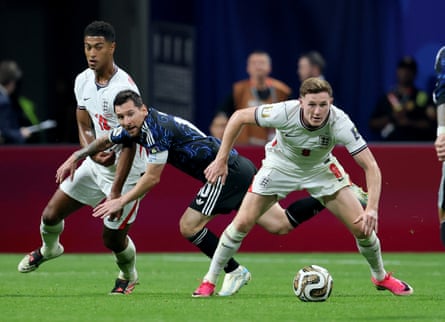
And you have to challenge these things at source, because if you don’t challenge them they become established fact, whether or not they’re actually true. Well, I’ve watched the tape back so you don’t have to. Specifically, the 13 minutes from Anthony Gordon’s goal hitting the net to the second drinks break. In those 13 minutes England have to weather quite a bit of Argentina pressure. There are corners, crosses, a header from Nicolás González that Jordan Pickford gets down well to save. But none of this is remotely out of the ordinary.
Indeed pretty much as soon as Argentina kick off they gift England another opening, Lisandro Martínez letting the ball run under his foot, Morgan Rogers winning possession, and Harry Kane not quite able to control his pass. By 61 minutes England have pressed Argentina back into their own third. In the subsequent minutes Kane and Declan Rice will both have low-percentage shots from distance.
The problem here is not tactics, not fatalism, not an endemic national culture of failure, but poor decision-making, perhaps reinforced by fatigue. Lionel Messi is not yet running the game, and none of what follows is inexorable or inevitable, let alone generational. The drinks break arrives and England can rest for a few minutes, perhaps even make a sub or two to freshen things up. It is at this point that Tuchel decides to blow up England’s chances of winning the World Cup.
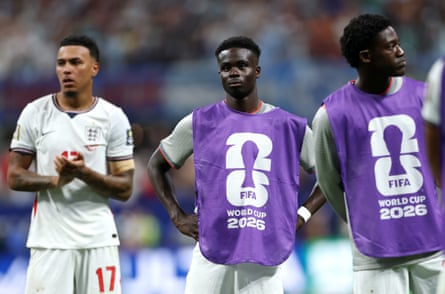
As a counterfactual, what would have a more optimistic and effective response looked like at this point? Kane was clearly out on his feet, and keeping him in play for the faint possibility of penalties in an hour was madness. So Ollie Watkins comes on to stretch the play and lead the press. This is no longer a game for Rogers and so you throw on Bukayo Saka, not just for his defensive skill but his ability to dribble his way out of pressure and feast on the spaces that will open up. Above all you trust in the process, the sense of purpose and ambition and unity that knows that World Cups are won, not survived.
“If we lose, we lose in our way,” Tuchel told his players at half-time in the opening game against Croatia, a call to arms that generated some of the most thrilling football England have played at a major tournament in my lifetime. Where did that go, Thomas? Or: where did that Thomas go? Perhaps at some point on the road to the Azteca, or in the heat of Miami, Tuchel lost the simple faith that had brought England to this point.
This is how you end up with six defenders on the pitch, with Saka and Watkins and Kobbie Mainoo and Eberechi Eze and Noni Madueke all fresh and unused on the bench, with Cole Palmer and Phil Foden and Trent Alexander-Arnold and Adam Wharton and Morgan Gibbs-White at home. Between the second hydration break and the second Argentina goal, England had less than 8% possession, completed just five passes in 25 minutes, allowed a 39-year-old player from Major League Soccer to play exactly the sort of game he would have craved.
Let us not relitigate every single one of these decisions in isolation; what is being argued here is a broader direction of travel. For an England fan this is perhaps the part that hurts the most: we believed in this team and these players right to the end. What if Tuchel never really believed in them at all?
after newsletter promotion
“Ball possession is not in our DNA like it is in the Spanish DNA or the Argentinian or Brazilian DNA,” Tuchel said after the game. If this was once undeniably true, it is now at best arguable and at worst a form of gaslighting that should disqualify Tuchel from the job on the spot. Rice, Saka, Mainoo, Elliot Anderson, Eze, Reece James, John Stones: based on what we know of them at club level, are these players who have trouble keeping the ball? Perhaps it is no wonder that in subsequent days reports have emerged from the England camp that the players themselves were unhappy with Tuchel’s safety-first approach: an approach that left them with no outlets, no options, no tools except the bluntest of all.
These are players who want to play football, who want to express themselves, backed by thousands who emptied their life savings to travel, to pursue, to feel something. This is no longer a nation that punches pitifully below its weight at international level, that neglects the tactical and technical aspects of the game, that quivers at the thought of penalties. Is it unreasonable to demand a coach who sees what these players can do, rather than imagine what they can’t? There are those who argue soberly that changing the coach at this point is a triumph of emotion rather than reason, that there is nobody better out there, that there is a lucrative contract that needs to be honoured.
But for a coach hired to win these hinge moments, detonating a World Cup semi-final feels like the ultimate red-flag behaviour. And beyond this the small-mindedness, the absence of ambition, the audacity required to neg the entire English game rather than admit to one’s own cowardice. Tuchel was hired to unleash the considerable potential of a supreme generation of English footballing talent. From what we’ve seen, it’s not immediately clear whether he can even see it.