.png)
 4 weeks ago
43
4 weeks ago
43
55 minutes ago
Priya Sippy and Basma El AttiBBC Focus on Africa

 Diaa Talha
Lead vocalist Ibrahem Mahmoud was arrested several times for "singing the truth"
Members of one of Sudan's most influential bands, Aswat Almadina, are scattered across the world, clinging to the hope that their music will be an inspiration for peace in a nation ravaged by war.
Timon was among the six members of the band who left Sudan two months after the conflict started in 2023, traumatised by the sight of dead bodies, destroyed buildings and burnt-out cars in the streets of the capital, Khartoum.
More than 150,000 people have died in the conflict, and about 12 million have fled their homes in what the United Nations has called the world's largest humanitarian crisis.
Timon - whose real name is Mohammed Almustafa - was among the founding members of Aswat Almadina, meaning Sounds of the City, in 2014.
Their music blends Middle Eastern folk influences with urban pop and vibrant jazz, creating a distinctive and compelling sound from a once-peaceful city with an estimated population of more than seven million.
"We called ourselves 'Sounds of the City' as Khartoum is our inspiration," says Timon.
"Our music comes from the atmosphere in Khartoum, the natural sounds of the city, the sounds of the people, the sounds of the streets."
They quickly built a devoted following, especially among Sudanese youth, and became the first Sudanese band to tour the country.
"I remember one time we were performing, and we saw one lady holding a sign that said: 'Your music saved my life'," says Ibrahem Mahmoud, the co-founder and lead vocalist.
"I always keep that memory with me - it means that our music has a big responsibility."
Their lyrics, addressing social justice, corruption, and the everyday struggles of young people, earned them recognition as UNDP Goodwill Ambassadors in 2017.
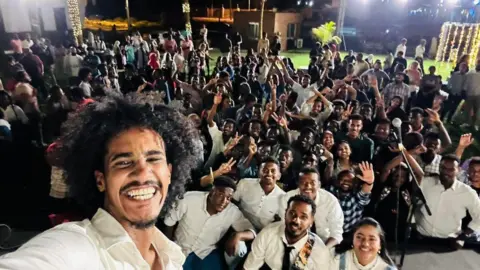 Aswat Almadina
Ibrahem Mahmoud says he is "just visiting" Saudi Arabia
For Ibrahem, music was always intertwined with activism. Before the uprising that saw longtime leader Omar al-Bashir ousted in 2019, he was repeatedly arrested for songs critical of the political system.
"I got arrested a lot by national security because of what I was doing - singing the truth. Thank God I'm still alive," he says with a smile.
The unrest began in December 2018, when Bashir introduced austerity measures to address a deepening economic crisis.
Cuts to bread and fuel subsidies triggered protests that spread from the east to the capital, evolving into nationwide calls for his removal after three decades in power.
Music became a defining feature of the uprising, with the lyrics of Aswat Almadina being chanted through the streets.
Ibrahem now lives in the Saudi Arabian city of Jeddah, after spending several years in Kenya's capital, Nairobi, but life in exile remains uncertain.
"I don't consider myself based in Saudi Arabia. I'm just visiting. My journey is still going on, and I don't know when it will end," he tells the BBC Focus on Africa podcast.
Timon, meanwhile, is based in the Egyptian capital, Cairo, having endured a difficult journey from the United Arab Emirates (UAE) to be reunited with his family after two years.
"I missed the birth of my second child because of that," he explains.
Today, Timon sits in a softly lit studio, looking at a photograph from one of their final concerts in Khartoum.
"It was a month before the war. When you look at this, there was a Khartoum. There were very lovely nights in Sudan."
Elsewhere, Ibrahem reflects on those same memories.
"It was beautiful. It was warm."
Ibrahem and Timon remember exactly where they were when the civil war broke out in April 2023.
They were huddled, with several other members of the band, in a small studio in Khartoum, surrounded by electric guitars, keyboards, drums and saxophones, writing lyrics and recording new music.
But later that day, everything changed.
The studio fell silent as the sound of gunfire echoed through the streets.
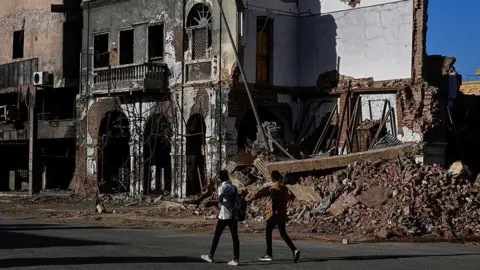 AFP via Getty Images
Years of war have left cities across the country in ruins
"At that time I didn't believe it was a war," says Ibrahem.
"It was a confusing moment. We didn't know what was going on. We had never been in this situation before. It was very, very confusing."
Believing that the conflict would pass quickly, the recording studio became Ibrahem's temporary shelter while he continued to make music, writing and recording a song, whose title translates as Give Peace A Chance.
It was recorded remotely with a musician based in central Sudan, but they struggled to exchange files over a flickering internet connection amid ongoing shelling.
"The sounds of the weapons were loud, but there was always music going on," Ibrahem recalls.
"Music is my survival mechanism, it's always saving my life," he adds.
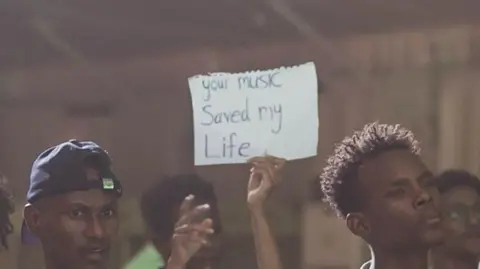 Aswat Almadina
Three years after the war started, music is a symbol of hope for many people
Despite the distance between them, the band's connection remains unbroken. They continue to collaborate remotely, working on a new song titled Sudan. The song, which they say reflects both the country's beauty and its pain, will be released later in April.
They believe the music will mean a lot to their fans at a time when the country continues to endure the devastation of war.
"The arts have a power," says Ibrahem. "It carries a lot of emotion for people."
They hold onto the hope that one day, Aswat Almadina will stand together again in the same room.
"Being part of this band is a dream come true for us," Timon says.
"There's always hope. I want everyone, not just me, to speak about peace and love. That's what will make things better, more than speaking about war."
More on the Sudan war from the BBC:
 Getty Images/BBC