.png)
 1 month ago
22
1 month ago
22
“It’s tough, it’s stressful, it’s completely draining … but I absolutely love what I do,” says Scott Davies, sitting in an empty dressing room waiting for his players to arrive for training. Since 2022, Davies has been the player-manager of Slough Town who, in third from bottom in National League South, are the lowest ranked team left in this season’s FA Cup.
Some players are stuck in traffic; training was moved forward to teatime to accommodate a local team’s match on the Arbour Park pitch. When the session gets under way in the bucketing rain, the sixth-tier side are sharing the 3G surface with a junior team. “I always thought I’d love to be a manager of a non-league football club and have a job on the side,” says Davies. The 37-year-old has opted out of training himself, instead watching the session from inside, with a tactics board propped up in front of him.
The day before, he is at Aylesbury grammar school to work his other job. Over the course of 45 minutes, he quietens a lecture theatre of sixth-formers with a sobering talk on how a gambling addiction derailed his career as a professional footballer, put a strain on his relationships with friends and family and took him to the verge of ending his own life.
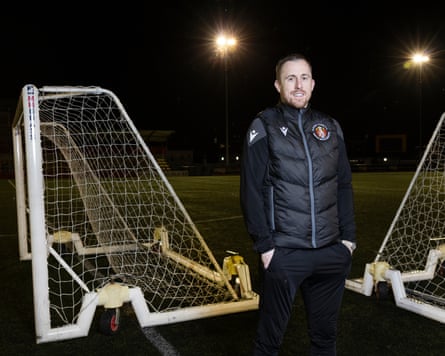
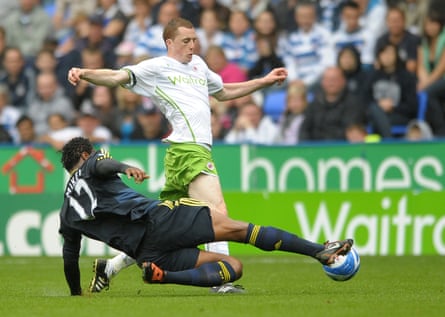
After going into rehab 10 years ago, Davies has not placed a bet since and is now an educator on the dangers of gambling for Epic Risk Management. He talks to the all-boys school of how, when he scored a free-kick against Chelsea’s Petr Cech in a pre-season friendly for Reading in 2009, he thought he had made it. But by then, at 21 years old, his betting was out of control.
The talented midfielder, then playing Championship football, was sneaking out of training at the first opportunity to head to the bookmakers, often making up excuses to leave – one day saying that he had a dentist appointment. When asked by his manager, Brendan Rodgers, to call the dentist to prove it, Davies could not and he was not picked by Reading again.
While on loan at Wycombe in League One, Davies thought he was on his way to Leeds. When he saw on Sky Sports News they had signed someone else, he went to the bookmakers and lost £7,000 in one day. When he was at Crawley in League Two, he started gambling on his own matches and would sneak off into a toilet cubicle at half-time to place bets. Then at Oxford United, he would stay up all night to place bets.
By the age of 26, Davies’s career was in freefall. He dropped three divisions to play for Dunstable Town. His first game was away at Bideford, with the team bus driving past Reading’s stadium. “That was a moment of realisation,” Davies says. “I remember looking at the ground as I went past it and thinking: ‘What has happened?’ I’m never going to forget that moment.”
His coach at Dunstable, Tony Fontenelle, is now Davies’s assistant at Slough and the pair have created an environment where their players can talk to them about anything, breaking down the barriers of macho culture that existed when Davies first came through and was afraid to talk to anyone at his club about his addiction.
“We always stress the importance that we’re not just managers: we’re life coaches, we’re counsellors, we’re father figures,” he says. “We’ve had lads in this changing room stood here crying, with our arms wrapped around them, having heart-to-hearts, where they’ve been going through something outside of football.”
While every case is individual, Davies believes young footballers are susceptible to becoming problem gamblers. The money, the spare time, the competitive nature of it, the perceived insider knowledge when it comes to sports betting were all factors that contributed to his addiction. “When you put all of those things together, you’ve pretty much got the perfect customer for a bookmaker.”
In the week leading up to Sunday’s second-round tie at home to Macclesfield, Davies is speaking to Ipswich and Aston Villa’s under-21 teams. “I do feel like we’ve got a duty of care to protect the younger generation, the ones that are coming through, and that’s why I do the job that I do,” he says.
after newsletter promotion
Balancing his two jobs has not been a problem until now but, while Davies has not put all his eggs in the management basket, you can sense a desire to prove a point. When the previous managers resigned three years ago, the Slough board asked the midfielder if he wanted the job. “I was a bit bamboozled,” he says. “I did my first coaching badge when I was 16. And then I did my next badge when I was 36. I qualified with my Uefa B [licence] this year. I only did it because I became a manager almost overnight.”
Now settled, married and the father to a 10-month-old daughter, Davies is yet to hang up his boots and is planning to start on his Uefa A licence. “There’s a lot of regret but the beauty of coming out the other side and moving on to management is that I’m going to right the wrongs of my playing career with what will hopefully be a long, distinguished management career.”
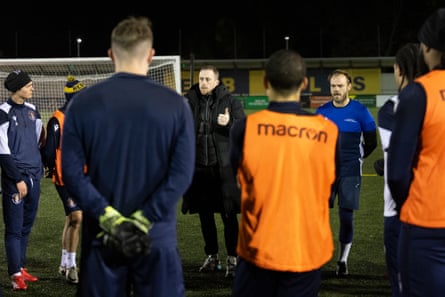
Slough have never reached the third round of the Cup and have already made it through four rounds. Their eight second-round exits are a record for a non-league club. Such is the money involved, drawing a Premier League club in the next round could bring a windfall in seven figures for a team whose squad includes builders, personal trainers and teaching assistants.
The prospect of facing coaches such as Pep Guardiola in the third round is a curious one for Davies. “I don’t think there would be any tactics that go with the game. It’s one of those where you’d be happy to lose the football match just for the experience. It’s incredible to see the non-league teams that get drawn against some of these giants over the years. You see it and you think: ‘One day, can it be you?’”
-
In the UK, support for problem gambling can be found via the NHS National Problem Gambling Clinic on 020 7381 7722, or GamCare on 0808 8020 133. In the US, call the National Council on Problem Gambling at 800-GAMBLER or text 800GAM. In Australia, Gambling Help Online is available on 1800 858 858 and the National Debt Helpline is at 1800 007 007
-
In the UK and Ireland, Samaritans can be contacted on freephone 116 123, or email [email protected] or [email protected]. In the US, the National Suicide Prevention Lifeline is at 988 or chat for support. In Australia, the crisis support service Lifeline is 13 11 14. Other international helplines can be found at befrienders.org