.png)
 1 month ago
84
1 month ago
84
If you’re going to die, die with your boots on. Belatedly and pointlessly on. But on all the same. It felt deeply fitting that West Ham should show some fight on the final day of the Premier League season, but that relegation should still be confirmed by events elsewhere, any pleasure at a 3-0 defeat of Leeds rendered irrelevant by Tottenham’s win at home against Everton, as West Ham’s season flopped like an ailing dog in the mid-summer heat.
There was at least some joy at the London Stadium, a reminder that joy is both the only thing that actually matters here, and also the precise polar opposite of the football-club-shaped blob that West Ham’s ownership has created. When Jarrod Bowen scored West Ham’s second goal on 78 minutes, charging past a Leeds defence already ranged about the place on sun loungers flicking through the latest Sally Rooney, there was a brief glimpse of some other West Ham, some other reality, a lost place of greater care and competence, other hands on the wheel.
But no. Events elsewhere, old boy. Here was another day in this club’s history that said, very clearly, this thing is now beyond your reach. This was the story of the day and also of the season. “You sold our soul for this shithole,” the home fans sang through the dappled late-afternoon sun as David Sullivan sat looking opaque in his VIP director pod – and this is exactly what has happened here, a macro-collapse, a managed alienation, a club that has forgotten what it was trying to be.
It was a genuinely strange day at the London Stadium. Football clubs have such profound cultural life in them. This stuff is in your blood like holy wine, so bitter and so sweet. But it doesn’t mean they’re unbreakable, and West Ham have been broken, a case study in managed corporate entropy.
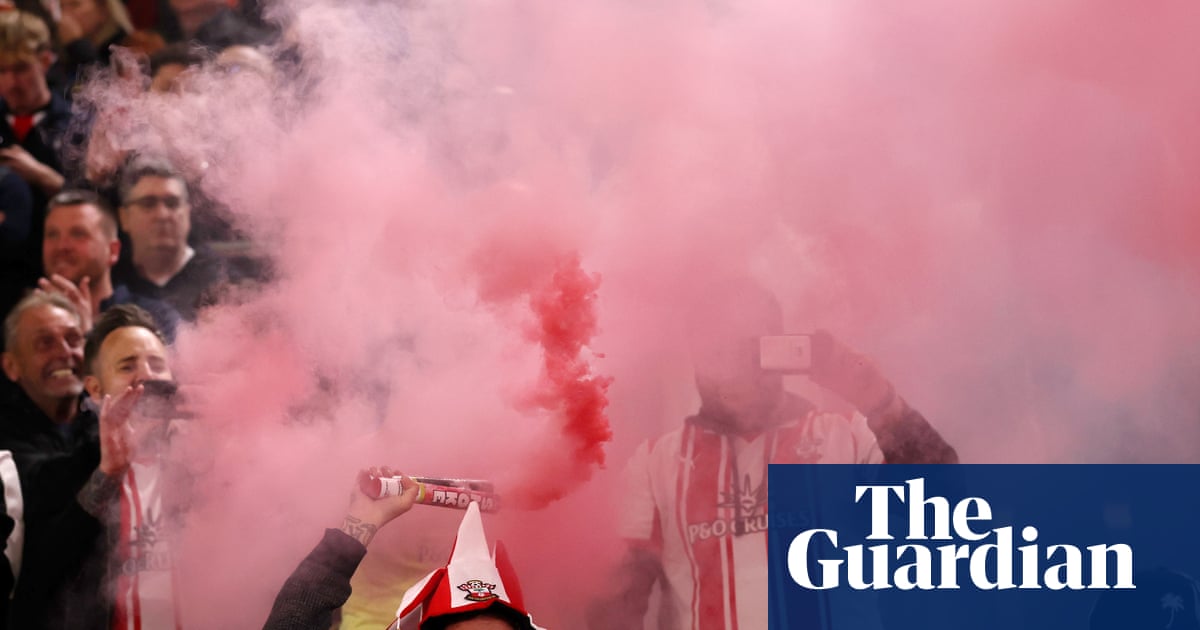
They are, of course, far from alone in this. The prize here wasn’t just escaping relegation, but avoiding the title of most appallingly-managed London team, most debauched waste of resources, most impressive incineration of your own advantages on a brazier of incompetence. Even the West Ham matchday programme featured a cover photo of a righteous flame devouring a darkened corporate hell-hole, although on closer inspection this turned out to be a picture of some excited fans watching a pre-match fireworks display.

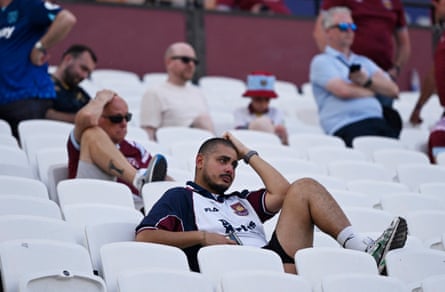
In the event it took 43 minutes for that flame to die. It is rare to hear a genuinely new and surprising expression of emotion. But there was one of those here as news filtered through that Spurs had scored and instantly the energy just vanished from the stands, like watching a blackout engulf Los Angeles. Even the boos at half-time felt like boos by rote, as though the club had employed its own outside hype-booers just to generate some energy.
These are always creepy occasions, ghost games haunted by voices through the wall. The ground had been debilitatingly hot at kick-off, the pitch-side machines pumping out exhausted, heat-sapped bubbles, which sank instantly and expired on the running track.
This place always feels odd just because of its topography, the sense of being at the wrong angle to the pitch. Ten years here have never fixed that disconnect. Perhaps the club can at least rustle up a beta-level naming rights deal for the second tier. Wimpy. Ask Jeeves. This game is brought to you by the Ryanair extra legroom executive hate-space.
Nuno Espírito Santo was out on his touchline from start to finish, something of a relief in itself given his deeply-haunted picture above his programme notes. “There are a great many things we could say about the last few matches,” Nuno had written. “Almost none of them are good.”
So, what now then? By common estimates West Ham’s relegation will cost the club £100m in its first season alone. Jobs will be lost, members of staff laid off. There are wider implications too. Sadiq Khan has suggested relegation will cost everyday Londoners £2.5m to cover the rent and stewarding, consequence of a disastrously bad deal negotiated by (no, really) Boris Johnson.
It is no mystery why this has happened. Why have West Ham been relegated? Relentless executive failure. The shameful squandering of resources. A complacent, low-quality management tier that has been completely outflanked by highly competent middleweight clubs elsewhere levelling up in every area, while West Ham have doodled around in their rented shopping centre annexe.
Sullivan and his assorted close relatives in executive roles must take the blame for this. It is commonplace to call old-school football figures “dinosaurs” but this is unfair on dinosaurs, who did at least evolve to some degree, who are still among us, pivoted into birds and lizards.
West Ham’s entire corporate structure contains nothing but slackness, no exceptional qualities from player production to managerial hiring and firing. This is a hugely mediocre organisation, one that has now expressed those qualities in the hard currency of results. The remaining dinosaurs will at least live to see their own investment value shredded. Or better, cut their losses and lumber off, with the Czech billionaire Daniel Kretinsky flexing his ownership muscles.
What kind of West Ham will emerge from this? One without Bowen and Mateus Fernandes for starters, and presumably with a new manager to sift the wreckage. This seems fair. All that’s really worth hanging on to here is the noise, the rage, the applause at the end; in fact the only things that actually mattered all along.