.png)
 5 hours ago
1
5 hours ago
1

 BBC
BBC
Prize draws and competitions are a "significant and growing market", the government says
Prize draws and competitions seem to be everywhere, from social media feeds to adverts on TV, but gambling support organisations have warned of their addictive potential and say they are having to help and support people who have fallen foul of the lure of luxury rewards.
Lisa, whose real name has been withheld, said she found herself in thousands of pounds worth of debt, hungry and having to use tissues for tampons due to a lack of cash after becoming addicted to such prize draws.
"I lay awake one night and just felt like I didn't want to continue life because of this awful secret: debts building up, nowhere to turn. I was so ashamed," she said.
Lisa, 33, a single mother-of-one who had previously struggled with gambling addiction, explained that she had initially started taking part in raffles on Facebook before she came across more official competitions advertising bigger and better prizes like houses, cars and cash.
In association with such larger competitions, many websites also offer instant-win draws, which are available to play 24/7 for as little as one pence and which allow someone to enter as many times as they like.
Lisa said she found these temptations too enticing to ignore.
"You win £20 credit and £30 instant win prizes and it keeps you going and feeling, 'oh, this is fun'. It's like when you play a slot machine," she said.
"I'm not a mindless gambler. These do offer an incentive and I'm in it for the incentive."
Lisa said that with no spending limits in place, she reached a point last year when she was spending so much to chase her losses that she could not afford basic essentials like shopping.
She said that in one week she spent her entire monthly disability benefit of more than £1,200 on one website, but the luck of the draw was not on her side.
"Once you hit that desperation point you start increasing it," she admitted.
Lisa did not tell her family about the £5,000 debt she had racked up entering competitions again and again, with no limit on how many times she could try her luck.
"You feel a complete lack of hope or care for the future. You are just going through the motions," she said.
"You are waking up every day and worrying how you are going to afford things."
Under the Gambling Act, to avoid regulation, competition giveaways must offer a free entry route or feature a skill-based element, such as a multiple-choice question, which players answer correctly to take part.
Dr Matt Gaskell MBE, clinical lead and consultant psychologist at the Leeds-based NHS Northern Gambling Service, said: "It looks like a real grey area that's being exploited."
 Milamai/Getty
Lisa emailed the prize draw firms and begged them to block her account
Under the Gambling Act, to avoid regulation, competition giveaways must offer a free entry route or feature a skill-based element, such as a multiple-choice question, which players answer correctly to take part.
Dr Matt Gaskell MBE, clinical lead and consultant psychologist at the Leeds-based NHS Northern Gambling Service, said: "It looks like a real grey area that's being exploited."
In the absence of an industry body, the government has introduced a voluntary code of "good practice" for the sector, which it described as a "significant and growing market", with at least 177 operators having signed up to the code so far.
Sir Iain Duncan Smith, co-chair of the Gambling Reform All-Party Parliamentary Group (APPG), said the move was "welcome" but "does not sufficiently address the risks posed by the rapid growth of prize draws and competitions".
In Lisa's view, a lack of regulation meant that escaping the temptation of instant win prizes became even harder.
Safeguards such as blocking payments from her bank and stopping adverts from popping up online were unavailable to her, she said.
These safeguards would have been available had the sector been regulated by gambling laws, with some introduced as part of the voluntary code.
Lisa admitted to putting "everything" she had into her addiction - at one point making 90 transactions totalling £400 in a single day.
In an email to one prize competitions firm, pleading with them to block her account, which has been seen by the BBC, she wrote: "This morning I had to accept that using tissue paper as tampons and going hungry is my new reality."
"They will text you, they will email you, and you feel an urgency," she said, unable to recall how many companies in the burgeoning industry she had spent money with.
"They really want to tap into the quick, instant desire."
Lisa said her experience had been "costly and upsetting", but she was eventually able to overcome her addiction to instant win prize draws with the help of a gambling support service.
Dr Emma Ryan, deputy medical director of the Primary Care Gambling Service, an NHS service for adults experiencing gambling harm, said celebrities advertising prize draws had led to their "normalisation".
Women and those experiencing loneliness were particularly vulnerable to experiencing gambling harm, according to Ryan.
"People tend to get pulled in because it's a community, and before they know it they have given quite a lot of money over," she said.
"We see gamblers who have it ingrained because they have grown up with gambling or they have had a really traumatic childhood, so they are using it as an escape.
"We also see individuals who have been influenced by the industry. Lots of the adverts and lots of the products out there are trying to hone in on women."
Ryan added: "All these products out there, whether they come under the Gambling Act or not, they are all very dangerous.
"People don't realise what they are getting pulled into because they don't see it as gambling, because it's normalised everywhere."
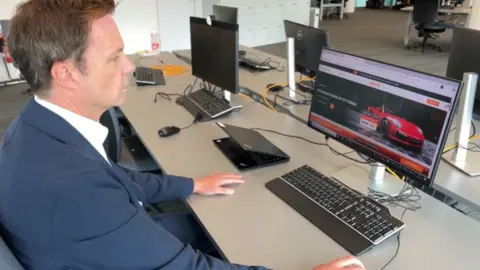
Dr Matt Gaskell has raised concerns over the "aggressive marketing" used by giveaway companies
Meanwhile, Gaskell said that, like gambling, prize draws and competitions "exploit the reward pathway in the brain".
"With gambling, we are always concerned with the way it seems to disproportionately harm deprived communities. That doesn't seem to be any different here," he said.
"It's becoming something that more and more staff are mentioning. That's why we think there need to be tougher laws and regulations."
Sharing his own experience of taking part in a giveaway competition, Dr Gaskell said: "It seemed to be something that looked like gambling, felt like gambling.
"It seemed to be that you are actually going to be wagering and losing money on primarily.
"The biggest thing that surprised me was the aggressive marketing that went with it. There was more aggressive marketing that lent itself to the potential of more aggressive wagering. That's where harm tends to ensue."
- If you have been affected by any of the issues raised in this story, information and support can be found at the BBC's Action Line.
After a BBC reporter set up an account with one prize firm website, they received seven marketing emails from the company in a single day.
One recovering gambling addict who now volunteers for a gambling support helpline said people seeking help for addiction to prize draws and competitions was "definitely on the increase".
"It's everywhere, all the time," the 59-year-old said.
"If you watch a programme for an hour, you can guarantee that you see an advert to win a house."
Discussing his experiences of supporting people who were addicted to prize draws, he said: "Most were at the point where they had lost control and they have spent all their money and started borrowing and stealing.
"They get fixed on a prize and think, 'if I keep on and keep on, I'm going to win it'."

Many prize draw operators offer instant win draws along with bigger giveaways
The government announced its voluntary code for prize draw and competitions operators in June last year.
It came after a research paper, based on interviews with 764 players, concluded that those taking part were "significantly more likely to be experiencing gambling harm than both the general population and those who participate in other gambling activities".
According to the research, over a fifth of players said they strongly agreed prize draws and competitions were addictive and 46% agreed, while just 7% disagreed and 2% strongly disagreed.
The paper also found there was "limited evidence of transparency around the free entry route" to enter giveaways, while the usual types of player protections were "absent from the websites of most operators".
Several people the BBC spoke to about one former prize competitions firm said the skill question they were required to answer to enter would be easy and remained unchanged for months at a time.
Additionally, the government's research paper found that a "substantial number" of operators did not mention a minimum age requirement to play, which in most cases was 18.
As part of the voluntary code, safeguards such as age limits and a ban on using credit cards for instant win prize draws have been introduced, as well as "suitable and proportionate" spending limits.
Signatories must implement the code by 20 May.
The Department for Culture, Media and Sport has said it would "periodically review" its effectiveness "to ensure that it is fit for purpose".
However, Duncan Smith said self-regulation had "proven ineffective across much of gambling policy" and called on the government to introduce "a robust regulatory framework with enforceable safeguards".
"The APPG is examining this sector as part of its ongoing inquiry and will assess whether the current framework is fit for purpose," he added.
The BBC contacted the UK's two largest competitions companies, Omaze and BOTB, both of whom have signed up to the voluntary code, for a response to these findings.
An Omaze spokesperson said its model was "built on products that appeal to a broad base of customers contributing modest amounts".
A voluntary spending limit was already in place prior to the code and would remain in place even though it was not required by the new legislation, they added.
The Omaze spokesperson said the introduction of the code of conduct was a "positive step in further strengthening standards across the sector".
"Omaze has long been a pioneer in customer safety practices, and we are proud that many safeguards that we have long-employed voluntarily are now formalised in the code for our sector," they added.
A BOTB spokesperson said it was a "responsible operator" and would "support raising standards across the prize competition sector".
They welcomed the voluntary code, adding: "It provides greater clarity for customers and strengthens important safeguards designed to protect players."
"The majority of our customers engage with our competitions as a form of low-stakes entertainment, and available government research does not indicate widespread harm, the spokesperson added.
"That said, we recognise the importance of consistency and transparency, which is exactly what the code is designed to deliver.
"We believe responsible operators should embrace higher standards."