.png)
 1 month ago
85
1 month ago
85

 Getty Images
Power banks are not allowed in checked luggage
Power banks are causing a growing number of serious issues on flights worldwide, the UK's aviation regulator has warned as it encouraged passengers to check the rules.
The Civil Aviation Authority (CAA) said "more awareness" was needed as portable chargers carry "serious risks" of overheating or catching fire.
Jonathan Nicholson from the CAA told BBC News that restrictions such as not putting the devices in checked luggage were not "somebody being pedantic" or "for the sake of it", with passengers urged "to do the right thing".
Nicholson said the "basic set of international rules" all passengers must follow on power banks are:
- Take them with you on board the aircraft, not in checked luggage
- A maximum of two power banks per passenger
- When on board the aircraft, don't use them and "absolutely do not charge the power bank itself because that's when they become really hot and most susceptible to having an issue"
The CAA is planning to launch a campaign this summer with UK airlines to explain what the rules are and why, for those going on their holidays and business travellers.
Last week, EasyJet flight EZY2618 from Hurghada in Egypt to London Luton changed course to land in Rome Fiumicino as a "precaution" after a passenger told crew members that a portable charger was in the aircraft's hold.
Passengers had to stay overnight until a rescheduled flight to London the next day.
"It is absolutely a rule that can make a difference," Nicholson said.
He added: "I wouldn't want to be the passenger who packed it in the wrong place and ended up with all the other passengers in the wrong city because the flight was diverted."
Nicholson said incidents involving power banks were "certainly on the rise" as portable chargers grow in popularity, alongside vapes which are not allowed in checked luggage either.
 CAA
CAA
Jonathan Nicholson of the CAA suggested passengers charge up their devices before boarding planes
This means lithium-ion batteries overheating - posing serious fire risks.
The data was compiled through voluntary reporting by 37 passenger and cargo airlines, and covers all rechargeable devices with lithium-ion batteries such as power banks, phones, tablets and laptops.
There was a 15% rise in incidents between 2019, when the organisation began collecting data, and 2024.
A survey by the CAA of 1,000 UK passengers in November 2025 suggested more than a third know what lithium batteries are and are aware rules exist, but are unsure what the rules involve. Over-55s typically knew the rules better.
Explaining why the rules are so strict, Nicholson said that compared to the likes of digital cameras and laptops, "power banks have a much bigger battery, much stronger and get a lot hotter".
"These things, when they catch fire, they go - they really go - they are big, big issues and big fires," he added, although cabin crew are trained on how to deal with it.
 Anadolu Agency/Getty Images
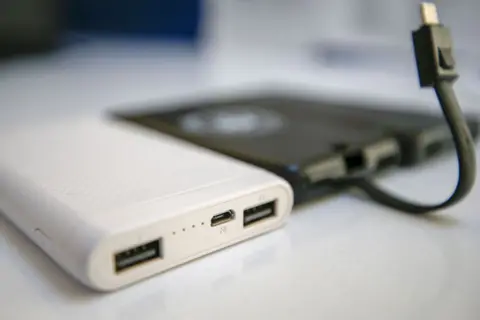
Portable chargers are a popular choice for passengers, with many short-haul flights not having plug sockets
He urged passengers to be careful with power banks not just on aircraft, but also in everyday life.
"I mean, I look after my mobile phone probably better than I do my power bank. Power banks tend to be things like, 'oh yeah, let's take the power bank, throw it in the bag, bash it around and that kind of thing'... and they probably take a lot more damage."
He added it is worth "getting the best power bank that you can afford in terms of the quality" as "there are a lot of not so good products around" with cheaply made, replacement batteries carrying higher risks.
Airline rules have slight differences in their advice to passengers on the issue, but generally ask that portable chargers be kept in a bag under the seat rather than in overhead compartments.