.png)
 1 month ago
103
1 month ago
103
When Pep Guardiola arrived in English football in the summer of 2016, there was a degree of scepticism. The quality of the football produced by his Barcelona had been extraordinary – and it’s perhaps difficult now, 18 years on, to remember the impact that side had when they first emerged, how incomprehensible the focus on passing and the manipulation of space seemed.
But his Bayern Munich had not won the Champions League and it was reasonable enough to ask whether that very precise, technically accomplished style would be as effective amid the hurly-burly of an English winter as it had been in Spain and Germany.
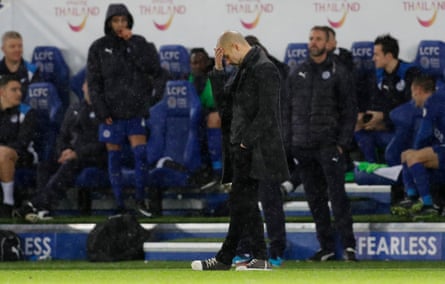
After a fine start, City fell away in the autumn. Then, at the beginning of December, away to the reigning champions, Leicester, they went 3-0 down inside 20 minutes. Jamie Vardy claimed a hat-trick as City, despite having 78% of the ball, were ripped apart on the counter and lost 4-2. Guardiola sounded almost bemused afterwards. “The second balls is a concept that is typical here in England when they talk a lot about the tackles,” he said. “I am not a coach for the tackles so I don’t train the tackles.”
The feeling then was Guardiola had a lot to learn about the English game and he would have to change. And perhaps there has been some evidence of that, but Guardiola revolutionised the English game before it shaped him.
Go down the divisions, to the ninth and 10th tiers and watch the football being played. This used to be the game in its rawest, least sophisticated form, physical, direct and played in thick mud for half the year. Yet now it’s common, almost the default, for sides to take goal-kicks short, to pass out from the back.
Talk to a coach at that level and they’ll tell you that kids simply grow up playing that way, in part because that’s what they see on television and think football looks like, and in part because surfaces are so much better than they were two or three decades ago. Hybrid and 3G pitches have transformed the game.
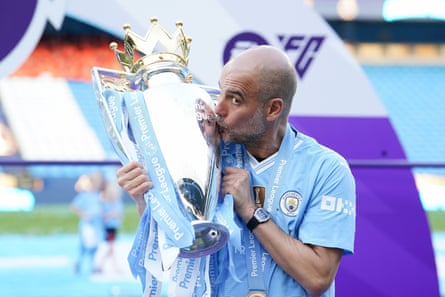
But pitch technology always underlaid Guardiola’s vision. Not that long ago, even the most skilful players would have carefully to watch the ball on to their foot for fear of a bobble. Once pitches improved to the point that a first touch could be taken almost for granted, the player receiving possession could focus less on controlling the ball than on deciding what they were going to do with it.
The game became more strategic, more about the manipulation of shape and structure to create space or overloads. That was the key to Guardiola’s football and while the English game might have been more resistant than La Liga or the Bundesliga, the model was no less valid.
The money helped, of course. Manchester City would not have been as dominant without the vast resources of Abu Dhabi. Until the outstanding Premier League charges, which City deny, are resolved there will always be a question mark.
And the widespread adoption of the Guardiola style was facilitated by the changes to youth coaching brought about by the elite player performance plan (2012) and the England DNA programme (2014). But none of those issues change the fact that Guardiola has radically changed the landscape of global football, and that has been just as true in England as elsewhere.
He himself has kept evolving, from overlapping full-backs to full-backs who inverted and tucked into midfield to full-backs who were actually centre-backs to having John Stones step out of defence as an auxiliary midfielder, from a false No 9 (or at least a centre-forward who was very involved in buildup play) to a classic No 9, from a demand for absolute control through the protection of possession to something looser, based in the capacity of technically adept forwards to beat their man.
It would be oversimplistic to say that the other great tactical thinkers who shaped English football had one big idea and then stopped. But, equally, Guardiola stands alone in his willingness to adapt, to tweak and to change. That perpetual inventiveness perhaps lay behind his tendency at times to overcomplicate his approach in the Champions League, but it is also why Guardiola has remained at the very peak of the game for 18 years.
It’s indicative of the state of perpetual revolution in which he exists that Guardiola leaves the Premier League with the hegemony of his tactical approach having apparently ended, control through passing yielding, at least for now, to a more direct approach that prioritises set plays and long throws, and yet with his side still in the fight for a domestic treble.
Other visionaries have left with the world they created falling about their ears; no other, surely, has done so having ridden the change, perhaps even to an extent led the change.
The fecundity of his mind, that flexibility, that constant striving for something new, something better, that belief that football is never done, should be Guardiola’s legacy. And perhaps, the consensus ended, a new wave of coaches waiting to see in which direction the game’s tactics will go, a wealth of possibility everywhere, it will be.
But what is sure is that the English game is more tactically aware, more focused on possession than position, more convinced of the need for technical excellence than it was when Guardiola arrived.
For a decade, there has been a dance of mutual influence, but Guardiola has changed English football far more than English football changed him.