.png)
 1 month ago
91
1 month ago
91
The Festival da Gamboa is the largest music festival on Santiago Island, Cape Verde. Since its inception in the early 1990s, the small stretch of beach, nestled at the foot of the plateau of Praia, has been transformed for a weekend from the home of a dozen or so fishing boats to one of the country’s biggest shindigs, attracting thousands of partygoers.
It has staged some of Cape Verde’s greatest musicians playing the rhythms of mornas, funaná, coladeira, batuque and tabanca. But last Friday, on opening night of the three-day event, it staged Cabo Verde’s newest and most popular act, the Tubarões Azuis, the Blue Sharks.
After opening act O Grupo Sumara finished their set, the stage was converted into one of the biggest World Cup watch parties in the country and the Cape Verdean faithful settled in for a nerve-racking 90-minute act headlined by the World Cup’s newest star Vozinha and his teammates who were taking on Saudi Arabia in the nation’s final group game.
Ninety minutes of tension were followed by a night of ecstasy that lasted long past the 8am close of the festival as Cape Verdeans celebrated the nation’s 0-0 draw that saw them reach the knockouts of the World Cup. Now they face Argentina in Miami on Friday.
“It was simply incredible,” Janice Miranda, who watched the game with thousands of others on the beach, tells the Guardian. “Seeing so many Cape Verdeans, along with so many tourists and visitors, celebrating this important milestone with us was an unforgettable experience. Our Blue Sharks’ World Cup campaign has been phenomenal. We’re all incredibly proud of them.”
Phenomenal is the word. From the 0-0 draw with Spain, Kevin Pina’s wondergoal against Uruguay, to the now 17.5 million new Instagram followers that goalkeeper Vozinha has gained over the past two weeks, Cape Verdeans have been revelling in the Blue Sharks’ success, since the World Cup kicked off.
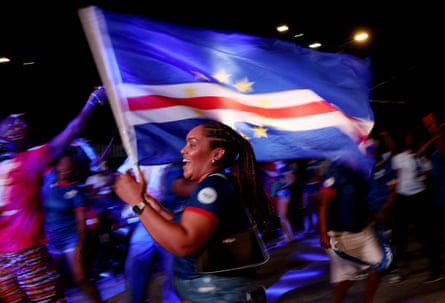
“For the Spain game everyone was given a half day off,” the Praia-based journalist Joao Pina tells the Guardian. “But really we can say no one worked that day.”
Instead, the nation watched with bated breath as Cape Verde, who only took part in World Cup qualifying for the first time in 2000, drew with the European champions and pre-tournament favourites. Since then, the nation has been in a near constant state of celebration.
“It’s a party. Each game is a party,” says Anibele Lizardo, a teacher in Mindelo, the nation’s second city on São Vicente Island. “They told us we had a 1% chance to win but we don’t care about the odds. We just want to party.”
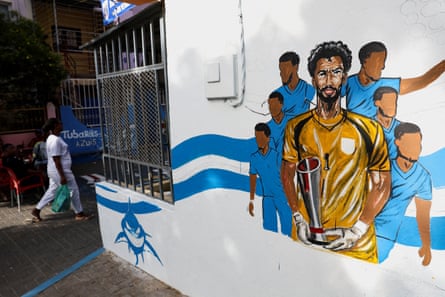
And party they have. From Gamboa Beach to the Estádio da Várzea down the road, the historic home of the Blue Sharks, to the Praça Alexandre Albuquerque in the old town of Praia, free fan zones have been set up across Praia and the nine inhabited islands of Cape Verde.
On game day and every day in between, the new national uniform – regardless of the job – is the Blue, White or Red kits of the national team.
“Before the World Cup, you would mostly see our flag at the Presidential Palace or on some public buildings. But now, everyone is proudly displaying it,” says Janice. “You can see Cape Verdean flags on houses, cars, and motorbikes all across the country.”
after newsletter promotion
“People’s conversations in the streets are all about football and about Cape Verde. After every match, no matter what time it is, people take to the streets for car parades to celebrate.”
It is a remarkable rise for a nation that doesn’t have a professional domestic league. But a well-run federation, a talent pipeline that allows players to move to Portugal and the smart recruitment of players from the diaspora has catapulted the nation from the fringes of football to the world’s biggest stage. On Friday they will become the smallest nation in history to play a knockout match at the World Cup.
That success has put the country on the map, which, for a nation of just half a million, is something precious. “Before this, no one knew where Cape Verde was,” says Anibele. “Now people will have the curiosity to see Cape Verde, to learn about the culture and how we, such a small country, are making such big waves.”
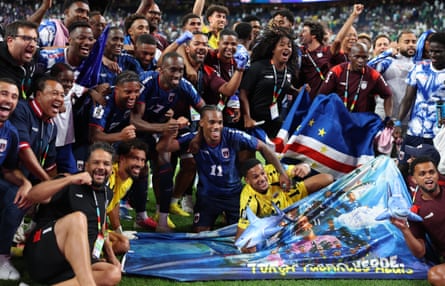
Now they have a date with the world champions and Lionel Messi, a dream not only for Cape Verde’s fans but for Vozinha too. “Sharing the pitch with Messi is a dream,” Vozinha said after the draw with Saudi Arabia. “And I’ll proudly tell my kids I played against him one day.”
But after three defiant performances at the World Cup, confidence on the islands is sky high. “We have what it takes to beat Argentina,” says Janice. “We know Argentina is the best national team in the world. But I truly believe we are capable of defeating them and continuing to write our history.”
Regardless of how the team plays on Friday, they will be celebrated as the national heroes they are. The Festival de Gamboa may have finished, but the headline act has one more set in them. The party has simply moved from Gamboa Beach to the rest of 10 islands and the rest of the world.