.png)
 1 month ago
66
1 month ago
66

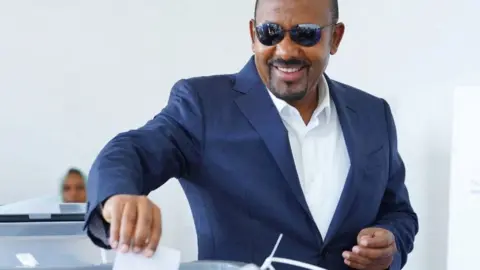 Reuters
Abiy Ahmed says he is transforming the economy of Africa's second most-populous nation
Ethiopian Prime Minister Abiy Ahmed is the big winner following the country's general election as his party has retained its overwhelming parliamentary majority, despite the poll being overshadowed by conflict, accusations of repression and little participation by opposition parties.
The Prosperity Party, which has won 438 of the 501 seats declared, will form the new government with Abiy set to be sworn in for another term at the beginning of October. It is a boon for Abiy's supporters, who believe he will continue with the economic gains he has overseen.
But others fear the internal divisions and security challenges facing Africa's second most-populous country are only going to get worse with Abiy at the helm.
The 49-year-old first came to power amid anti-government protests in 2018, and he was at first hailed for his campaign to heal divisions - though he upset politicians from the northern region of Tigray who had dominated the government for more than two decades.
Just a year later he won the Nobel Peace Prize, mainly for his efforts in ending hostilities with Ethiopia's northern neighbour Eritrea.
But security experts fear the country could be heading back to war, while the violent and deadly insurgencies in Ethiopia's Amhara and Oromia regions show no sign of ending.
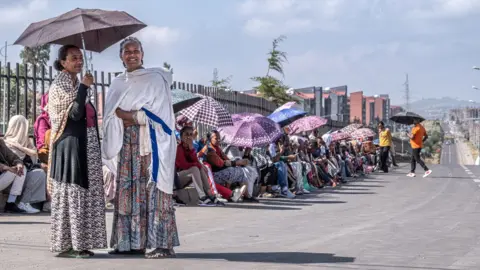 AFP via Getty Images
Ethiopia's capital, Addis Ababa - where these people waited to vote on 1 June - has been undergoing a rapid transformation
On election day, 143 polling stations failed to open in the country's two most-populous regions because of safety concerns caused by armed groups fighting the government.
The Fano militias in Amhara and the proscribed Oromo Liberation Army (OLA) in Oromia, which both want greater autonomy, rejected the election and its results.
The situation is also troubling in Tigray, which is still recovering from a two-year civil war that only ended in 2022. The region and its six million inhabitants, comprising 38 constituencies, were completely excluded from the poll amid rising fears that fighting could break out once more.
In a dramatic about-turn, Asmara has now allied itself with Tigray's leaders - and should any new conflict erupt, it is likely that Eritrea would side with Tigrayan forces and vice-versa.
Addis Ababa has also been accused of involvement in the civil war in Sudan, which borders both Ethiopia and Eritrea.
Multiple reports have alleged that Addis Ababa has supported one of Sudan's warring factions, the Rapid Support Forces (RSF), although Ethiopia has repeatedly denied this.
While Eritrea and Tigrayan forces have long been understood to have close links to the Sudanese military, which is fighting the RSF.
It all makes for a toxic cocktail which could potentially spread across the region - and it does not look like Abiy is about to play peacemaker.
The enmity between Abiy's government and the Tigrayan People's Liberation Front (TPLF), the dominant party in the region, was supposed to have ended with the peace deal signed in November 2022.
But both sides accuse each other of violating that agreement.
"The risks are real and are driven by both sides," Cameron Hudson, an Africa analyst who once worked for the US State Department, told the BBC.
Just before the election, the TPLF restored its pre-war administration, disbanding an interim one appointed by Prime Minister Abiy.
"The Tigrayans bear responsibility for the growing tensions and they've been making moves and statements that suggest that they are preparing for a renewal of fighting," said Hudson.
There are reports that the TPLF is forcibly recruiting young men to join its forces.
Shewit Wudassie, a member of Salsay Weyane, an opposition political party operating in Tigray, told the BBC: "People in Tigray are worried as many youths are being recruited to join the military."
A young man in the town of Adwa told BBC Tigrinya how armed men in civilian clothes had gone to his home and "told us that they were detaining us to join the armed struggle".
The local authorities have denied there is any "forced recruitment".
"The youths are simply getting training to defend themselves," said Tesfaye Abadi, head of security in north-western Tigray.
However, Hudson says these actions by the TPLF have also been driven by Abiy, who has "moved away from the agreement and made threatening moves towards the Tigrayans".
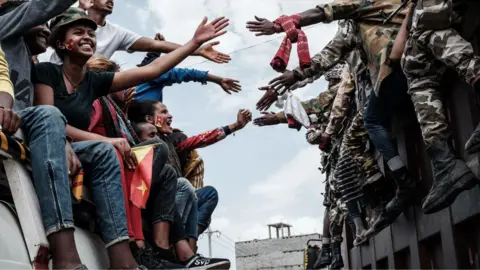 AFP via Getty Images
Unlike the support show in the early days of the civil war, there is little appetite for a return to war in Tigray
The European Union recently issued a warning and called for "an immediate de-escalation" in northern Ethiopia.
The US - a key driver behind the 2022 peace deal - this week announced targeted visa restrictions on "hardline members of the TPLF and their immediate family members".
Magnus Taylor, a Horn of Africa analyst at the International Crisis Group think-tank, does not believe there will be an immediate return to war. But he says the continuing low-level tension is "a dangerous scenario".
"With this very polarised, poisonous regional politics in which Addis Ababa believes that TPLF is siding with Ethiopia's enemies, there is more chance it might escalate into a regional conflict centred on Tigray," he told the BBC.
For Shewit, the opposition politician in Tigray, the problem is that each side is stubborn and neither is willing "to address their differences through negotiations".
"I believe they are waiting for the perfect timing to assert power. And this could lead to fighting."
According to Hudson, the coming months could decide Ethiopia's future.
"I think there's a legitimate concern that many of us have that [Abiy] uses his consolidation of political power to once and for all end or address the conflict and in Tigray."
You may also be interested in:
 Getty Images/BBC