.png)
 1 month ago
49
1 month ago
49

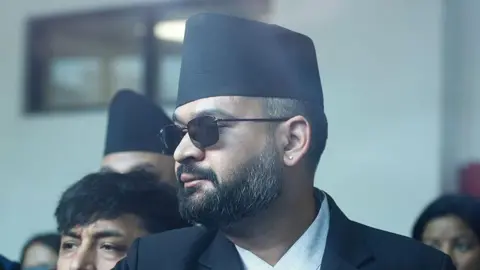 Getty Images
Balendra Shah first gained prominence in Nepal's underground rap scene
Rapper-turned-politician Balendra Shah will be sworn in as Nepal's prime minister after a landslide victory in the country's first election since last year's youth-led protests.
The 35-year-old's rise marks an important shift in Nepali politics. His promise of change resonated with an electorate that was angry at corruption, nepotism and elite rule.
Before taking office on Friday, Shah, popularly known as Balen, released a song filled with optimism about Nepal's future.
"Undivided Nepali, this time history is being made," he rapped in a track that garnered more than two million views within hours of its release.
The song harks back to his roots in the underground rap scene, where he used music to call out corruption and other social problems in Nepal.
After just three years as mayor of the capital Kathmandu, Shah teamed up with the Rastriya Swatantra Party (RSP) as its prime-ministerial candidate, scoring a decisive victory in general elections this month.
His supporters see him as a symbol of change and a break from the failings of Nepal's old guard. But some question whether the four-year-old RSP is capable of making good on its bold pledges.
Shah was born in 1990 in Naradevi, Kathmandu, and is his parents' youngest son. His father is an Ayurvedic practitioner and his mother stayed at home to bring up the family. Shah is married and lives with his wife and daughter.
After leaving school he graduated with engineering degrees in Kathmandu and later in the southern Indian state of Karnataka.
In 2013, he shot to fame after winning a popular rap battle in Nepal, with sharp verses that carried the frustration of a generation that felt suppressed and abandoned.
Shah went on to release several popular songs which criticised corruption and social inequality in the Himalayan nation. He cut a distinctive figure in the music videos with his trademark square black sunglasses, a black blazer and black trousers.
One of his best-known hits, Balidan, has amassed 14m views on YouTube.
The song title means sacrifice, and part of its lyrics go: "While we sell our identity abroad government employees get 30k salary and have properties in 30 different places. Who will pay the debt of people working seven seas away?"
In 2022, the political newbie won Kathmandu's mayoral race by a landslide as an independent candidate, triumphing over parties which had dominated elections for decades.
His tenure as mayor was marked by efforts to clean up the city, preserve indigenous heritage, and a crackdown on corruption. He also started a controversial campaign to bulldoze illegal buildings – which helped ease traffic but also drew criticism from street vendors and residents in informal settlements.
Shah's message continued to resonate with the country's youth during last September's protests, in which 77 people died – many of them protesters shot by police. The unrest was triggered by a ban on social media but fuelled by anger against corruption, unemployment and economic stagnation.
Protesters adopted his song Nepal Haseko – which means Smiling Nepal – as one of their anthems.
"I want to see Nepal smiling, I want to see the hearts of Nepalis dancing. I want to see Nepal smiling, I want to see Nepalis living happily," its lyrics played out in the streets and inside households for weeks.
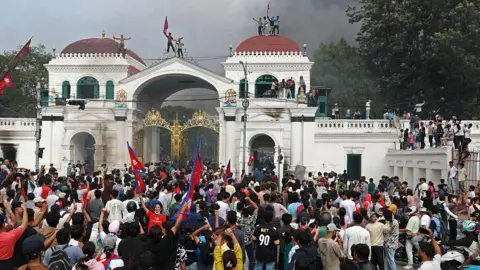 Getty Images
Shah's message resonated with the country's youth during last September's protests
Shah brought his unconventional style into his campaign for Nepal's top office this year, largely staying out of the spotlight and avoiding media interviews.
His critics argue this strategy has allowed him to avoid public scrutiny of his record.
Shah opted instead to speak to voters through social media posts, in which he pledged a sweeping anti-corruption agenda, judiciary reforms, and to create 1.2m new jobs, among other things.
It worked – the RSP swept the 5 March general elections, shattering the political elite and entrenched power structures. Shah even unseated former prime minister KP Sharma Oli in the Jhapa 5 constituency, which had long been the latter's stronghold.
Controversy and challenges
It's not altogether a clean sheet for Balendra Shah, though.
As mayor he was criticised by rights groups for using the police against street vendors in a heavy-handed manner, as he worked to keep roads clear in the capital and crack down on unlicensed businesses. Shah's campaign did not respond to a BBC request for comment.
Human Rights Watch is one of the groups that raised those concerns and told the BBC it's the type of behaviour they've often observed of new leaders who want to show results quickly.
"We hope as prime minister, there would be a focus on a more rules-based order," said Meenakshi Ganguly, deputy Asia director of Human Rights Watch.
Shah has also sparked controversy on social media. Last November, he put up an expletive-laden post on Facebook which named America, India, China and several Nepali political parties, including the RSP, which he eventually joined in January. He deleted the post shortly after.
Beyond these controversies, Shah and his party leaders will have to confront huge expectations from voters hungry for change, as well as a host of challenges.
These include the war in the Middle East, where millions of Nepalis find work, chronic unemployment and a stuttering economy within Nepal, and the RSP's lack of experience in office.
There is also public pressure to release the findings of an investigation into the deadly 2025 uprising, which toppled the previous government.
Nepal's interim administration has said it will make a summary of findings public but it will be up to the newly elected RSP to decide how to implement the commission's recommendations.
Additional reporting by Azadeh Moshiri, South Asia correspondent