.png)
 3 weeks ago
40
3 weeks ago
40
2 hours ago
Helen BriggsScience correspondent

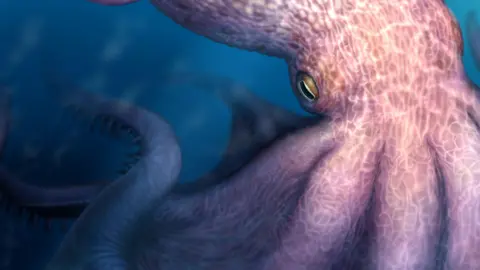 Image: Yohei Utsuki, Department of Earth and Planetary Sciences, Hokkaido University
A sketch of what the giant octopus might have looked like
Giant octopuses may have ruled the ancient oceans 100 million years ago, when dinosaurs roamed, according to new research.
Some of the earliest octopuses are believed to have been powerful predators equipped with strong arms for grabbing prey and beak-like jaws for munching on the shells and bones of other animals.
A new study of some remarkably well preserved jaws suggest they reached up to 19 metres, potentially making them the largest invertebrates ever known to scientists.
For decades, palaeontologists believed that the largest ocean predators were vertebrates with backbones such as fish and reptiles while invertebrates like octopuses and squid played supporting roles.
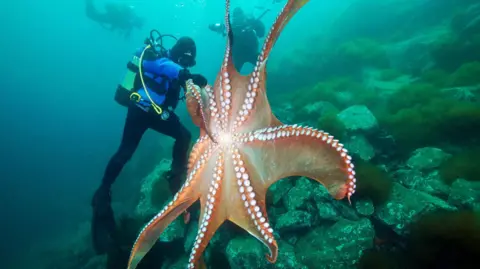 Getty Images
A Giant Pacific Octopus meeting a diver on the ocean floor
New research by scientists from Hokkaido University in Japan challenges the picture scientists had of ancient octopuses.
Their analysis of fossil jaws suggests giant octopuses glided through the oceans equipped with the ability to chew on the hard shells and skeletons of large fish and marine reptiles.
The study estimates a body length of about 1.5 to 4.5 metres, which, when the long arms are included, comes to a total length of roughly 7 to 19 metres.
Even at the lower end of that range, the animal would have been enormous by today's standards.
Another striking feature is that the wear on the fossilised jaws is uneven from left to right, suggesting the animals may have favoured one side when feeding.
In living animals, favouring one side of the body over the other is linked to advanced brain function.
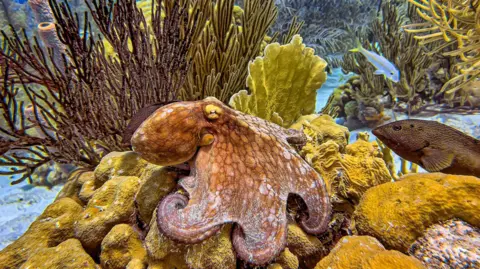 Getty Images
Octopuses are known for their extraordinary intelligence and for being masters of camouflage
Modern octopuses are known for their intelligence, problem solving and complex hunting strategies.
The Giant Pacific Octopus, the largest living species today, can have an arm span of more than 5.5 metres.
Video footage shows these animals taking on sharks more than a metre long.
"With their tentacles and their suckers they could perfectly hold on to such an animal and there is no escape," said Christian Klug, a palaeontologist at the University of Zurich, who reviewed the research.
However, many questions remain. Scientists can only guess at the exact shape of the animals, the size of the fins, or how fast they could swim.
And no fossil has yet been found with stomach contents that would offer direct evidence of what they were dining on.
Dr Nick Longrich, a paleontologist at the University of Bath, said his hunch was that they were mainly preying on ammonites.
However, like the modern octopus, they would have been opportunistic and voracious predators, and wouldn't have passed up other prey if they had the chance.
"It's going to take a while before we figure this thing out," he said. "It's a bit of a mystery."
For now, the fossils offer a tantalising glimpse of a giant of the deep that may have roamed ancient seas, armed with a crushing jaw, powerful arms, and a brain that may have helped it compete with other top predators.
The research is published in the journal, Science.