.png)
 1 month ago
24
1 month ago
24
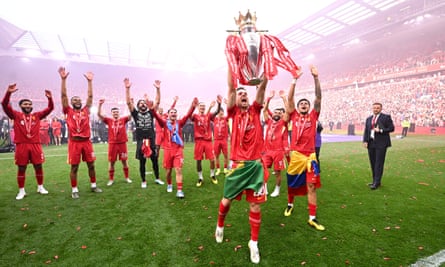
As Virgil van Dijk raised the Premier League trophy on a cool May afternoon at Anfield, the cap was sealed on a serenely glorious season for Liverpool. For sure there had been challenges en route to a 20th league title, but not many, and those that did arise were dealt with in a calm, orderly fashion. The ultimate prize had been captured with minimum sweat.
Cue the celebrations after a final‑day 1-1 draw with Crystal Palace: players and staff dancing on the pitch, supporters doing the same in the stands, and no sense this was as good as it was going to get for the just-crowned champions. It took less than 24 hours for everything to change and set in motion an astonishing seven‑month period in the history of a club where it was probably thought they had seen and done it all.
Chaos, fear, tragedy, excitement, joy, despair, farce, fallout and setback after setback – it’s been there in one form or other for Liverpool since the Palace game, starting on the afternoon of Monday 26 May with a trophy parade that drew thousands of people to a 10-mile route through the city. Heavy rain lashed down but that was stopping nobody from rejoicing, including those at the top of an open-top bus where Van Dijk had the Premier League trophy in his hands for a second day in a row but this time with shades on and Calvin Harris at his side. It was a party all right and looked set to continue into the night, but then came the incident for which the parade is remembered – a car ploughing into more than 130 people, with injured victims ranging from a six-month-old to a 77-year-old woman. The horrific moment led this month to the 54-year-old dad-of-three Paul Doyle receiving a jail sentence of more than 21 years.
That has brought a level of closure for those affected but the sadness and pain will never fully recede, something that can also be said about the death of Diogo Jota in July. It is impossible to quantify the impact the sudden loss of a beloved figure has had on everyone associated with Liverpool, and especially those who knew him personally. Andy Robertson’s comments after Scotland sealed qualification for the World Cup with a 4-2 victory over Denmark at Hampden Park spoke volumes. “I’ve been in bits today,” the left‑back said. “I couldn’t get my mate Diogo Jota out of my head. We spoke so much about the World Cup. He missed out last time because of injury, I missed out because Scotland didn’t qualify, and we always discussed what it would be like.”
Immense grief does not pass, certainly not quickly, and as Robertson’s words in November highlight it is still very much there for Liverpool’s players, affecting their minds and, consequently no doubt, their performances, which, to be frank, have been dreadful this season. Nine defeats came in 12 games, with a team renowned for sturdiness and control conceding 10 goals in the final three of those through a combination of individual and collective head‑loss. It was Liverpool’s worst run since 1953-54 and felt especially remarkable given a start to the campaign that had brought seven successive wins, albeit the signs were there then that not all was right.
This has been a collapse, pure and simple, and one no one saw coming when Liverpool broke the British transfer record to sign Alexander Isak from Newcastle for £125m on the final day of the window and take their summer spending to more than £440m on, among others, Florian Wirtz for £116m and Hugo Ekitiké for £79m. The biggest outlay in the club’s history appeared to set them up for a run of further titles. Instead they have fallen at the first hurdle.
Now Isak is out for a couple of months at least with a fractured leg sustained in Saturday’s win at Tottenham, with Giovanni Leoni, another summer recruit, out for the season with a torn anterior cruciate ligament sustained on his debut against Southampton in September. Mohamed Salah is unavailable owing to Africa Cup of Nations duty and may not play for the club again after that mixed‑zone interview at Leeds. And then there are all the other things that have taken place in recent weeks, such as Ekitiké being sent off for taking his shirt off. Yes, that also happened.
“Liverpool’s 2025-26 season has been chaotic,” says the freelance football writer and lifelong supporter Andrew Beasley. “Emotions have, understandably, veered all over the place and overall it’s been exhausting to watch. But despite the low points, the club should persist with Arne Slot. How many multiple league-winning managers are out there if they don’t? So much has been invested in the new-look Liverpool, Slot needs time to mould it.”
That is reasonable, albeit Slot has hardly helped with some of his tactics, team selections and general handling of the squad. Equally, he has shown grace under fire and proved to be a compassionate and considerate figurehead in the aftermath of the parade and Jota’s death. For Slot as much as anyone this has been the most trying of times, stretching his remit of “head coach” to the limit, and as he moves through the festive period into the new year the one thing the Dutchman may desire more than anything is a return to the peace of old.
In that regard it helps that Liverpool’s next game is at home against Wolves. Rob Edwards’ side will arrive at Anfield on Saturday with two points from 17 games and on course to be the worst‑performing side in Premier League history. This should be a straightforward win for the hosts. But, then again, nothing has been straightforward for them since that increasingly distant joyful spring day.