.png)
 3 weeks ago
38
3 weeks ago
38
Wednesday night, Atlanta Stadium, 101 games down, three left to play, and finally it makes sense. Bring on The Countdown, that moment just before kick-off in every one of those quietly fascinating World Cup matches where suddenly the world’s most excited man is bellowing over the PA system in a state of outraged, crowing transport, like the last voice you’ll ever hear before the American century explodes in a ball of inanity, fried chicken and porn.
“NAYYYN!! EEEIGHYYT!! SEEEVEERRN!! …” the world’s most excited man shouts, prelude to some cautious rolling possession, maybe an early back-pass, and an agreeable reminder that the game itself will not be stage managed. You want quiet bathos? This World Cup will deliver the greatest goddam quiet bathos the galaxy has ever seen.
Except, not this time. Send for the excited man. Fire up The Countdown. A World Cup that has been undeniably gripping on the field of play finally has an occasion so layered and so luminous that, frankly, countdown guy feels about right, even a little understated.
England versus Argentina for a place in the World Cup final. Is this the biggest game international football can throw up? Argentina-Brazil has more majesty. Germany and the Netherlands is always good. Spain-France is the state of the art when is comes to talent and quality, if not quite depth of feeling in the football sphere.
But for energy, ghosts, weight, the iconography of colours and shapes, this is right up there, an event that feels less like a football match and more like a weather front about to break, a cultural throb, a gravity pulse.
Squint a little and it feels as though the whole World Cup has been a countdown to this point for England and Argentina, a sense of dramatic inevitability even before you get on to the online conspiracy theories (which are also having a moment right now).
There are three aspects to this sense of scale. Most obviously the relationship between the two nations, which will continue to be defined by the conflict over ownership of the Falkland Islands slash Malvinas, 290 miles from Argentina, 8,000 miles from Britain, and an object of renewed interest in recent years, no doubt related to the discovery of significant oil reserves nearby.
For Argentina the Falklands war of 1982 remains an open wound, still present in its sense of itself as a nation and of course in its football lore. Imagine Ten German Bombers, but fuelled by actual living scars.
This is not a balanced state of enmity. As with so many of its most urgent sporting contests – see also: Wales, Australia – there is a sense the English don’t quite grasp how large they loom as villains in this two-hander.
Argentina itself only really exists as a footballing entity. It’s Ossie on his way to Wembley. It’s handball chicanery, Gabriel Batistuta applauding sadly as the red card is brandished in Saint-Étienne. For the English this is essentially a football rivalry. Wednesday night should at least help to clear this up, to reassert the depth of feeling.
There are shared qualities here. Both nations belong to that list of places where football occupies a position of overblown prominence in the national sense of wellbeing. And on the pitch these are two well matched teams; or rather, not really teams, but excitingly wonky collections of parts dragged to this point by star players and wild-eyed comebacks, emotion as opposed to process.
Whatever happens in Atlanta, it is unlikely to be rational, cold or free from further episodes of whiplash. England have been on the edge in their last two matches. Argentina have at least half a team’s worth of players with a thirst for confrontation. High-stakes VAR screen debacle anyone? A third-minute 50/50 with Cristian Romero? Emi Martínez in a penalty shootout against England? Never mind shithousery. Expect a shitmansion, a shitpalace.
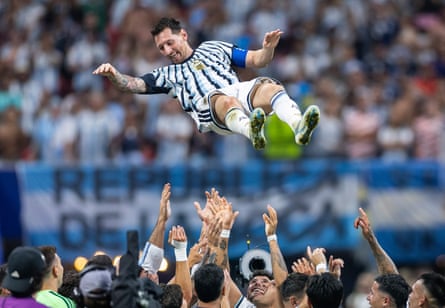
There is a wider plot line here too, the story arc the rest of the word will see. This is of course the denouement to the elite sporting life of Lionel Messi, the greatest player of all time, and an object of obsessive icon-worship in a way only the new global hive mind can really dish up.
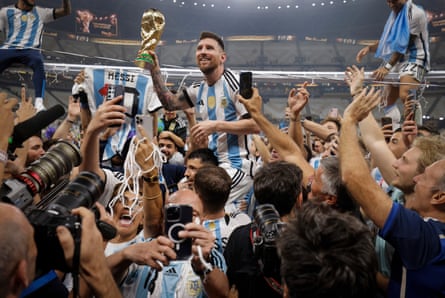
It is tempting to conclude this is just a Messi story, that Messi’s genius will simply not allow him to lose here, to end his career with defeat to his nation’s most hated rival. Never mind the glory, the era-defining style, the eight Ballons d’Or. That’s all fine. But lose this one and he’s going to have to go into witness protection.
But there is an end to all things. And the degree of reverence for Argentina’s star footballer does feel irrational, overblown, his teammates serenading him in the dressing room, an entire sporting nation parading in his shirt, worshipping his numbers.
Argentina don’t really seem to be playing for a shirt or a team or a country at this World Cup, but for Messi, the trinity in one being. Leader-worship, the personality cult is in the house, a sporting version of what George Orwell called “emotional nationalism”. Does this seem a little odd? What do you really know about this opaque, unassuming athlete-genius, other than his opaque, unassuming athletic genius?
after newsletter promotion
Then again Messi’s level of performance at 39 is irrational. Given the commercial value of this spectacle, given the nature of Fifa and its host president, it is unsurprising that conspiracy theories have entered the building. England and Argentina have benefited from some favourable refereeing decisions, although plenty have also gone against them. The main source of this energy is the most obvious one: the suspicion that Fifa wants Messi in the tournament, for eyeballs, numbers, star power.
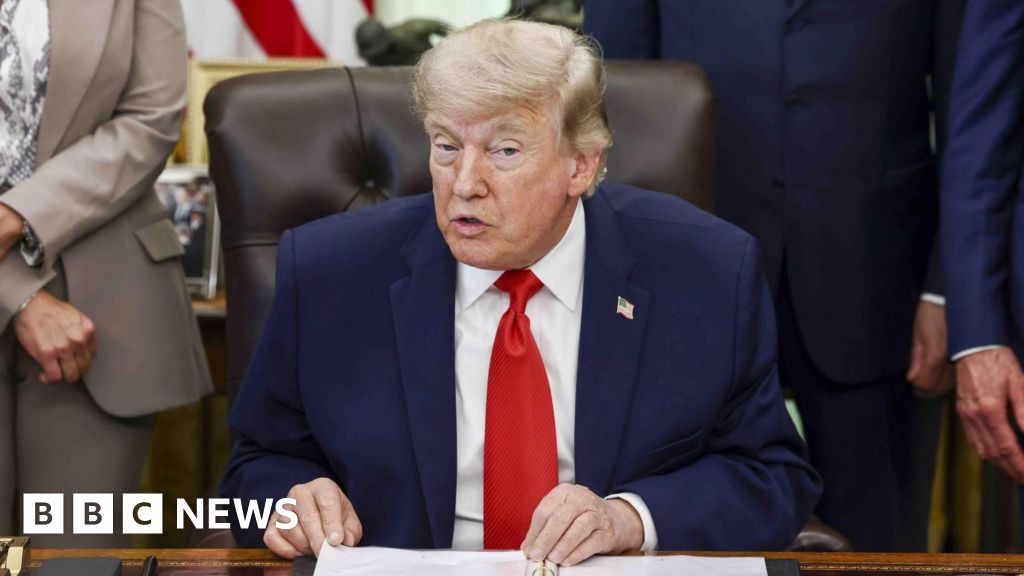
There is no hard evidence to suggest this is happening, just a confusing chain of assumed circumstances. But then, what does Fifa expect? Faith in the process, when faith in the process has been destroyed? The US president has already admitted to trying to alter the rules. This is not conspiracy theory. It’s machinations in plain sight, admitted by one party, flatly denied by Fifa.
So who exactly is earning the world’s faith there? Who do you trust to promote the sanctity of sport above interference or commercial gain? The body that served the World Cup to Saudi Arabia on a show of applause on a Zoom call? Fifa opened the door to this lack of faith with its opaque exercising of power, its cosying up to despots. If there are those who have begun to doubt the product, then Fifa is reaping what it has sewn. How to torpedo your own brand, part 94.
For all the history, the ghosts at the edge of the picture, there is also novelty here. Messi has never played against England. But he has played a lot against Premier League clubs and it is here that some kind of precedent can be sought, perhaps even a way for England to address the challenge of containing this roving, ferreting, unmapped force of the imagination.
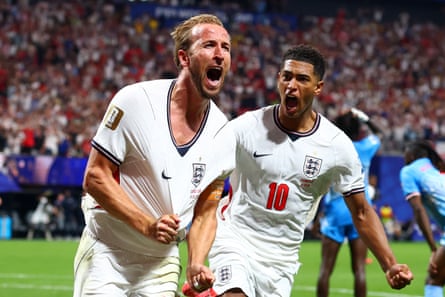
The point of ignition for Messi versus English clubs was the 2009 Champions League final. From that date Messi has played 26 games against English clubs, won 17, lost four and scored 27 goals. He has delivered what are surely two of the most sublime club football performances ever on English soil: Manchester City at the Etihad, a night of high speed dribble and duck and pass, feet battering the turf; and Tottenham at Wembley, the more ruminative, conductorial Messi, the days when his passing just seems to rearrange the pieces, to shift the spaces between the shirts.
The positives: Messi has only played two games against Premier League teams since the 4-0 at Anfield, winning one, losing one. Most significant, his five English club team losses have come against opponents that play at a high tempo and like to apply physical pressure. The only lean times were against the robust and aggressive Chelsea of the José Mourinho and post-Mourinho era, just as England can learn something from the way Cape Verde changed the game against Argentina by pressing higher up the pitch and strangling the Messi supply lines.
Make it hot, because it will be hot anyway. Make it a battle, because it will be one anyway. Messi has been fouled twice so far at this World Cup; 367 players have been fouled more. There’s no need to kick him. But there is evidence here of that aura-bubble, of a footballer operating within his own portable pocket of light.
Either way the Messi arc will reach a decisive note on Wednesday night, either a third final or an exit in circumstances that will test the limits of that collective faith. Argentina are an excellent team in any case, with plenty of supplementary attacking players capable of punishing England’s defensive mistakes.
Declan Rice’s running power is a genuine ace against these opponents. Harry Kane is surely due a big moment in one of these late stage games. And as ever there is Jude Bellingham, whose post-match stramash with his manager is not some kind of insurrection but evidence of exactly why this England team has some hope, why Bellingham is able to seize rather than shrink from the day.
Abrasiveness, disruption, a junking of the hierarchy. This will be a contest of will and aura, the ability to bend this strange, overheated occasion your way. A little healthy disregard for the moment, some useful insubordination sounds exactly the ticket.