.png)
 1 month ago
54
1 month ago
54
Soutik BiswasIndia correspondent

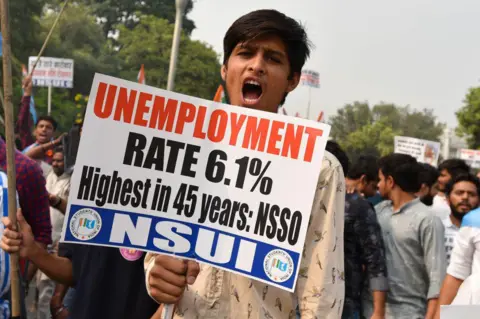 Hindustan Times via Getty Images
A young man participates in an opposition protest against joblessness in the Indian capital, Delhi, in 2019
India's youth story is a study in contradictions - of abundance and scarcity, promise and drift.
As the British economist Joan Robinson once quipped, whatever "you can rightly say about India, the opposite is also true".
Few studies illustrate that paradox more crisply than the latest State of Working India report by Azim Premji University.
Start with the headline number: 367 million young people between the ages of 15 and 29 - the largest youth population in the world, and making up a third of India's working-age population.
Of them, 263 million are not in education and constitute the potential workforce.
It is an enviable demographic bulge, the kind that powered East Asia's economic miracles. Yet, beneath this statistical bounty lies more troubling arithmetic.
There is, at first glance, reason for optimism.
Over four decades, the country has transformed its educational landscape, the report finds.
Enrolment in high school and colleges has surged, broadly keeping pace with India's development levels. Gender gaps have narrowed. Caste barriers, though far from erased, have reduced.
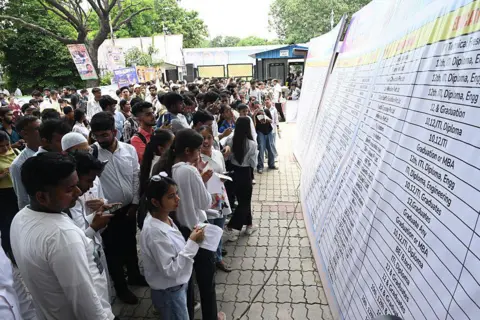 Hindustan Times via Getty Image
Aspirants at a 'job fair' organised by the opposition Congress party in Delhi last year
Between 2007 and 2017, the share of students from the poorest households enrolled in higher education rose from 8% to 17%.
A far more educated and connected generation is entering the labour market. Young workers are moving out of agriculture faster than older cohorts over the long term, finding opportunities in manufacturing and services.
On paper, this looks like the making of a classic demographic dividend.
"Never before have so many young Indians been as educated and as connected," the report says.
The bad news: the transition from education to employment remains stubbornly broken.
Graduate unemployment in an increasingly challenging labour market is strikingly high. The last half decade has not generated salaried jobs in adequate numbers, the report finds.
Nearly 40% of graduates aged 15-25 - and 20% of those aged 25-29 - are jobless, far higher than among the less educated, the report finds. Only a small share secure stable, salaried jobs within a year.
Part of this reflects how labour markets evolve over a life cycle. As Rosa Abraham, economist and lead author of the report, told me: "When you're young, you wait - and report unemployment."
Track the same cohort over time and joblessness falls; by their late 20s, many are working, says Abraham.
Early joblessness, she argues, reflects an "aspiration-availability mismatch" combined with the ability to wait. Over time, "you mellow, build networks and take what you can", often in the private sector.
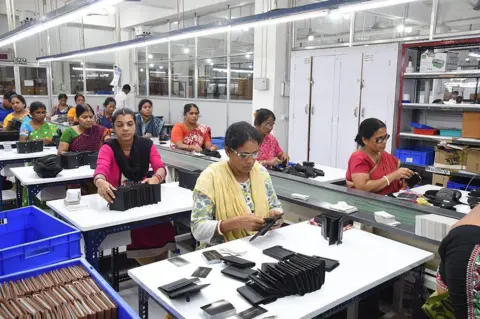 NurPhoto via Getty Images
Women working in a leather factory in the eastern Indian city of Kolkata
This is not a new problem.
In 1969, British economist Mark Blaug published a book called The Causes of Graduate Unemployment in India, tracing a gap between education and jobs that had been evident since the 1950s. And between 1983 and 2023, graduate unemployment remained stubbornly high at around 35-40%.
What has changed is the scale. India now produces about five million graduates a year - but since 2004-05, barely 2.8 million annually have found jobs, with even fewer securing salaried work.
The broader labour market tells a similarly mixed story.
In the two years after the pandemic, India added 83 million jobs, lifting total employment from 490 million to 572 million, with gains for both men and women, the report finds.
Yet nearly half were in agriculture - dominated by women and typically marked by low productivity and disguised unemployment.
In other words, the economy has been creating work, but not the kind that transforms livelihoods.
Women's employment is rising - but here, too, the picture is split.
At one end, a small but growing cohort of educated and skilled women is entering salaried roles in IT, automobile manufacturing and business services. The shift is especially pronounced in states such as Tamil Nadu and Gujarat, says Abraham.
At the other, far larger end, most of the increase is in self-employment and unpaid or home-based work, often within households or family enterprises. This signals necessity rather than opportunity.
 NurPhoto via Getty Images
Young job aspirants at a recruitment drive by the Indian army in Kashmir
The result is a statistical rise in participation that masks a qualitative divide: opportunity at the top, compulsion at the bottom.
Education has expanded rapidly - especially higher education, driven largely by private providers - but not without trade-offs.
The number of colleges and universities has surged from about 1,600 in 1991 to nearly 70,000, with a 150% jump in the 2001-10 decade alone. Around 80% are now private, a sharp shift from the 1950s-80s when the sector was evenly split.
Access has widened, but quality is uneven, with faculty shortages and stark regional gaps. Participation from poorer households has risen, yet professional courses such as engineering and medicine remain costly. Vocational training has expanded - largely through private institutes - but its link to jobs remains weak, the report says.
There are also signs of strain beneath the surface.
Since 2017, the proportion of young men in higher education has fallen - from 38% in 2017 to 34% by late 2024 - as more cite the need to support household incomes, the report finds.
"A growing share of these men - now including graduates - are supporting family incomes by working on family farms or businesses. This used to be largely women's work. It's a worrying shift," says Abraham.
Migration has become a crucial coping mechanism.
Young workers move from poorer states such as Bihar and Uttar Pradesh to more prosperous but ageing regions like Tamil Nadu and Karnataka, chasing opportunity where it exists.
This churn helps balance disparities, but also underscores them. India's labour market remains a patchwork of uneven opportunities, the report says.
Clearly, India has expanded education, improved access and built capacity. But it has not yet aligned these gains with the creation of productive, well-paying jobs at scale.
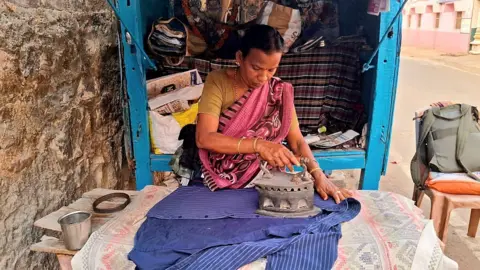 NurPhoto via Getty Images
Most new jobs for women are in self-employment and unpaid or home-based work
Many economists say India's growth model helps explain the bind.
Unlike much of East and South-East Asia, which relied on export-led manufacturing to absorb low-skilled workers, India's expansion has been driven by skill-intensive services - IT and communications in particular. Export-led manufacturing, by contrast, has remained weak.
The result is a lopsided labour market: opportunities for the educated, but too few pathways for everyone else.
Time, moreover, is not on India's side.
With a median age of 28 and nearly 70% of its population of working age, the country remains one of the youngest in the world.
But this advantage is peaking, the report warns.
From around 2030, the share of working-age Indians will begin to decline as the population ages, closing the window that has long underpinned hopes of a demographic dividend.
The challenge, then, is not simply to create jobs, but to create the right kind of jobs- at scale and at speed. Artificial intelligence could reshape entry-level white-collar work, adding fresh uncertainty to India's already fragile school-to-jobs pipeline.
"The extent to which this large, increasingly educated and aspirational cohort is productively absorbed into the labour market will determine whether this massive and continuing demographic dividend translates into an economic dividend," the report says.
The policy prescriptions are well known: more salaried jobs, closer alignment between education and industry, smoother school-to-work transitions and stronger social protection for informal and migrant workers.
The deeper question, possibly, is one of direction, economists say.
What kind of economy is India building - one that can match rising aspirations with real opportunity, or one that leaves millions navigating underemployment and drift?