.png)
 1 month ago
48
1 month ago
48

 Maddy Alexander-Grout
Mum Maddy says she places no restrictions on her children's screen time, but that they are not "addicted" to devices
The new guidance - the first of its kind - suggests children between the ages of two and five should be limited to one hour of screen time a day, while those under two should never watch screens on their own.
Screens should be particularly avoided at mealtimes and in the hour before bed, according to the guidance.
Instead, it recommends "screen swaps" - where devices are replaced with shared reading sessions or families playing games together.
She is a business owner and author who suffers with fatigue due to Hashimoto's disease and fibromyalgia, so says screen time for her children allows her to rest and recuperate.
"If I didn't have screen time for my kids, then I would never get anything done," she says.
She does not place explicit limits on her children's screen time, but says this means they are not "addicted" to their devices and are happy to go to the park or out for a walk.
She encourages educational content and games while her children are using their devices, but says some types of content are much worse than others.
She believes some online video content in particular "rots children's brains", so they are not allowed access to that.
When her children were very young, Maddy says she was "the mum who would say they were never going to give [the] kids screens", but that reality turned out differently.
"You can't carry on just surviving when you need to clean the house, you need to do some work," she says.
"Mums are not the stereotypical, do all the childcare, spend every second with your kids anymore. That's just not how lives work."
'Our home felt like it was unravelling'
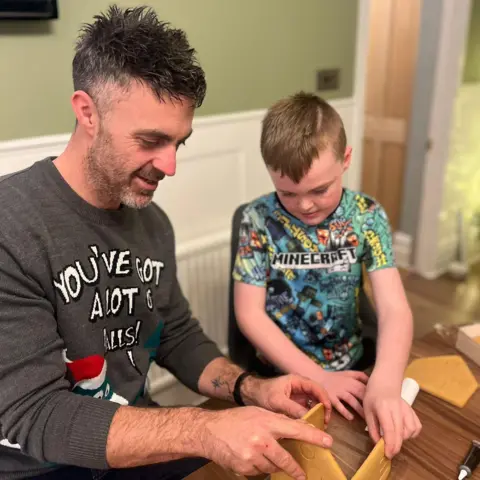 Nik Bannister
Nik says there were meltdowns when screens were switched off but they have now been replaced with other activities
Nik Bannister, from Leeds, said he became concerned about the behavioural changes he had seen in his now eight-year-old son Josh back when he was a toddler.
Josh would watch shows designed for children, with Nik saying he initially thought they were "innocent", but noticed changes in his son that made him question it.
"Our home honestly felt like it was unravelling," he says.
"Every time we turned screens off, it triggered full meltdowns. Anger, tears, constant arguments. He was restless, easily frustrated, and nothing seemed to hold his attention unless it was a screen.
"All these little cartoons and videos, they still use psychology tricks to keep kids hooked, there's a lot of deliberate dopamine spiking that's causing an addiction in young kids."
It led Nik and his wife to cut Josh's screen time dramatically, replacing it with regular games and activities like Lego.
He says it was difficult at first, but it was "what you have to go through" in order to see a change.
"If you keep with it, at first you'll need to sit with them and do the activity, but after a few days you find the enjoyment comes back from them and so they will go and do it by themselves."
'Another obstacle for children to overcome'
 Diamond McGill
Diamond McGill believes children need to be supported to adapt to screens in the outside world, like at school
Diamond McGill, from Weymouth, says her eldest son - who is now five - had been "very responsive" to screen time as a younger child and was "not in a good way".
Speaking to Radio 5 Live, she says she began to limit his screen time, but that he struggled when he started at school in September because of screens there.
"Even the interactive whiteboard is a screen," she says. "He really struggled to cope."
She reluctantly began to increase his screen time again at home to help him adapt, and now says parents should be aware of what children are exposed to at school and be wary of taking away home screen time entirely.
"Once they get to school, there's an enormous number of things that children need to cope with," she says.
"Adapting to screen time, if they haven't had it or it's been very severely limited, is just another obstacle for them to overcome."
 Hannah Deez
Mum Hannah says restricting her children's screen time was a "no-brainer"
Hannah Deez, from Warwickshire, says she knew she wanted her children to have "no or low" screen time after she gave birth during the Covid lockdowns.
Having achieved that aim, and despite the occasional family movie night and educational content online, Hannah says her kids have "barely seen a tablet".
She says they are a very "outdoorsy and creative family" and so restricting screen time was a "no-brainer".
"We don't own a tablet," she says.
"From day one we've said, 'no, this is what we use telly for, this is what we use phones for'.
"They don't really ask for games and videos and things like that on it because they know we're going to say no."
Hannah believes one of the main drivers behind screen time is apps and games marketed towards young children.
"I think restrictions on advertising apps and screen time to kids would be really beneficial," she says.
"Children are sponges and they learn best from face-to-face time with a key caregiver - a parent, a teacher."
While her children have little screen time, Hannah says this doesn't mean they are never allowed it.
"It's more about being really conscious about what we're showing them, and if we are we watching something with them, we are watching it as a family."
'Don't demonise parents too much'
 Emily Doughty / BBC
Dad Sam says he tries to keep the content his son Francesco watches at home as educational as possible
The government guidance recognises that not all screen time is equal, and encourages sharing screen time where possible.
At a music and movement class for parents and toddlers in Leeds, dad Sam Webb says that part of the guidance resonates with him, adding that when he watches programmes with three-year-old son Francesco, they try to make it as educational as possible.
Francesco's screen time can sometimes tip over the hour mark, Sam says, especially on wintry weekends, but argues that is not necessarily a bad thing.
"If it's raining outside and we're all tired and we need to rest, for that downtime we'll watch some TV," he adds.
Leah Robinson, whose son Owen is also two, says she sees the effects of screen time on the attention span of children as they get older through her work at a school.
But she said it was wrong to instinctively blame parents.
"Let's face it, sometimes we're absolutely knackered, we're tired, we're poorly, or for some reason or another, screen time will be used," she says.
"Don't demonise parents too much."
Additional reporting by Emily Doughty, James Kelly and Mary Litchfield