.png)
 1 month ago
91
1 month ago
91

 Getty Images
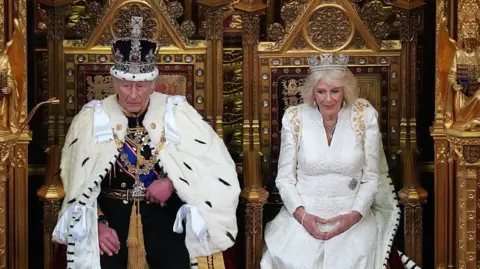
King Charles III has set out the government's law-making plans in a speech to Parliament.
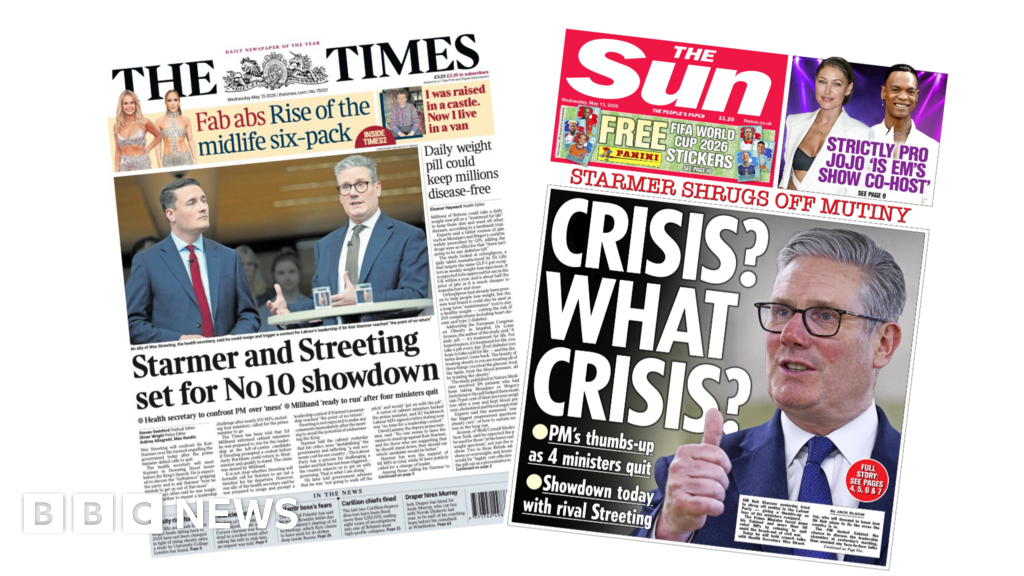
Despite furious speculation about his leadership, Sir Keir Starmer has said he will "get on with governing" and the speech outlines his agenda for the next parliamentary session.
Here, BBC correspondents analyse some of the potential new bills Sir Keir's government wants to pass.
Investment in northern rail
Theo LeggettInternational Business Correspondent
It will be carried out in three stages. Firstly there will be electrification and other improvements on routes between Leeds and Bradford, as well as Sheffield and York.
Then, there will be a new high-speed route between Liverpool and Manchester via Warrington and Manchester Airport.
Thirdly, the government is promising better cross-Pennine links, over and above the improvements that are already under way.
The scheme involves adapting the existing High Speed Rail (Crewe-Manchester) bill - which was originally proposed in 2022 by the Conservatives before being put before parliament in 2024 – following the cancellation of the northern sections of HS2.
It's no surprise to see this on the agenda. Major rail improvements in the north of England have been promised for years – with the promise of huge economic benefits once they're in place. Little has actually been done.
The plans are not as ambitious as they once were and construction is not expected to start until after 2030. But the chancellor has insisted this time they will actually go ahead.
Zoe KleinmanTechnology editor
Digital ID limps on - it was once heralded a "silver bullet" in the battle against illegal immigration, and now as "one way" for employers to check the credentials of new hires.
It is not compulsory, and could help people who have no other official form of identification like a passport or driving licence, the King said in his speech.
Last year Sir Keir Starmer told me he hoped the scheme would lead to people saving money on ID checks when taking on big financial commitments like a mortgage – needless to say, this did not go down very well with the ID verification industry.
Despite a distinctly lukewarm reception from the public so far, support from the top for digital ID has never fallen off the agenda. Let's not forget it started life in the form of a national ID card under former prime minister Tony Blair in the early 2000s.
Nationalise British Steel
Simon JackBusiness editor
The King's Speech contains emergency legislation to nationalise British Steel, which is based in Scunthorpe and employs 2,700 people.
The government took operating control of the business in April last year to prevent furnaces running out of fuel. Owners Jingye seemed reluctant to ensure continued operations, and negotiations with the Chinese company to invest in new operations alongside government support hit a dead end.
Attempts to find a new buyer for the plant were frustrated by Jinye's continued ownership - removing them as owners will allow that process to proceed.
This is not the first time the government has effectively taken over British Steel. The Insolvency Service, a branch of the Department of Business and Trade, ran the company and underwrote its losses after it collapsed in 2019. That nine-month period cost the tax payer £600m, while the current government supervision regime has cost nearly £400m.
Recent history suggests that this politically charged move could come with significant and, with no new buyer lined up, open-ended economic cost.
Fast-track green energy infrastructure
Simon JackBusiness editor
Energy policy has been a contentious issue with opposition politicians, businesses and even Labour-friendly unions calling for the government to be more open to new oil and gas exploration in the North Sea.
References to the Energy Independence Bill in the King's Speech show no sign of movement in that direction, with renewed promises to meet manifesto commitments to ban new oil and gas exploration licenses and accelerate adoption of renewables.
One feature of UK energy prices is that the price of gas often dictates the price of electricity, as gas-fired power stations are often the bit of energy that helps supply meet demand.
Plans to weaken that link are in the bill, along with measures to speed up the building of energy infrastructure to get new renewables connected to the grid more quickly by fast-tracking planning. The arrival of new substations, sea cables on shore and hundreds of miles of new pylons may create local disputes.
Tarah WelshHousing correspondent
Following the confirmation of leasehold reform in the King's Speech, the government has released details on when the new model of tenure, known as commonhold, will be introduced.
It says it's "expected to be available in 2029"- which means, from that date, flat owners will purchase their home and the building and land beneath it, rather than it being owned by a freeholder.
It also says a £250 cap on ground rents is expected in 2028.
But the word "expected" is key, says Sebastian O'Kelly from the Leasehold Knowledge Partnership, as freeholders are likely to challenge the legislation in court.
While the commitments are welcome, and commonhold has long been campaigned for, conversion to commonhold for current leaseholders is more complex than it will be for new flats which are built under the new tenure.
O'Kelly says many current leaseholders will be concerned about exactly when they can get control of their building and their money.
The government has also said changes to make it easier and cheaper to buy your lease, and the abolishment of the process known as forfeiture, will come in to force once the bill gets royal assent.
Tourist tax for overnight stays
Simon BrowningBusiness correspondent
A tourist tax is on the cards if you take a break in England. Regional mayors say it is needed to raise more income to invest in local priorities and support economic growth.
The Overnight Visitor Levy set out in the King's Speech will bring England in line with Scotland and Wales, where local authorities can already raise a tourist tax if desired.
These taxes are common in Europe and the rest of the world, with New York, Amsterdam and Rome applying overnight charges to accommodation stays to fund local services.
A break in England could become more expensive.
New bill to help realign with EU
Faisal IslamEconomics editor
There are lots of quite technical changes aimed at improving the broken plumbing of the British system, that could in time improve UK productivity and growth. There is not a stand-out transformative economic vision.
The prime minister himself mentions the European Partnership Bill prominently. The substance here could be significant.
These are the powers to integrate into UK law a process of realignment with the EU over food standards, electricity and energy trading. This could eliminate the need for post-Brexit rules for exporters of food and farm products. Many small exporters have given up exporting.
The government also argues it will help lower the cost of imported fresh produce, for example fruit and vegetables from Spain.
It will also provide a framework for further such deals in other areas, such as advanced manufacturing and the chemicals industry. The up side here is free-flowing frictionless trade in sectors where the EU is the UK's main trade partner.
The challenge is the loss of autonomy over regulations. The PM has indicated that he wants this fight, for economic and political reasons, despite the political strength of the Eurosceptic Reform Party.
Fewer, larger regional police forces
Daniel SandfordUK correspondent
The King's Speech referred to "significant reforms to the police", four words that describe what could be a revolution in policing in England and Wales.
It is what the government is calling "the biggest reform to policing in decades" and would see the creation of a National Police Service, and fewer larger police forces in England and Wales. It would also see the end of Police and Crime Commissioners, an experiment in changing the accountability of policing introduced by the coalition government in 2012.
The proposed National Police Service would bring together Counter Terrorism Policing, the National Crime Agency, the College of Policing, and also regional capabilities for tackling organised crime. It would be the closest the UK has ever got to the FBI in the US.
The argument for creating fewer, larger regional police forces is that they would be better suited to the more complex murder and sexual offence investigations of the modern era, and provide other specialist services like handling large amounts of digital evidence from phones and computers.
Tougher fines over cyber security
Zoe KleinmanTechnology editor
More companies will find themselves under more regulatory scrutiny as a result of the Cyber Security and Resilience Bill.
Specifically mentioned are the addition of firms supplying and running electric vehicle charging points and home heating appliances, as well as data centres. If companies fail to comply with the rules, the fines will get tougher, and they will be based on turnover.
This is targeting high-level, big impact threats rather than small fry: trying to minimise the very real possibility of a successful cyber-attack knocking out critical infrastructure and/or causing damage on a national scale, including economically.
Anthropic's powerful new AI tool Mythos, which can find hidden security weaknesses in seconds and would be a great asset to hackers, has sharply focused minds on cyber resilience.
Create a single patient record
The NHS Modernisation Bill has one key element directly relevant to patients in England - the introduction of a single patient record.
Doctors in A&E units can be frustrated when they can't access a patient's GP health record. And the information a patient gets through the NHS app can be confusing.
The plan now is to combine all health and social care information in one record, easily accessible by both clinicians and patients.
But some GPs have been concerned about the implications of sharing their data.
Ban groups linked to hostile states
Daniel SandfordUK correspondent
The King's Speech contained proposed legislation to tackle threats from hostile states and people planning mass violence.
The Tackling State Threats Bill will give the home secretary the power to ban organisations that are part of other countries' state apparatus, in the same way that she can currently ban terrorist groups.
It is clearly targeting Iran's Islamic Revolutionary Guard Corps (IRGC), but will be transferable to other "state entities" currently difficult to ban using terrorism legislation.
There is growing disquiet in policing and the security services at the amount of criminal activity being sponsored by foreign states, including the arson attack on a Ukrainian-owned warehouse in East London and some of the recent attacks on Jewish targets in North London.
Last year MI5 said it had seen "a 35% increase in the number of individuals we're investigating for involvement in state threat activity".
In recent years, more and more of the legislation designed to tackle terrorism has been borrowed or adapted for new legislation aimed at "hostile states" and this is another step in that direction.
The separate National Security Bill is focused on concerns about other forms of violence, particularly the planning of mass casualty attacks by people with no ideological motivation.
The loophole was highlighted by the Southport attack, where the attacker's main motivation was to kill young children. The proposed bill will create a new offence of preparing a "mass casualty attack". Again, this will be modelled on previous terrorism legislation that focused on preparing "terrorist acts".
The National Security Bill will also make it illegal to share "the most harmful violent material" online, and to disrupt people who encourage violence. Among other things, this is aimed at what are called "gore" sites that host videos of extreme violence.
Ban on resale of gig tickets for profit
Ian YoungsCulture reporter
A draft Ticket Tout Bill has been included in the King's Speech, but music industry and consumer groups have voiced their frustration that more progress isn't being made.
In November, the government announced it would make it illegal to resell tickets for gigs and other live events for a profit. That would put an end to the inflated prices sometimes charged by secondary ticketing sites.
The plans would also cap the service fees charged by resale platforms, and allow regulators to impose fines of up to 10% of global turnover on firms breaking the new laws.
Protections on ticket resales were part of the Labour manifesto in 2024, but the King's Speech only includes the proposals as a draft bill, rather than a full bill.
It will now go through further consultation and scrutiny, and will take more time.
No commitment to welfare reform
Zoe ConwayEmployment correspondent
The Work and Pensions Secretary Pat McFadden MP has said welfare reform must happen. Yet there is no commitment to legislate on it in the King's Speech.
The government argues that reform is happening all the time, that for example it is giving £3,000 to employers for every young person they take on that is on Universal Credit and has been out of work for more than six months.
But critics say this glaring absence in the legislative agenda smacks of weakness. The government had to largely abandon a welfare bill last year in the face of opposition from its own backbenchers.
Ministers say they're waiting for the outcome of a review into the nearly million young people not learning or earning and another review into disability payments. Chief Secretary to the Treasury James Murray MP told the BBC on Wednesday: ''It's not a job done, there is work to do.''
But that's unlikely to assuage the concerns of those who say the government has to be bolder to tackle an ever-increasing welfare bill.